Spirit Animal Meanings
37 spirit animals. Their symbolism, mythology, the shadow side they carry, and the moment in your life when each one appears. Plus how spirit animals actually work, the difference between totem / spirit animal / power animal, and how to identify yours.
What Is a Spirit Animal, Really?
The phrase has been flattened by internet culture into a punchline — "coffee is my spirit animal" — but the original concept ran much deeper. In shamanic and animist traditions across nearly every inhabited continent, the idea of an animal guide wasn't a personality quiz; it was a metaphysical proposition: each human life has an animal intelligence running parallel to it, something that can be consulted when the purely human mind reaches its edge.
What these traditions understood — and what depth psychology later confirmed — is that animal archetypes are not metaphors. They are functional patterns. The Wolf doesn't represent loyalty the way a red light represents stop. The Wolf is loyalty, fierceness, and belonging expressed as a living system. When that system resonates with your psychology, something precise has been named.
The 37 animals below are organized alphabetically for reference, but they aren't cute. They aren't Disney. They are real psychological forces with long mythological histories, shadow sides, and specific conditions under which they appear. Read them the way you'd read a map of somewhere you've always lived but never had named.
Spirit Animal vs. Totem vs. Power Animal
The three terms get used interchangeably in modern usage, but they have distinct origins and emphases.
The most common phrase. Usually refers to a single animal guide identified through resonance — quiz, recurring dream, repeated encounters in waking life. Often discovered rather than inherited. The animal that keeps showing up because it's been operating in your life already.
Lineage-based. An animal inherited through family, clan, or cultural belonging. In Indigenous North American traditions specifically, totems are clan symbols — the Bear Clan, the Eagle Clan, the Wolf Clan. The relationship is communal and ceremonial, not personal-discovery-quiz. Using "totem" for individual identification is generally considered appropriative outside of the originating traditions.
A term from shamanic practice (especially as taught by Michael Harner's Foundation for Shamanic Studies). A power animal is an ally specifically gained through shamanic journey work — usually through a deliberate ceremony in which the practitioner travels to non-ordinary reality and meets the animal there. The animal becomes a working partner, often called on for healing or guidance.
For practical purposes — and for this directory — "spirit animal" is the most accessible language. Just be aware that you're using a term that carries weight in traditions other than the one you might be coming from, and treat it accordingly: with respect rather than as a Buzzfeed throwaway.
How to Identify Your Own Spirit Animal
Four reliable methods, in increasing order of speed:
An animal that keeps showing up — in dreams, in unexpected encounters, in books strangers recommend, in art that won't leave you alone — is signaling something. The repetition is the message. Track these encounters for a month and a pattern usually emerges.
Some animals you immediately like, some you're vaguely repelled by, some you fear, some you feel oddly drawn to even though they're 'not your type.' These reactions aren't random. The animal you can't stop thinking about — even if you can't justify why — is often the one trying to make contact.
How do you handle conflict — like Wolf (direct) or like Snake (cold and surgical)? How do you take up space — like Lion (commanding) or like Cat (granted)? Where do you feel most like yourself — at the water (Dolphin/Whale), in the woods (Wolf/Bear), at altitude (Eagle)? Your behavior is the most reliable diagnostic.
The quickest method. Lore's 28-question Spirit Animal Quiz scores across element affinity, conflict style, social tendencies, and seasonal resonance to identify your dominant animal. The result includes a primary, a secondary, the shadow side, and a personalized AI reading.
The 37 Animals by Category
Six groupings that capture the elemental and behavioral spectrum. The full alphabetical directory follows below.
All 37 Spirit Animals, A–Z
Each entry includes the animal's description, symbolism across mythology, shadow side, and the conditions under which it appears in a life.
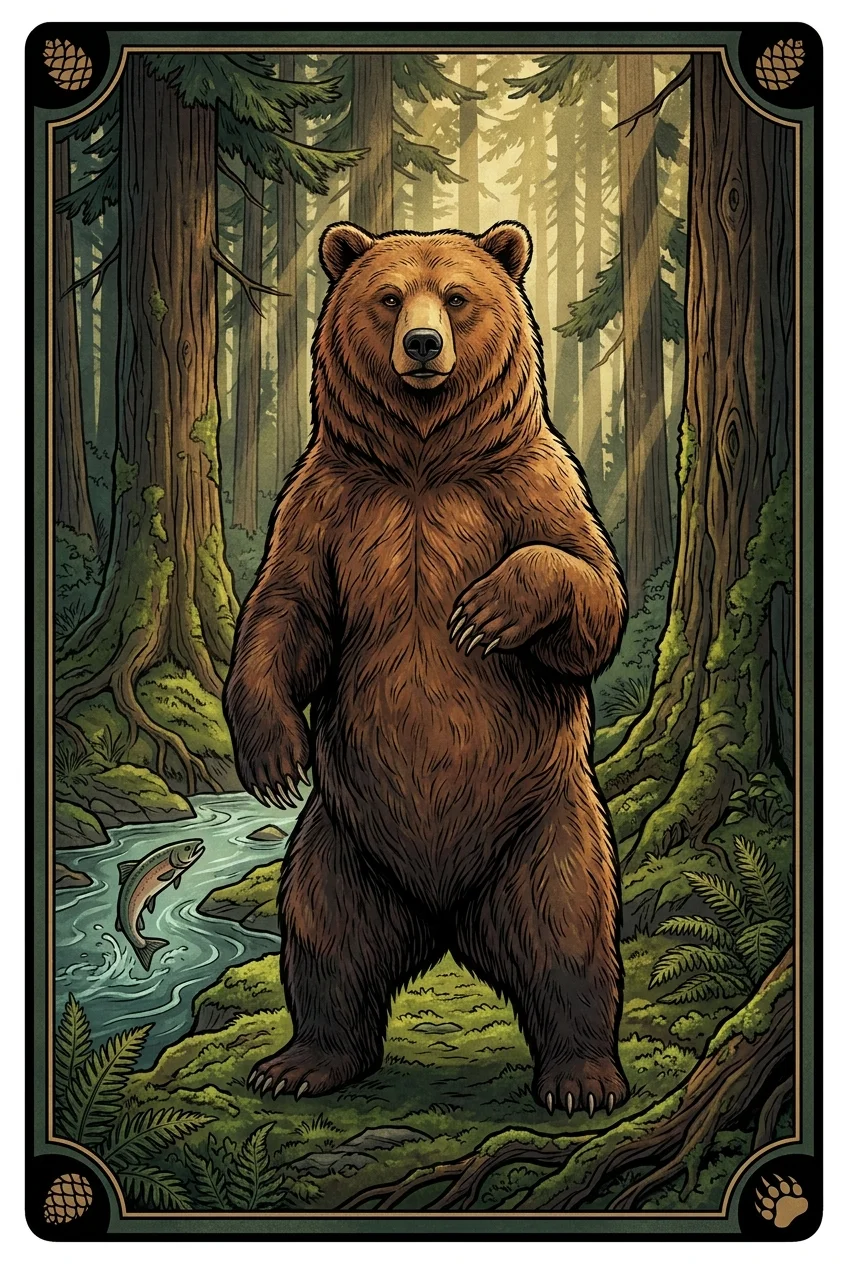
Bear
earth"You are the mountain that learned to breathe."
Bear is slowness deployed as power — a creature that knows how to be enormous without apology, how to take up space because taking up space is its nature. This is winter in animal form: rest as strategy, quiet as preparation, the kind of stillness that contains everything it needs. Bear people often carry grief as a companion because they feel things at an amplitude most animals cannot survive.
Symbolism: Bear is one of the most sacred animals in circumpolar shamanic traditions from Lapland to Siberia to North America's northwest coast. The bear ceremonial (wearing bear skins, ingesting bear fat) was a way of accessing primal healing and ferocity. In Norse mythology, Odin had bear associations; berserkers wore bear skins to channel warrior spirits. In Arthurian tradition, the name Arthur itself may derive from the Celtic word for bear. Bear is medicine for the winter soul — the creature that survives darkness by becoming it.
Shadow: Hibernation as avoidance. When hurt, Bear can disappear so deeply that connection is severed — mistaking withdrawal for healing.
When it appears: Appears when you need to go inward and trust your own healing, or when you've been too available and need to reclaim territory.
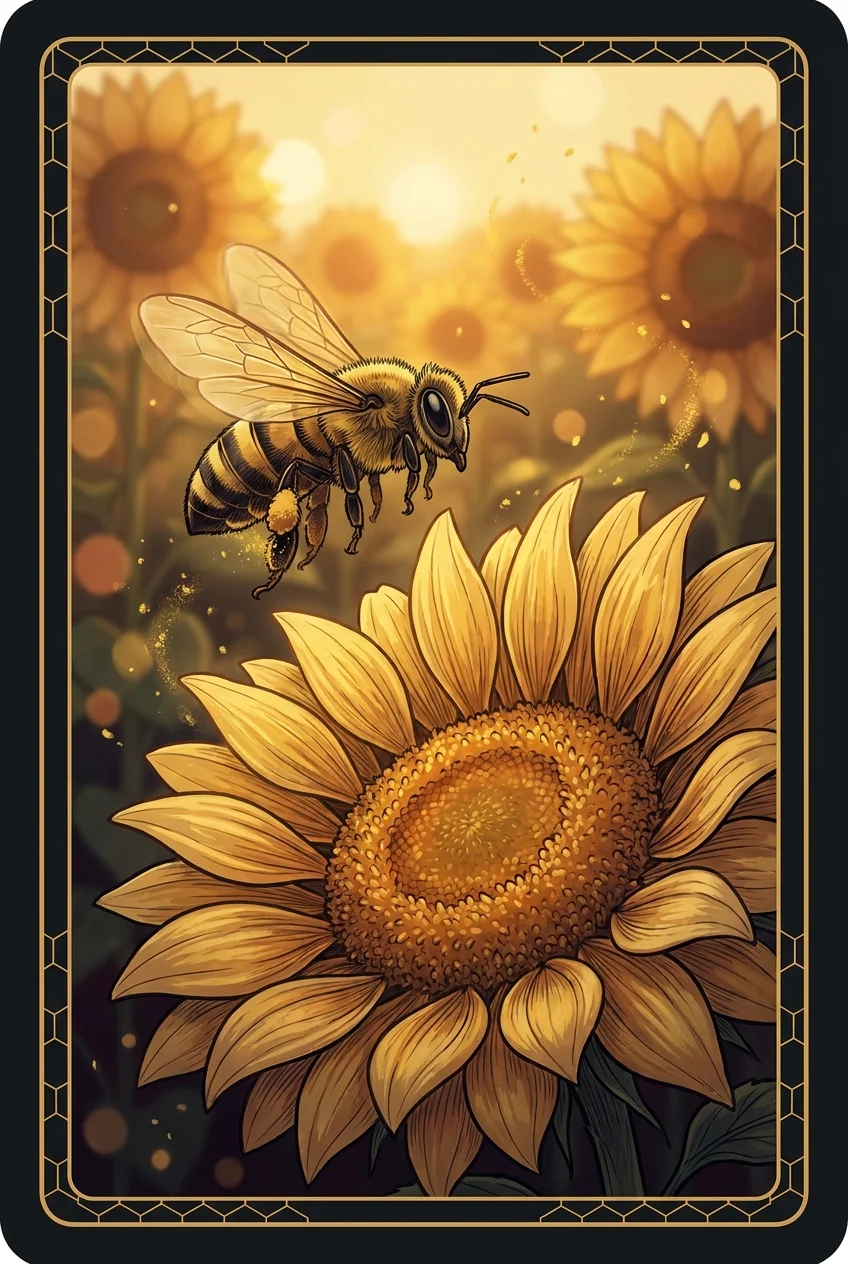
Bee
sky (earth-rooted)"You build what sustains everyone, one small act at a time."
Bee is the animal of sacred labor — not toil but devotion, the joy of doing the exact thing you were made to do in the company of others who understand the work. Bees build hexagons because the hexagon is the most efficient use of space in all of geometry. Bee energy is the intelligence that finds the optimal form, creates it together, and produces something that sustains life far beyond the hive.
Symbolism: In ancient Egypt, the bee was the symbol of Lower Egypt and of Ra himself — the bee was said to have formed from Ra's tears. Pythagoras and Plato used the beehive as a metaphor for the ideal society. In Celtic tradition, the bee was a messenger between worlds — its honey was the drink of immortality (mead). In Minoan Crete, the bee goddess was one of the earliest female divine figures, associated with the regeneration of the earth. Sacred bees kept in temples throughout the ancient world.
Shadow: The worker who has forgotten that workers can swarm. Overidentification with labor to the point of self-erasure — so committed to the collective that the individual dissolves.
When it appears: Arrives when you need to commit to collective work — or when you've been too solitary and need the hive's intelligence to complete what you've started.
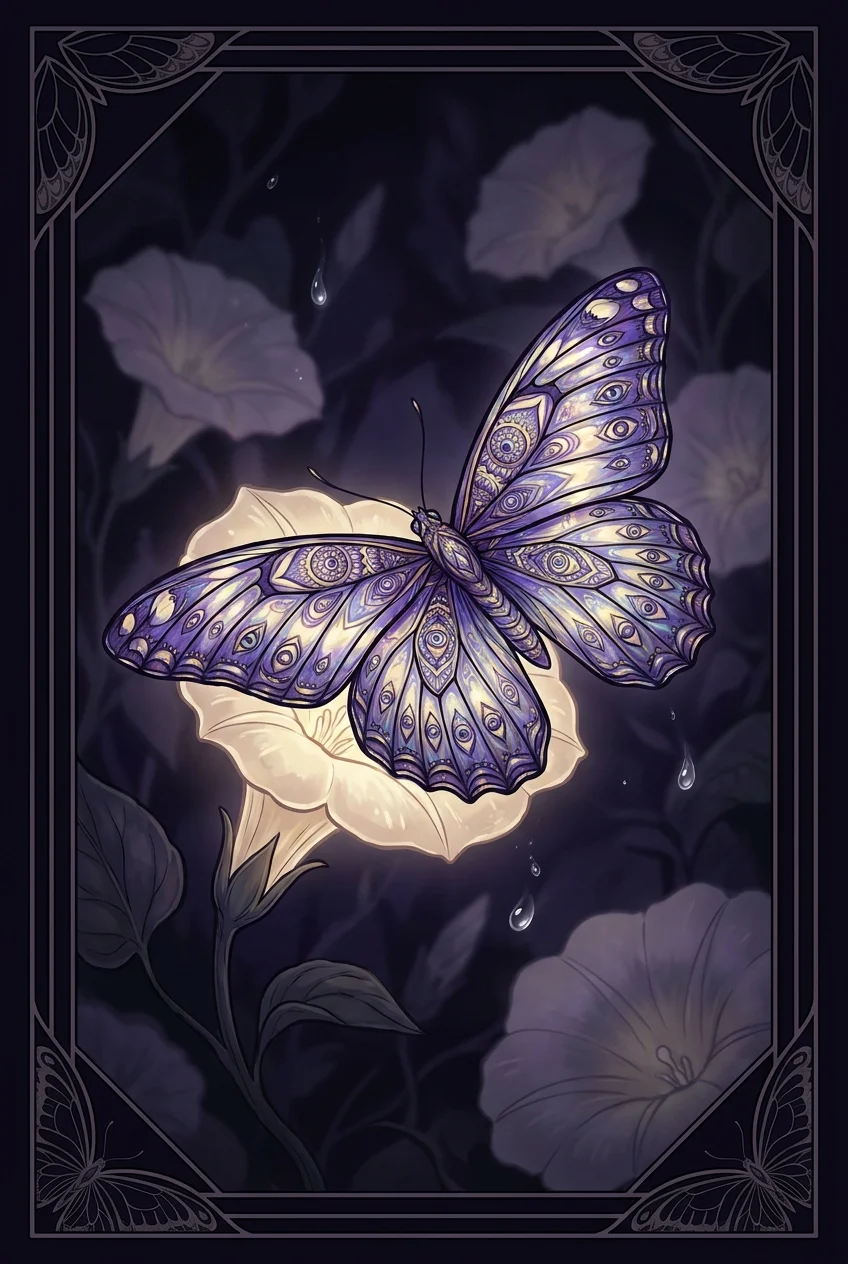
Butterfly
sky"You dissolved completely before you could become this."
Butterfly is radical metamorphosis — the caterpillar doesn't simply grow wings; it dissolves into undifferentiated cellular soup in the chrysalis before reconstituting entirely. Butterfly people have often had a complete identity dissolution — a period where they weren't sure who they were becoming — and they carry the knowledge of the in-between inside the beauty of their arrival.
Symbolism: In Greek, the word for butterfly and for soul is the same: psyche. Psyche's myth — the mortal girl who marries Eros and is granted immortality after completing four impossible tasks — is a butterfly-soul story. In Mexican tradition, the Monarch butterfly is the returning soul of the dead, arriving at Día de Muertos. In Chinese tradition, pairs of butterflies symbolize marital happiness. In Celtic tradition, butterflies embodied the souls of the dead and were sometimes associated with fire-fairies.
Shadow: The chrysalis that never opens. Can become comfortable in the dissolution phase, indefinitely "becoming" in ways that delay arrival.
When it appears: Arrives in the middle of a major transformation — or when you've been avoiding the chrysalis phase because you're afraid of dissolution.
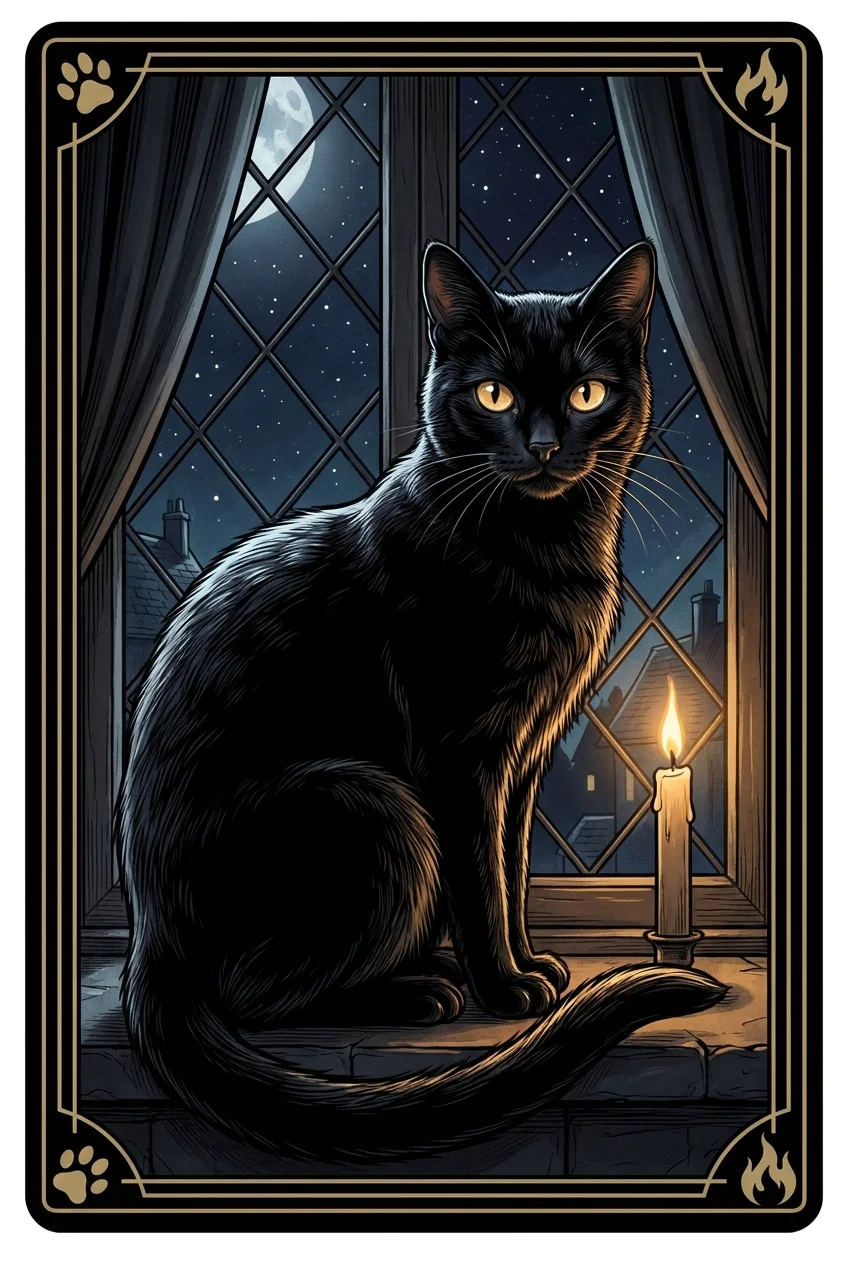
Cat
shadow (earth-comfortable)"You grant access. You don't owe it."
Cat is the only domesticated animal that domesticated itself — it chose the proximity to humans when the grain stores attracted mice and the arrangement suited it. Cat has never surrendered sovereignty. Every interaction is elected. The purr is real and so is the ability to be somewhere else entirely within the same body, watching from a place you cannot reach.
Symbolism: In ancient Egypt, cats were sacred — killing one, even accidentally, was punishable by death. Bastet, the cat goddess, was among the most beloved in the Egyptian pantheon, protector of the home and the pharaoh. In Norse mythology, Freyja's chariot was drawn by two giant cats. In Celtic Britain, the king of the cats was said to hold court in the Otherworld. In Japanese tradition, the maneki-neko (beckoning cat) is a good luck figure. In Islamic tradition, the Prophet Muhammad's affection for cats was recorded in hadith, making cats the most respected animal in the tradition.
Shadow: Disconnection masquerading as independence. Can become genuinely unavailable — a warmth that turns on and off with no correlation to the other party's need.
When it appears: Arrives when you've been too available, too accommodating — when it's time to reclaim the selectivity that protects your quality of connection.
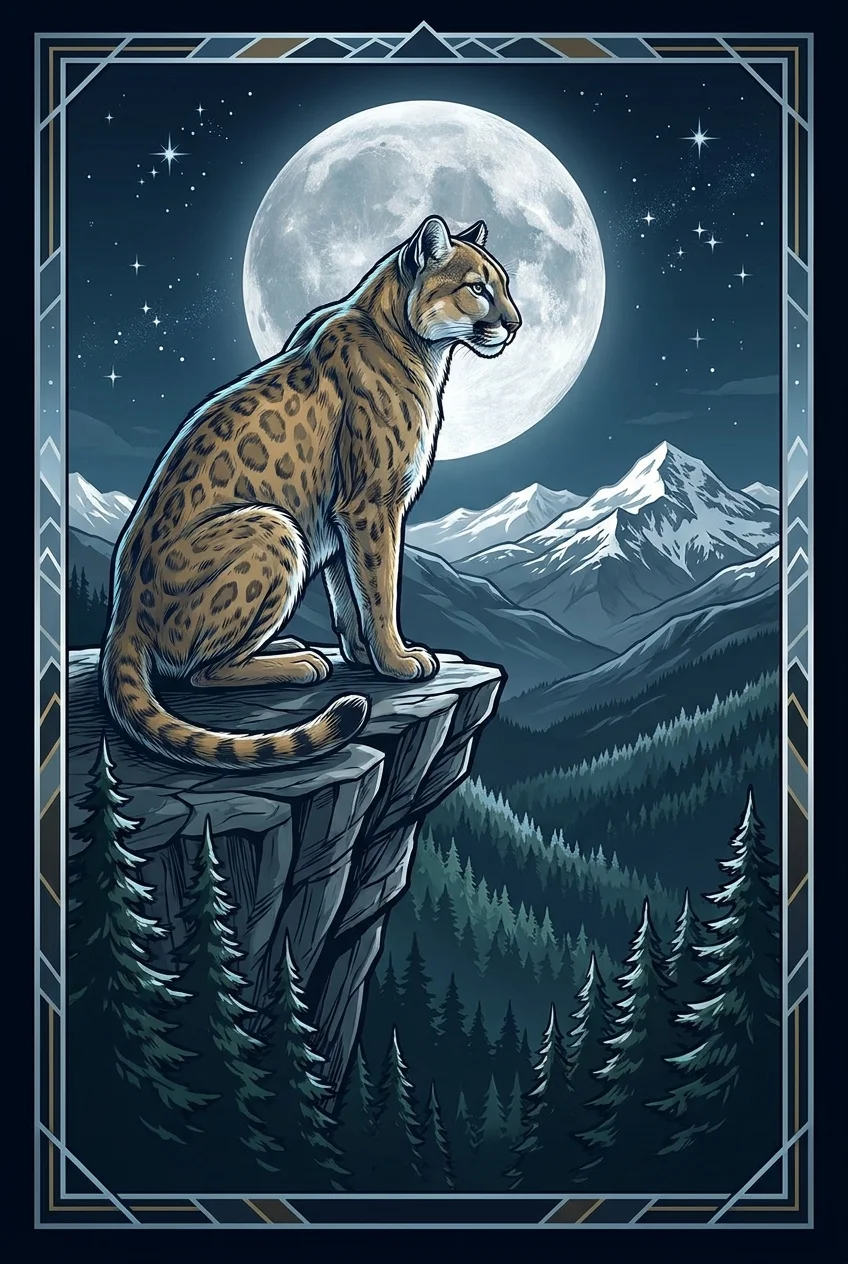
Cougar
earth"You take territory silently and completely."
Cougar is the American wilderness's most deliberate hunter — patient, self-reliant, and capable of a focused ferocity that arrives without warning from apparent stillness. Unlike Lion or Tiger, Cougar doesn't announce itself. It was already there. People with Cougar energy often discover their own power late, then can't be stopped.
Symbolism: In numerous Southwestern and Plains Indigenous nations, Cougar (Mountain Lion, Puma) was the spirit animal of leadership through solitary excellence — the being that didn't need a throne because it owned the mountain. In Incan tradition, the puma was one of three sacred animals representing the terrestrial world (alongside the serpent of the underworld and the condor of the sky). Cougar medicine is about reclaiming personal authority without requiring external confirmation.
Shadow: Lone-operator pathology. Can become incapable of cooperation, reading dependence as weakness when it's actually intelligence.
When it appears: Arrives when you've been deferring to others who have less competence. Or when you need to step into leadership without a formal invitation.
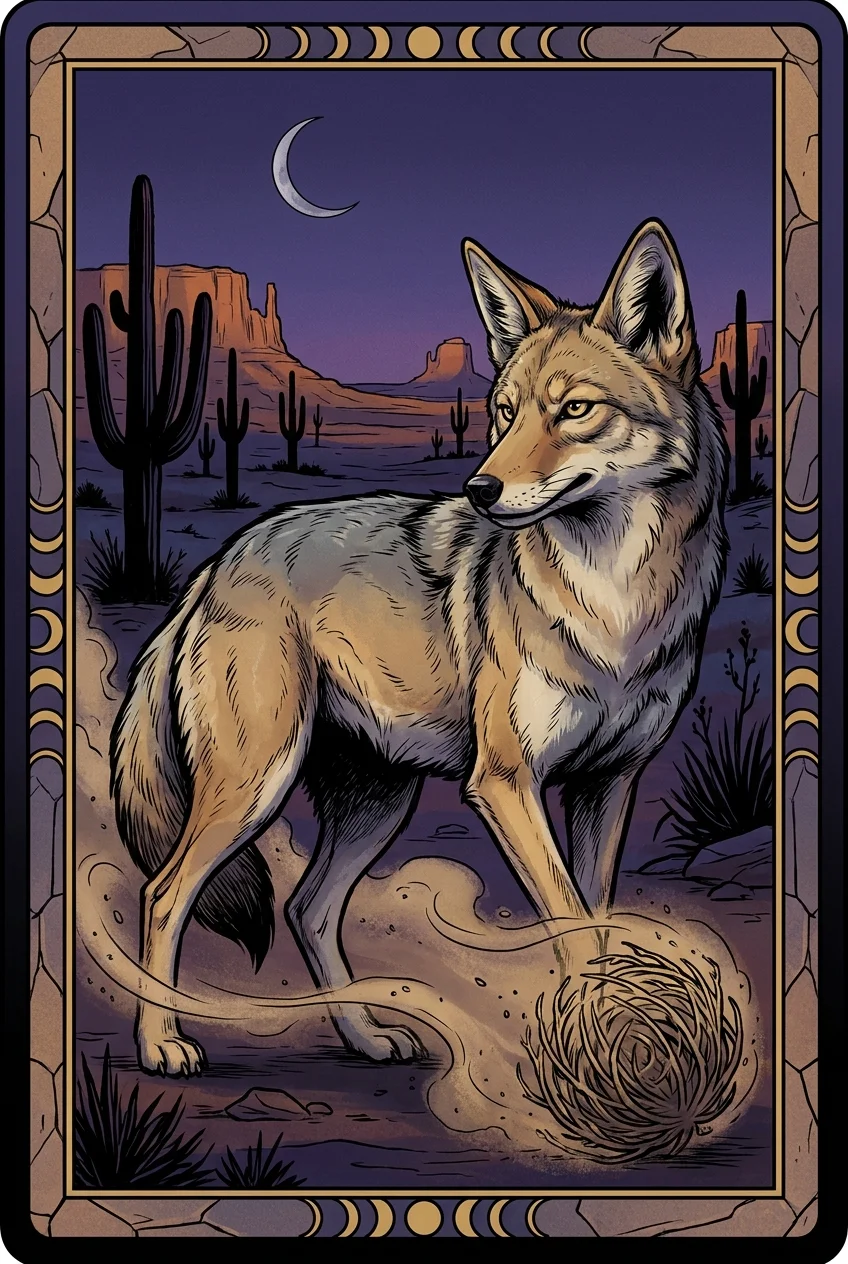
Coyote
earth (fire-touched)"You laugh at the sacred because you are the sacred."
Coyote is the North American trickster par excellence — the one who causes chaos not out of malice but because the system was so rigid it needed breaking, and Coyote was the only one willing to pay the price for the lesson. Coyote often steps in its own traps. Coyote learns from this and steps in them again. This is not stupidity; this is the willingness to keep testing the world.
Symbolism: In the oral traditions of dozens of Indigenous North American nations — from the Navajo to the Nez Perce to the Crow people — Coyote is the first animal, the transformer, the one who helped shape the current world often through accident and impulsiveness. Coyote stories are teaching stories: the lesson is not "don't be Coyote" but "here is the consequence; see what you can learn." Coyote stole fire; Coyote set the stars in the sky by tossing them from a blanket when he tripped. The accident is the gift.
Shadow: The compulsive disruption that breaks things with no plan for aftermath. Chaos for its own sake, wearing the costume of insight.
When it appears: Arrives when the situation has become too self-important — or when disruption is the only honest response to a system that has calcified around a lie.
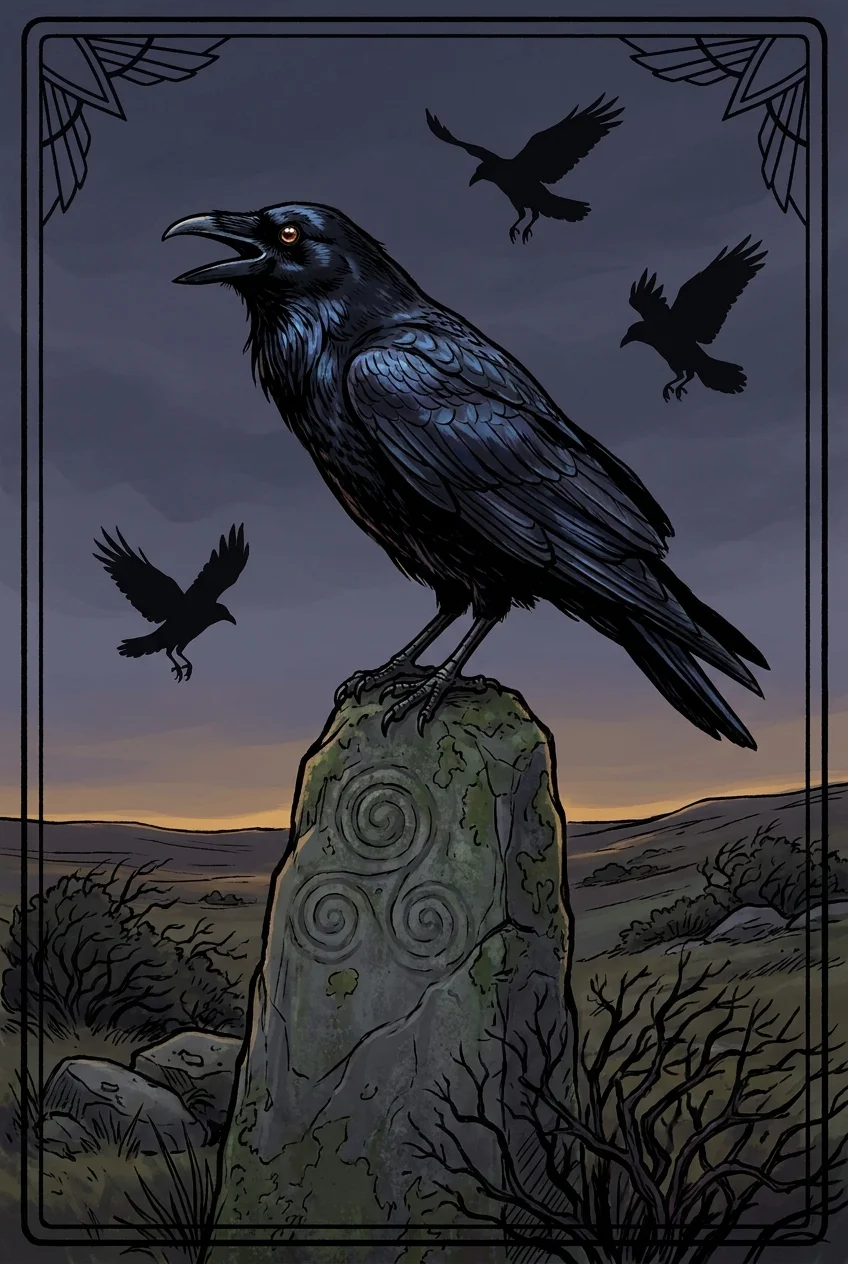
Crow
sky (earth-anchored)"You don't miss a thing and you never forget a face."
Crow is Raven's urban twin — closer to human civilization, more pragmatic, equally intelligent but operating in the texture of daily life rather than the mythological extreme. Crows use tools, recognize human faces, hold grudges across years, and gather in parliaments to decide the fate of their own. Crow people are observers who act; the watchers who eventually step in.
Symbolism: In Celtic Irish mythology, the triple goddess Morrigan appeared as a crow circling battlefields, deciding who would survive. In Japanese tradition, Yatagarasu — a divine three-legged crow — was the messenger of heaven and a guide to the sun goddess Amaterasu. Across Siberian shamanic traditions, Crow was an ancestor spirit and protector of the shamanic line. In many European folk traditions, a group of crows (called a murder) was an omen of imminent change — collective intelligence signaling disruption.
Shadow: Grudge-holding as identity. The memory that could be a gift becomes a ledger, and every relationship is measured against a debt that can never quite be paid.
When it appears: Appears when you've been ignoring something right in front of you — or when it's time to call in your coalition rather than managing alone.
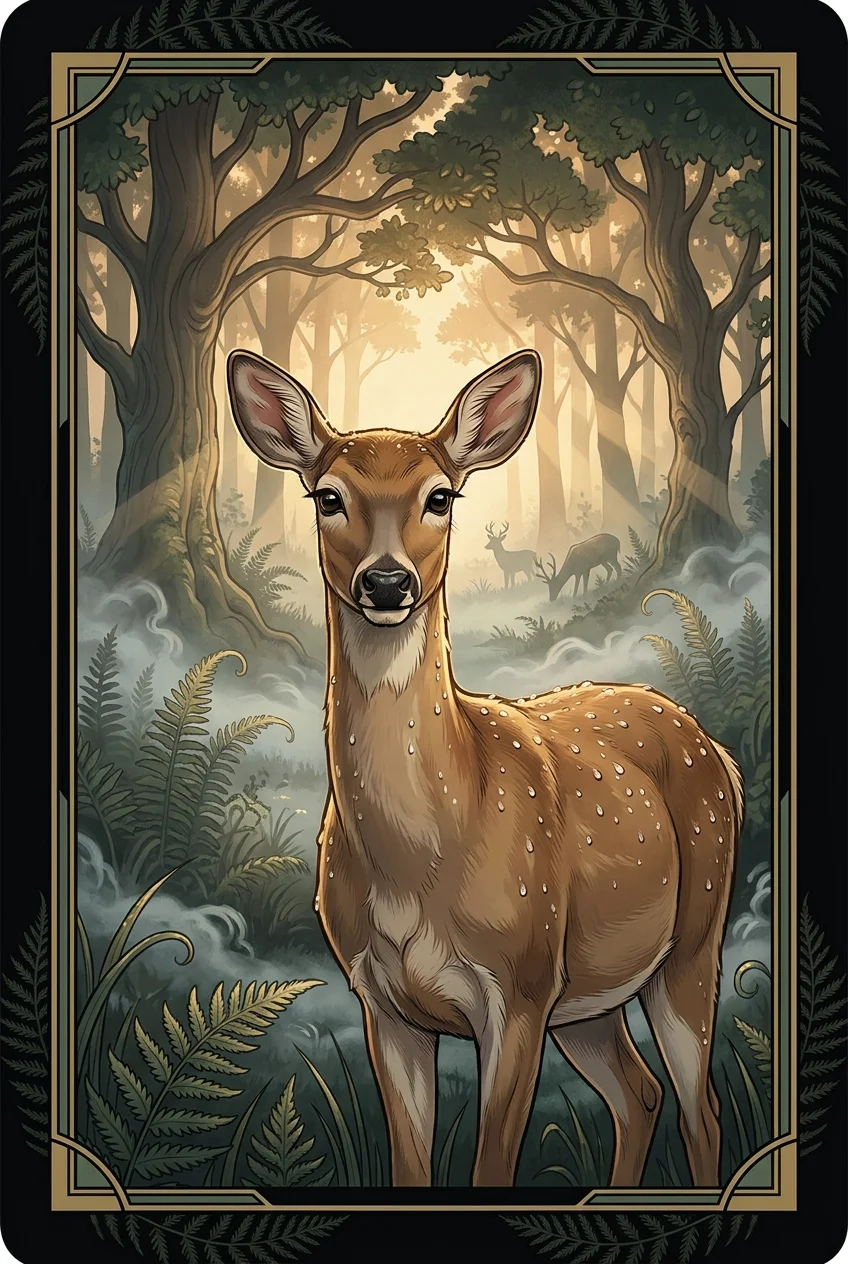
Deer
earth"Your softness is not a weakness. It is a frequency."
Deer is the animal of exquisite sensitivity — nervous system tuned so finely that it perceives what others need a century of practice to notice. This is not fragility; this is precision. Deer people often have a quality of presence that makes others feel safe without knowing why — something about them says, I am here and I am not dangerous and that is its own kind of power.
Symbolism: In Celtic mythology, the white deer or white stag was the otherworldly messenger — spotting one meant the Otherworld was nearby, that a threshold was active. Deer are associated with Artemis/Diana, the virgin huntress who also protected all wild creatures. In Huichol tradition, Deer was the first shaman's guide on the peyote pilgrimage — the animal of sacred seeking. In Shinto, white deer are messengers of the gods. Deer's antlers — grown and shed each year — represent cyclical renewal and the crown of innocence.
Shadow: Startle response as lifestyle. The hypervigilance that protected in real danger doesn't know how to turn off in safe environments — perpetual bracing for the strike that isn't coming.
When it appears: Arrives when you've been trying to become harder than you are — or when your sensitivity, rather than being a liability, is precisely what the situation needs.
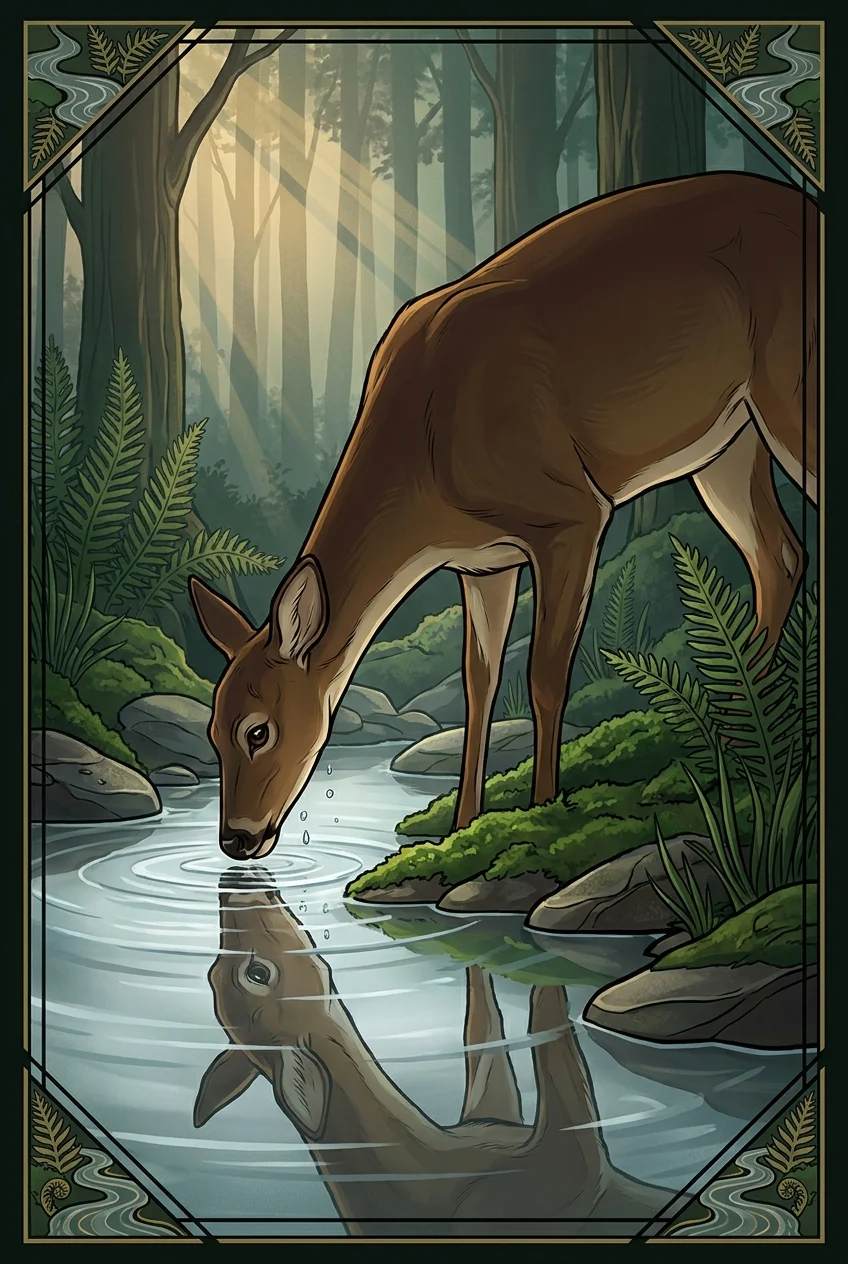
Doe
earth"You notice everything without looking like you're watching."
Doe is the feminine counterpart to Stag's ceremony — quieter, more lasting, the intelligence that sustains rather than commands. Doe is a profound listener, an observer who catalogues the forest's every change without requiring acknowledgment that it does so. The grace is real; so is the speed when it matters. Doe energy holds tremendous internal power in a container that the world repeatedly underestimates.
Symbolism: In many traditions, the doe represents the nurturing, life-sustaining aspect of the wild feminine — distinct from the hunted object of the chase. In Celtic tradition, the doe was often a shapeshifted woman or goddess, a reminder that what appears tender contains transformation. In Vedic tradition, the deer-skin (mrigasana) was the meditation seat of sages — the doe's receptive awareness was considered the ideal basis for contemplative practice.
Shadow: Self-minimization from learned environment. Can mistake invisibility for safety and stay invisible long past the point when visibility was what was needed.
When it appears: Arrives when your power has been functioning invisibly and it's time to recognize it — or when the underestimation of others has become your own self-underestimation.
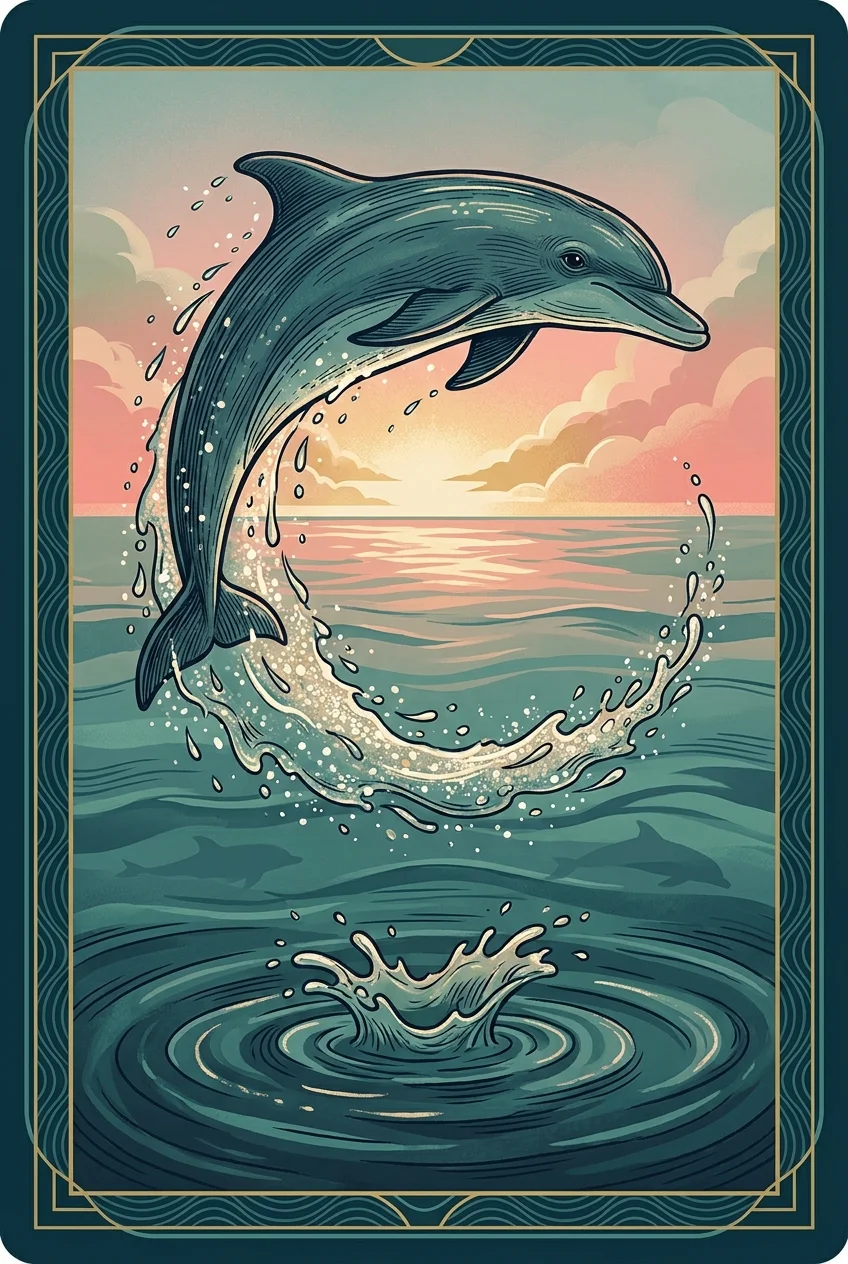
Dolphin
water"You turn the ocean into a conversation."
Dolphin is joy weaponized — an intelligence so fluid and social that it experiences the world as a collaborative game rather than a survival exercise. This is not naivety; Dolphins are strategic, sophisticated, and occasionally ruthless. But their native state is play, and play is how they access everything: information, bonding, problem-solving, ecstasy.
Symbolism: In ancient Greek tradition, Dolphins were sacred to Apollo and Poseidon alike — bridging sun and sea, reason and feeling. Greek sailors saw dolphins as good omens, believing them to be transformed humans or the souls of the drowned made playful. In Celtic mythology, Dolphins were guides to the Otherworld. In many Pacific Island traditions, Dolphin was a navigator spirit, teaching humans how to read ocean currents. The Hindu river dolphin (Susu) was associated with the Ganges goddess Ganga.
Shadow: Avoidance of depth in favor of perpetual movement. Play can become a refusal to sit still long enough for real reckoning.
When it appears: Appears when you've become too serious, too isolated, too afraid of joy — or when you're being called to use your social intelligence for something larger than yourself.
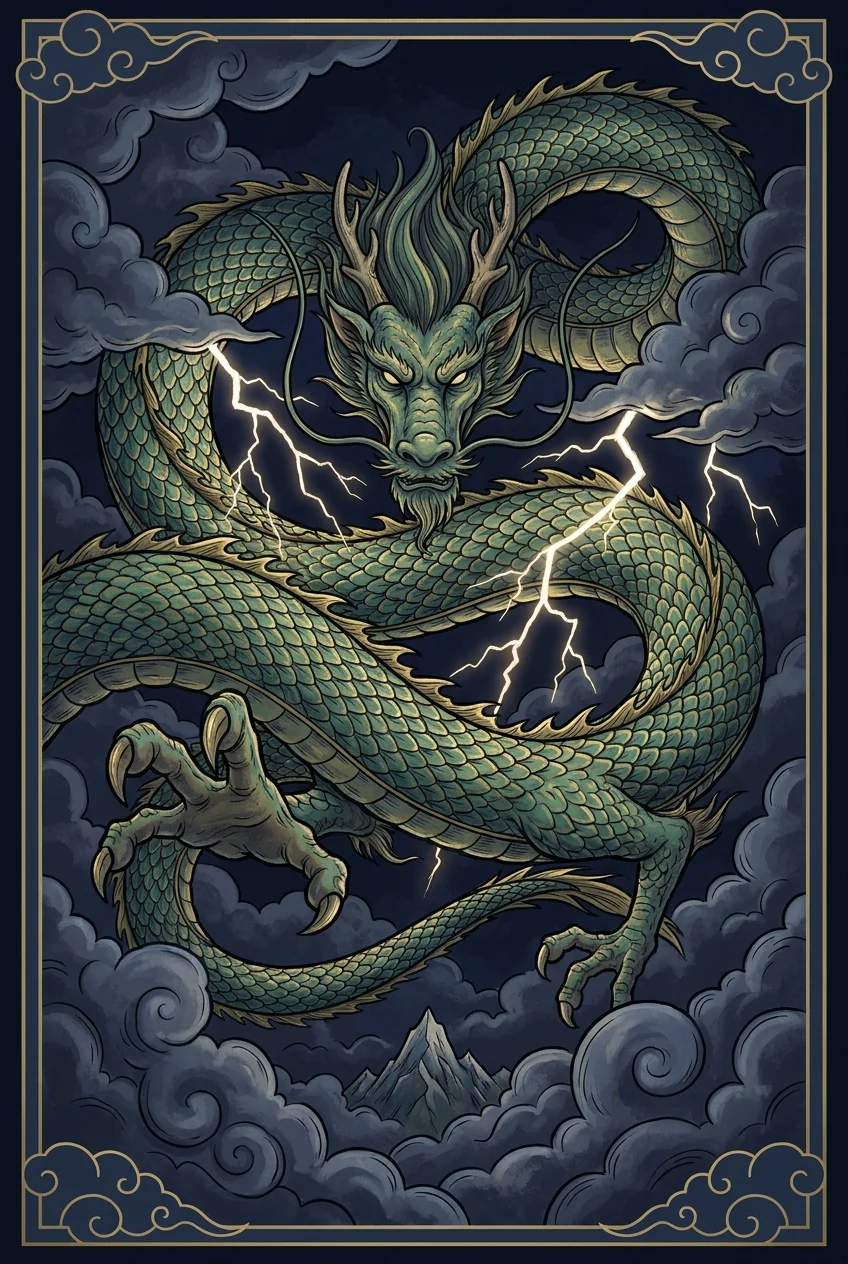
Dragon
fire (all elements)"You were never meant to be safe."
Dragon is the creature that appears in every major mythology simultaneously without any apparent cross-cultural transmission — which means it isn't borrowed; it's generated. Dragon is what happens when the human psyche tries to symbolize the most enormous power it can conceive: flying, armored, fire-breathing, ancient, and ultimately unownable. Dragon people know they are too much for most containers and have stopped apologizing for it.
Symbolism: In Chinese, Japanese, Korean, and Vietnamese traditions, Dragon is the supreme celestial creature — bringer of rain, lord of rivers, the emperor's emblem and the guardian of heaven's decree. Eastern Dragon is wisdom, prosperity, and imperial power — entirely positive, sought and honored. In Western tradition, Dragon is the chaos-creature that must be slain by the hero — the treasure-guardian, the obstacle to the kingdom, the test of sovereignty. These two traditions represent the split in the human psyche around enormous power: something to embody or something to overcome?
Shadow: The hoard. Dragon's protective instinct, unexamined, becomes possessiveness that eventually isolates — guarding treasure that has become the prison.
When it appears: Arrives when the scale of what's being called from you has expanded beyond what you previously believed you could contain.
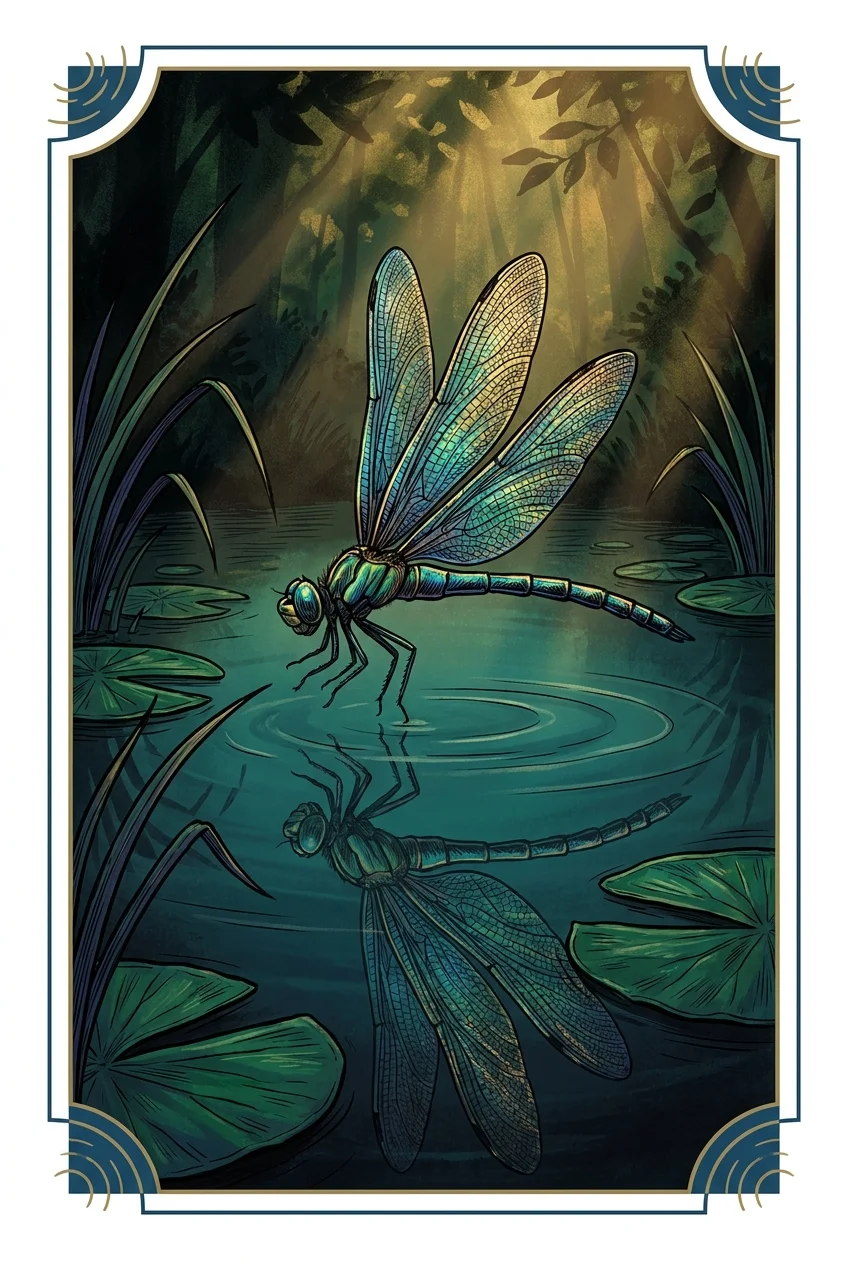
Dragonfly
water/sky"You know the difference between the surface and the light on the surface."
Dragonfly lives its larval life entirely underwater — sometimes for years — before emerging to fly. It sees in almost every direction at once through compound eyes. It is the animal of the double life between worlds, the creature that understands both depth and light, that has lived in the dark water before it learned the sky. Dragonfly people are not what they appear to be, and they know this about themselves.
Symbolism: In Japanese culture, the dragonfly (tonbo) is a symbol of autumn, victory, courage, and strength — it was a beloved symbol of samurai warriors. Japan was historically nicknamed "Dragonfly Island" (Akitsushima) by the emperor Jimmu. In many Indigenous North American traditions, Dragonfly is the messenger of transformation and the keeper of dreams. In Hopi tradition, Dragonfly is associated with the Water Clan and with healing through the integration of feeling. Its emergence from water to air mirrors the shamanic journey.
Shadow: The wound of the double life. Can become so skilled at liminal navigation that it belongs nowhere — always between, never of.
When it appears: Arrives at the completion of a long inner process — when the underwater years are done and it's time to fly. Also appears when illusion needs piercing.
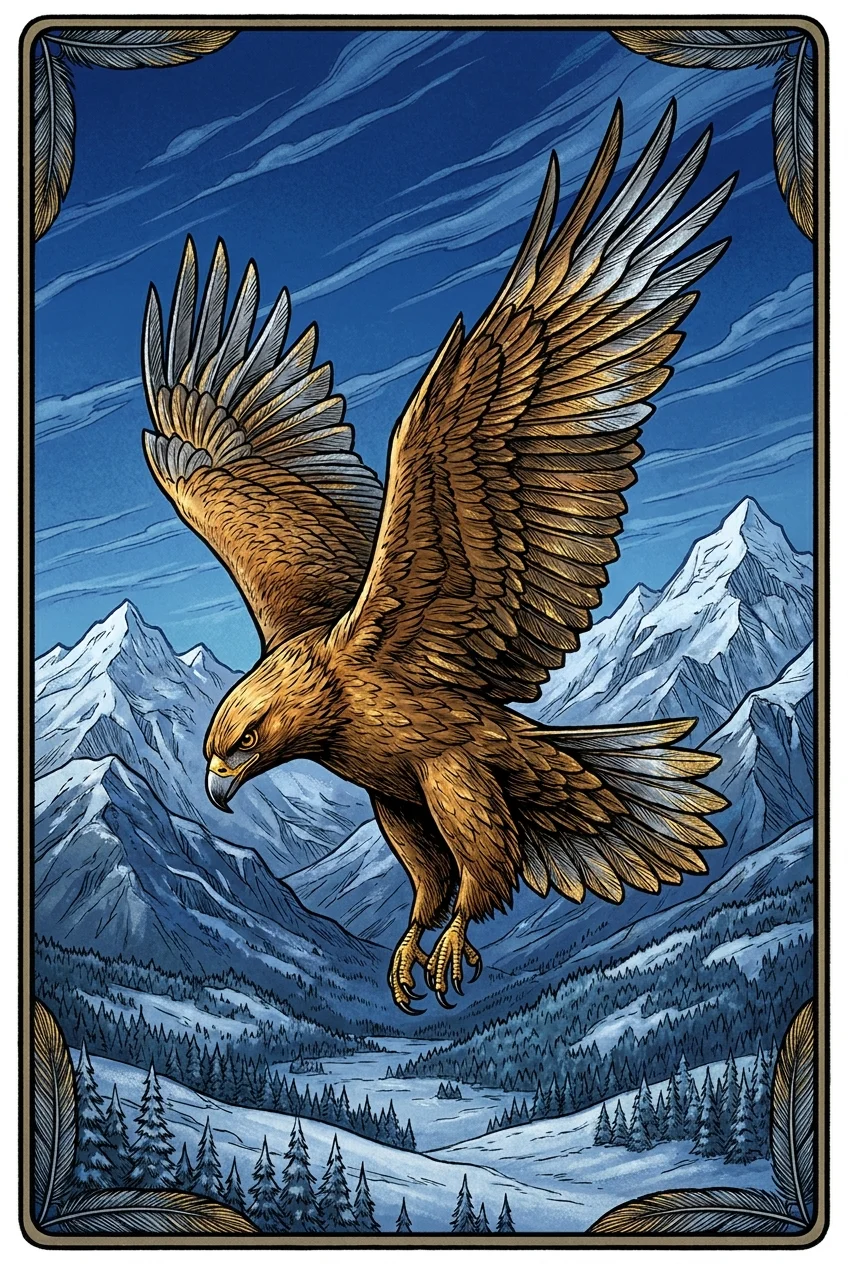
Eagle
sky"You see the whole field before anyone else has looked up."
Eagle lives at the intersection of sky and ground — able to perceive what others cannot, yet capable of dropping with lethal precision when the moment demands it. This is the animal of the long view, the strategist who holds still while others scatter, then acts with a timing that looks like luck to everyone else.
Symbolism: Across North American Indigenous traditions, Eagle carries prayers to the Great Spirit and symbolizes connection between earth and sky, human intention and divine response. In Aztec cosmology, the founding of Tenochtitlán was marked by an eagle on a cactus. Rome's legions carried eagle standards as symbols of sovereign authority. In Norse tradition, an eagle sat atop Yggdrasil, the world tree — the watcher at the axis of all things. Eagle's feathers are sacred objects in many traditions, used only in ceremony.
Shadow: Can become airborne permanently — so identified with the high view that it loses touch with the human-scale mess where actual life happens.
When it appears: Appears when you need clarity after a period of confusion — or when you've been operating too close to the problem to see the solution.
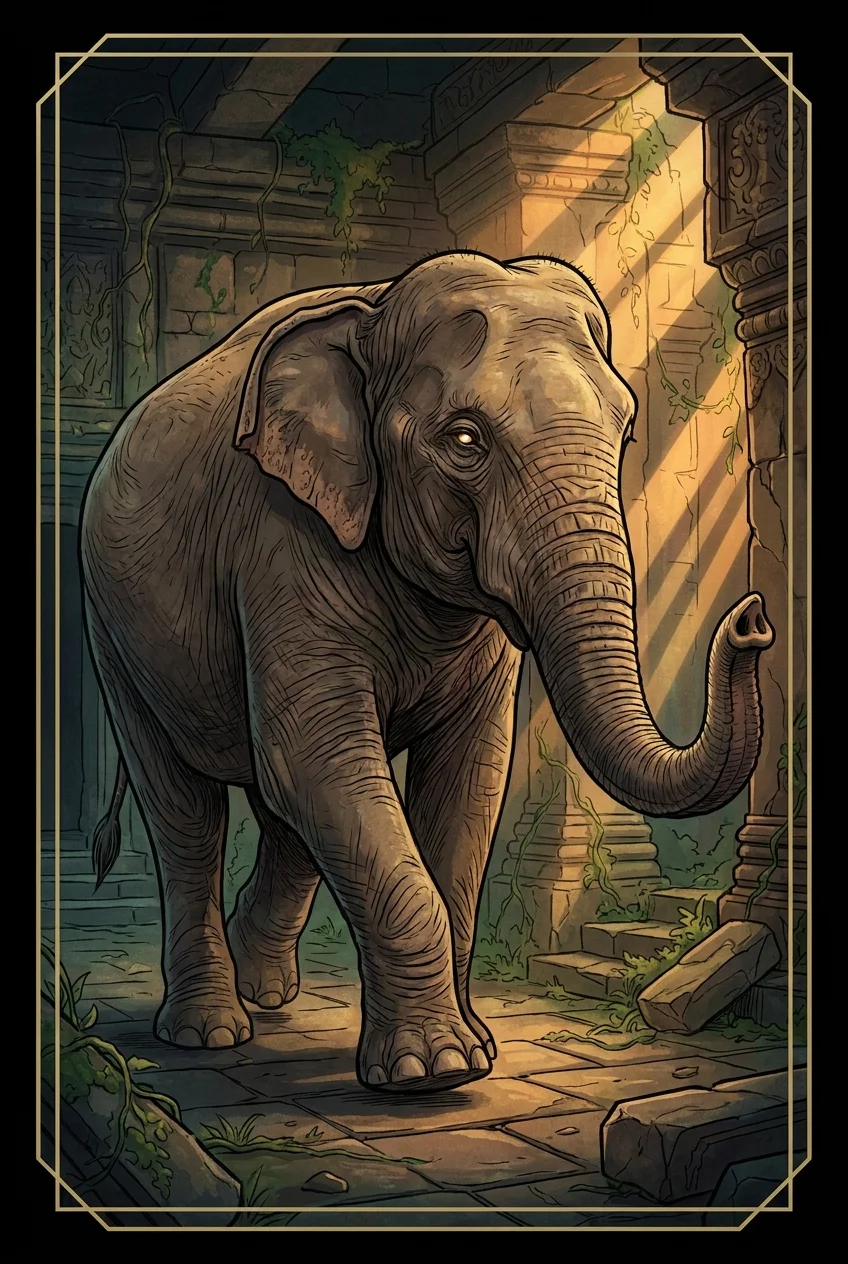
Elephant
earth"You remember everything and forgive nothing without understanding it first."
Elephant is memory made flesh — a creature with the longest grief of any land animal, one that returns to the bones of its dead and touches them with its trunk in what researchers now call mourning. This is depth, continuity, ancestral knowledge, and the weight of carrying it all without ever losing the thread. Elephant people are the keepers of family and community memory, the ones who know where everything is buried.
Symbolism: In Hinduism, Ganesha — the elephant-headed god, son of Shiva and Parvati — is the Remover of Obstacles and the Lord of Beginnings, invoked at the start of every significant undertaking. Ganesha's large ears hear everything; his big belly holds all the world's knowledge. In Buddhist tradition, a white elephant appeared in Queen Maya's dream announcing the Buddha's conception. In West African cosmology, Elephant represents the ancestor who witnesses all. Across sub-Saharan Africa, Elephant is a royal symbol — the creature whose passage is felt before it arrives.
Shadow: The weight of the archive. Can become the one who carries everyone else's history until the burden calcifies into something that can't be set down.
When it appears: Arrives when ancestral patterns are active — either to be honored or to be finally seen clearly enough to release.
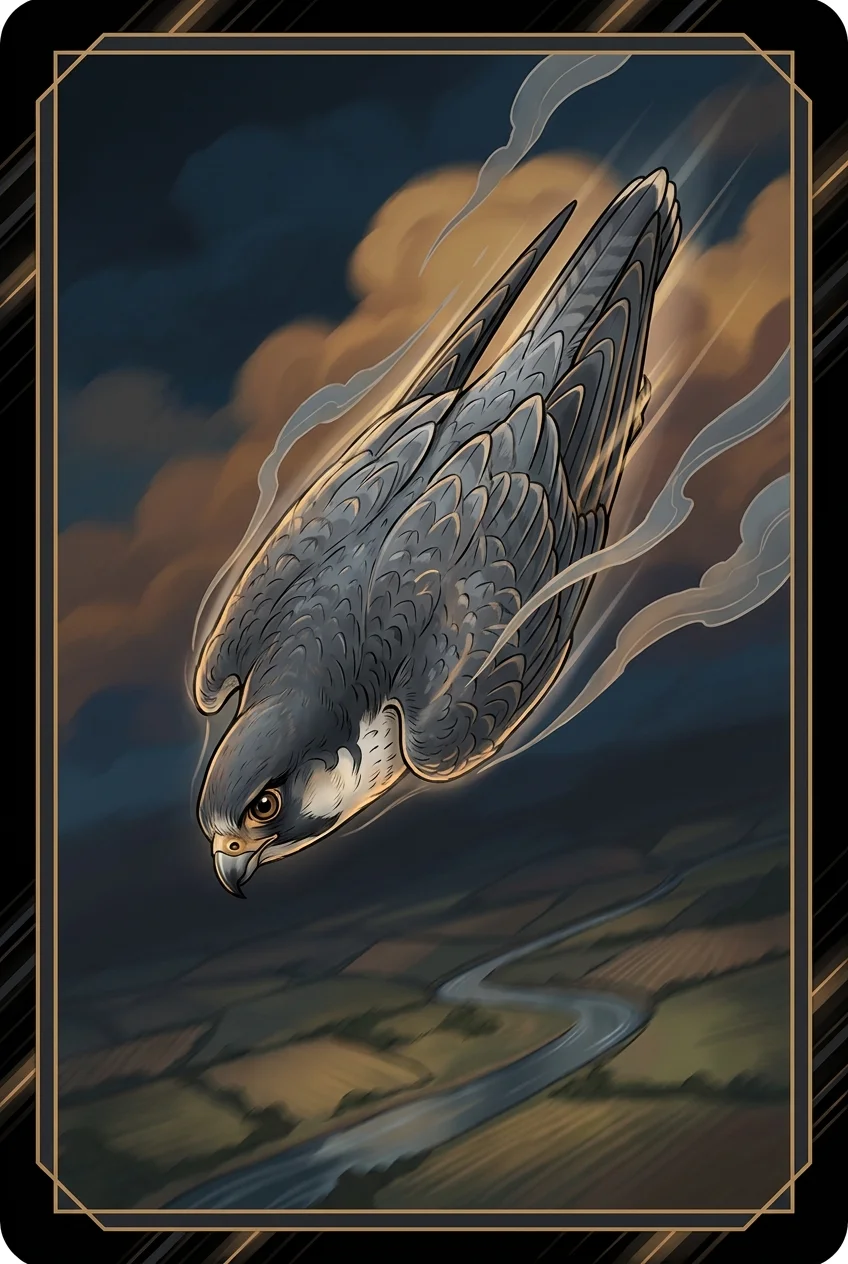
Falcon
sky"You commit at 200 miles per hour."
Falcon is pure velocity married to absolute precision — the peregrine dive is the fastest thing in the biological world, and this animal's spirit is exactly that: breathtaking commitment the moment the decision is made. No second-guessing in mid-air. What makes Falcon extraordinary is not the speed but the courage it takes to fold your wings and trust the fall.
Symbolism: Falconry in medieval Islamic and European courts was a symbol of elite mastery — the bird trained to return to the human hand despite being capable of freedom. Falcon was sacred in Egypt as Ra's solar bird, pulling the sun across the sky each day. In Mongolian shamanic tradition, Falcon was a warrior spirit, used in ceremonies asking for decisive action. The paradox of Falcon is taming and wild freedom held in simultaneous tension.
Shadow: Impatience with anything slow. Can sabotage complex situations requiring patience or politics — wants to dive when circling would serve better.
When it appears: Shows up when you've been circling a decision without committing — or when you need to move before the window closes.
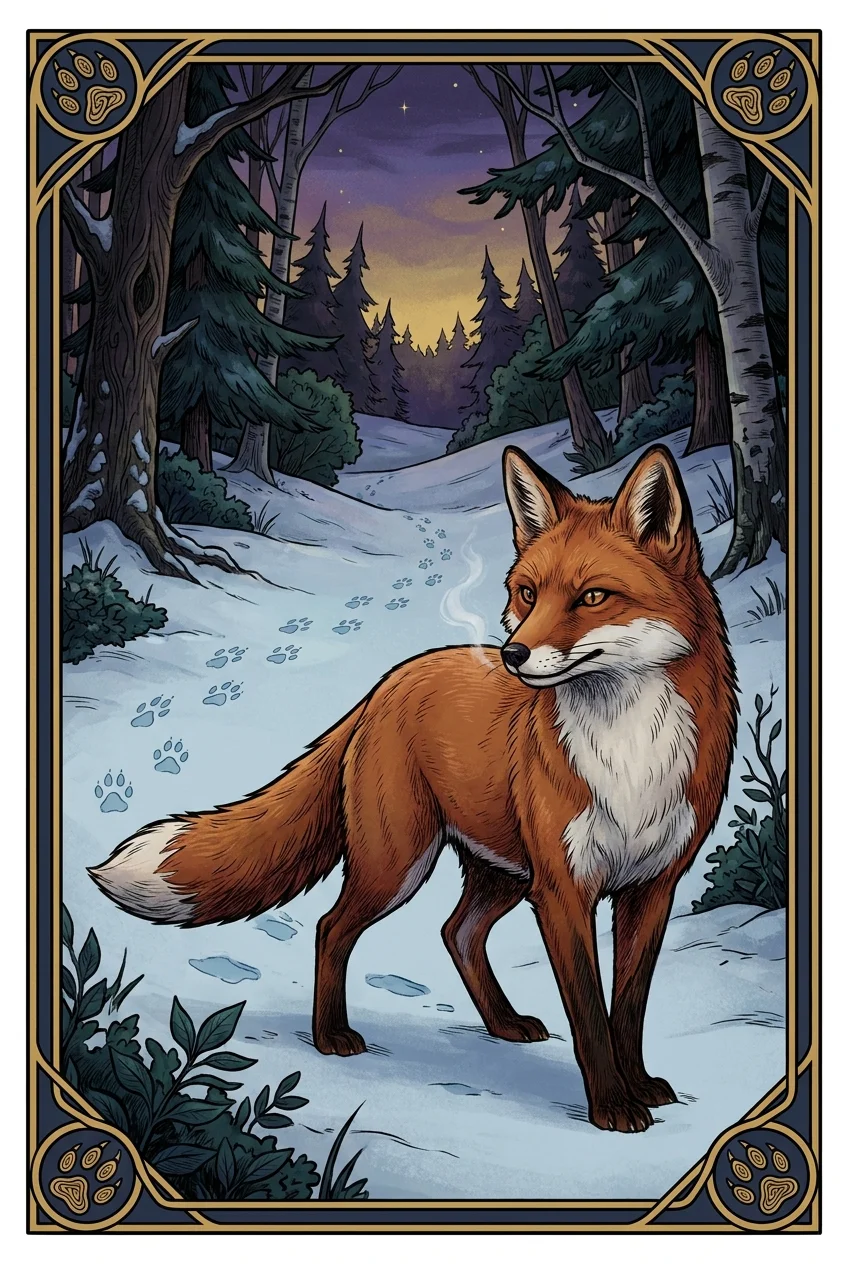
Fox
earth (fire-touched)"You solved the puzzle before they knew there was one."
Fox is intelligence in its most seductive form — quick, slant-eyed, and absolutely delighted by the game. Where Wolf hunts with loyalty and Eagle with vision, Fox hunts with wit, adaptability, and a talent for making the other party think they're winning. This isn't deception — it's the joy of the clever path, the side door, the answer that makes everyone gasp.
Symbolism: In Japanese Shinto tradition, the kitsune (fox) is a sacred messenger of Inari, the god of rice and prosperity — a shapeshifter who accumulates magical tails with age and wisdom. In Celtic tradition, Fox was the guide through the underworld, leading souls through the maze of the afterlife. Across West African, Native American, and East Asian traditions, Fox appears as the trickster — the figure who disrupts hierarchy and exposes pretension. Trickster mythology is sacred mythology: the Fox breaks what needs to break.
Shadow: Can lose themselves in the performance of cleverness. Might manipulate from habit even when transparency would serve better.
When it appears: Appears when direct force won't work and a smarter path is needed — or when you've been taking yourself too seriously and need to find the play again.
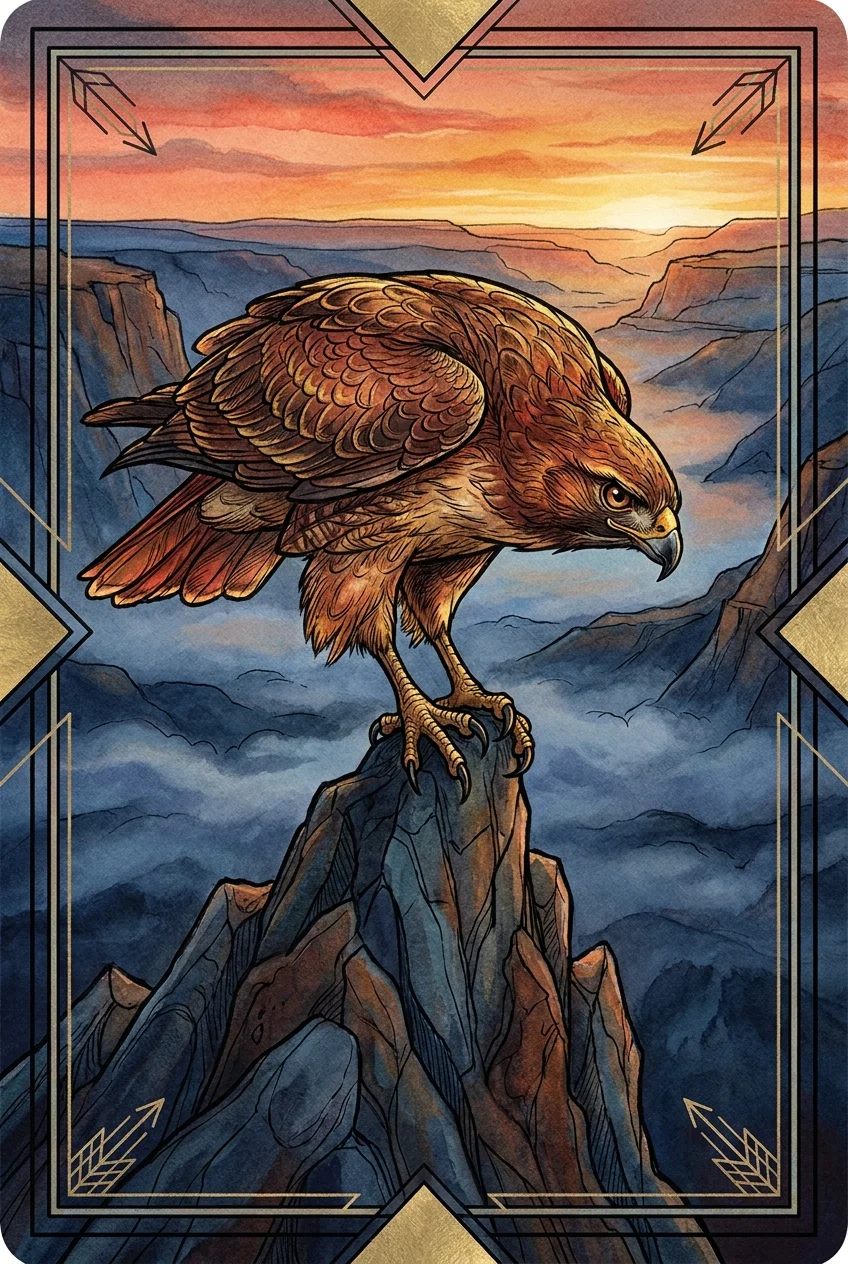
Hawk
sky"Nothing passes without your notice."
Hawk is Eagle distilled to its keenest edge — less imperial, more tactical. This is the animal of the messenger, the one who hunts small and fast, who communicates between worlds and doesn't linger in either. Hawk energy is kinetic, sharp-eyed, restless in the way that very intelligent people are restless when the problem hasn't been solved yet.
Symbolism: Horus, the falcon-headed Egyptian god, represented royal protection and the all-seeing eye of divine order. In Celtic tradition, Hawk was the oldest of animals — a keeper of ancestral memory. In many Plains Indian traditions, Hawk was the messenger between Great Spirit and human beings, carrying omens and answers. Hawk medicine is associated with awakening — the moment when you suddenly see what has always been there.
Shadow: Overstimulation — takes in so much signal that discernment collapses into anxiety. Mistaking every shimmer for prey.
When it appears: Arrives when you've been missing signals — ignoring warnings, misreading people, looking without seeing.
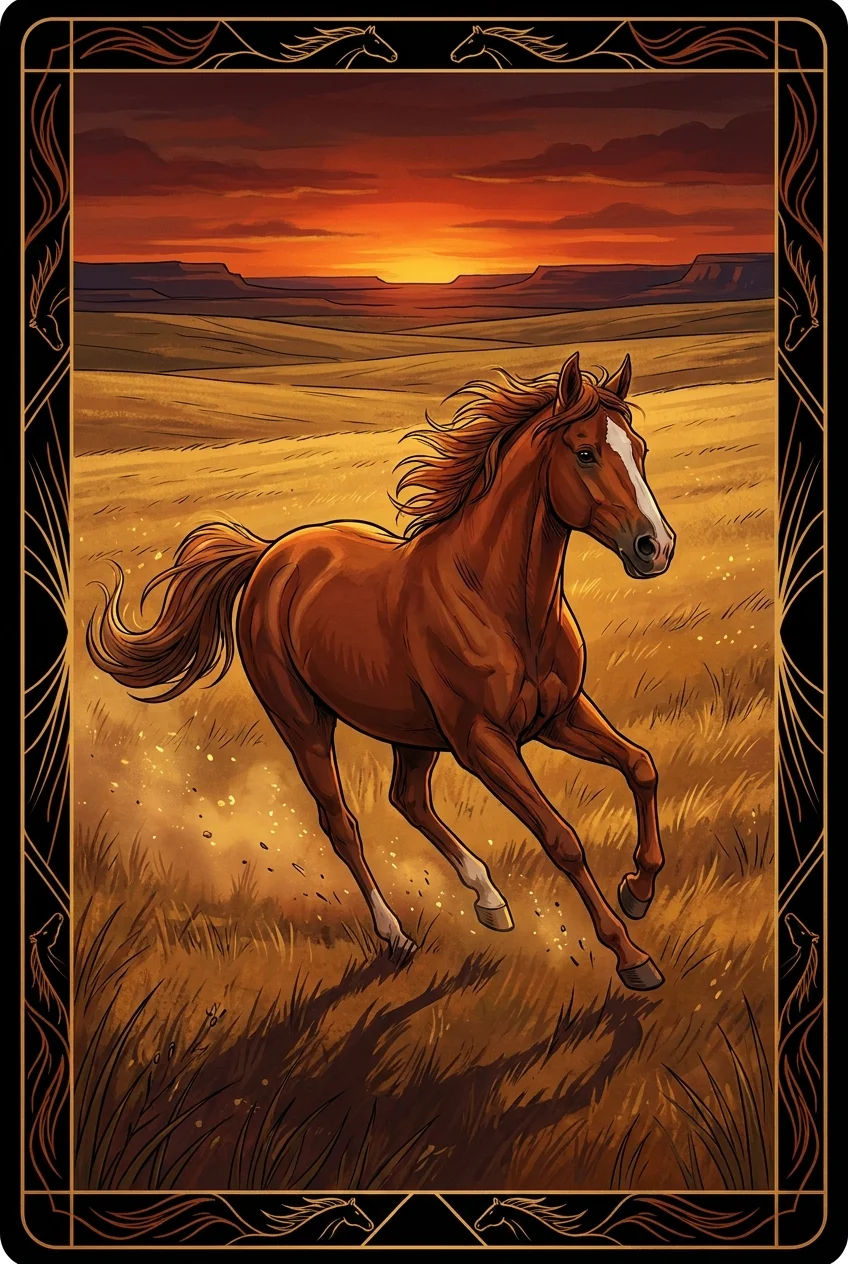
Horse
earth (wind-touched)"You were made for open ground and you know it."
Horse is the animal of freedom that has agreed, more or less willingly, to partnership — the creature that could outrun nearly everything and chose instead to carry humans across half the world's history. Horse energy is about the tension between wildness and covenant, between the open plains calling and the warm stable that someone else built. Those guided by Horse know exactly how fast they could go alone.
Symbolism: Horse domestication ~5,500 years ago changed human civilization more than almost any other development. In Greek mythology, Poseidon created Horse by striking his trident on rock — Horse as raw elemental power. Epona, the Gaulish horse goddess, was adopted by the Roman cavalry and became one of the few Celtic deities worshipped in Rome itself. In Norse mythology, Sleipnir — Odin's eight-legged horse — was the fastest creature in the nine worlds, able to travel between the living and the dead. In many Plains Indian traditions, Horse was a holy gift that transformed entire cultures.
Shadow: The need for open ground becoming a pathology — commitment-panic dressed as freedom-loving. Bolts when the stable gets too comfortable.
When it appears: Arrives when you're being called toward freedom — away from constriction, toward open territory, whether internal or external.
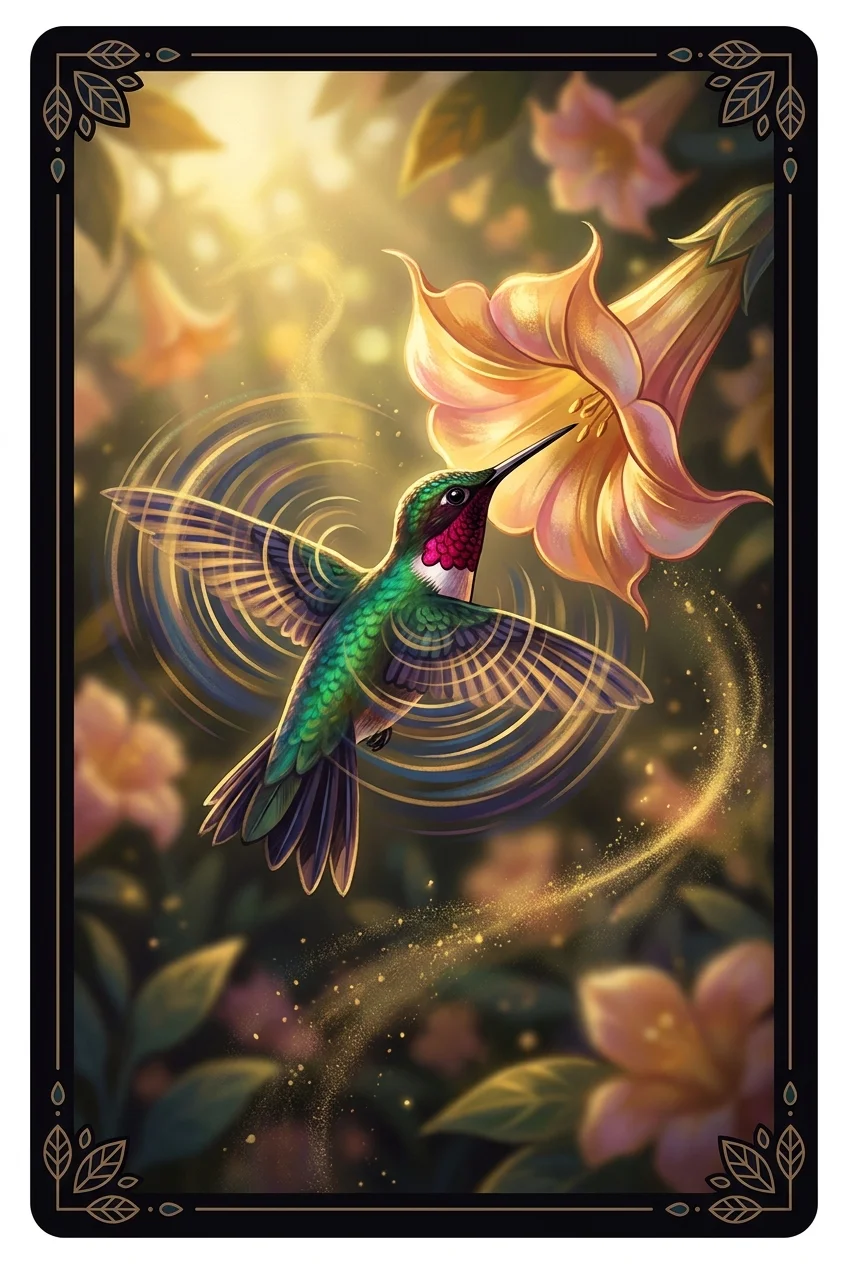
Hummingbird
sky (fire-touched)"You find the sweetness no one else is small enough to reach."
Hummingbird is the only bird that can fly backwards — it's also, proportionally, one of the most energetically expensive creatures on the planet, burning so fast it can barely slow down. But here's what the biology actually looks like in practice: extraordinary precision, joy in the specific and miniature, the capacity to hover in exactly the right place and extract the nectar that sustains entire ecosystems of meaning.
Symbolism: In Aztec mythology, Huitzilopochtli — the sun god and patron deity of the Aztec people — was associated with the hummingbird; warriors who fell in battle were believed to reincarnate as hummingbirds. In many Mesoamerican traditions, Hummingbird carried the prayers of the living to the dead and returned with messages. In Central American folklore, Hummingbird was the love messenger — the one who carries the desire between two people who have not yet spoken.
Shadow: Exhaustion from the speed of its own nature. Hummingbird can't stop metabolizing and doesn't know how to tell when it's burning out because it's always burning.
When it appears: Arrives when you've lost access to pleasure — or when the small things have been sacrificed to a large ambition that forgot why it started.
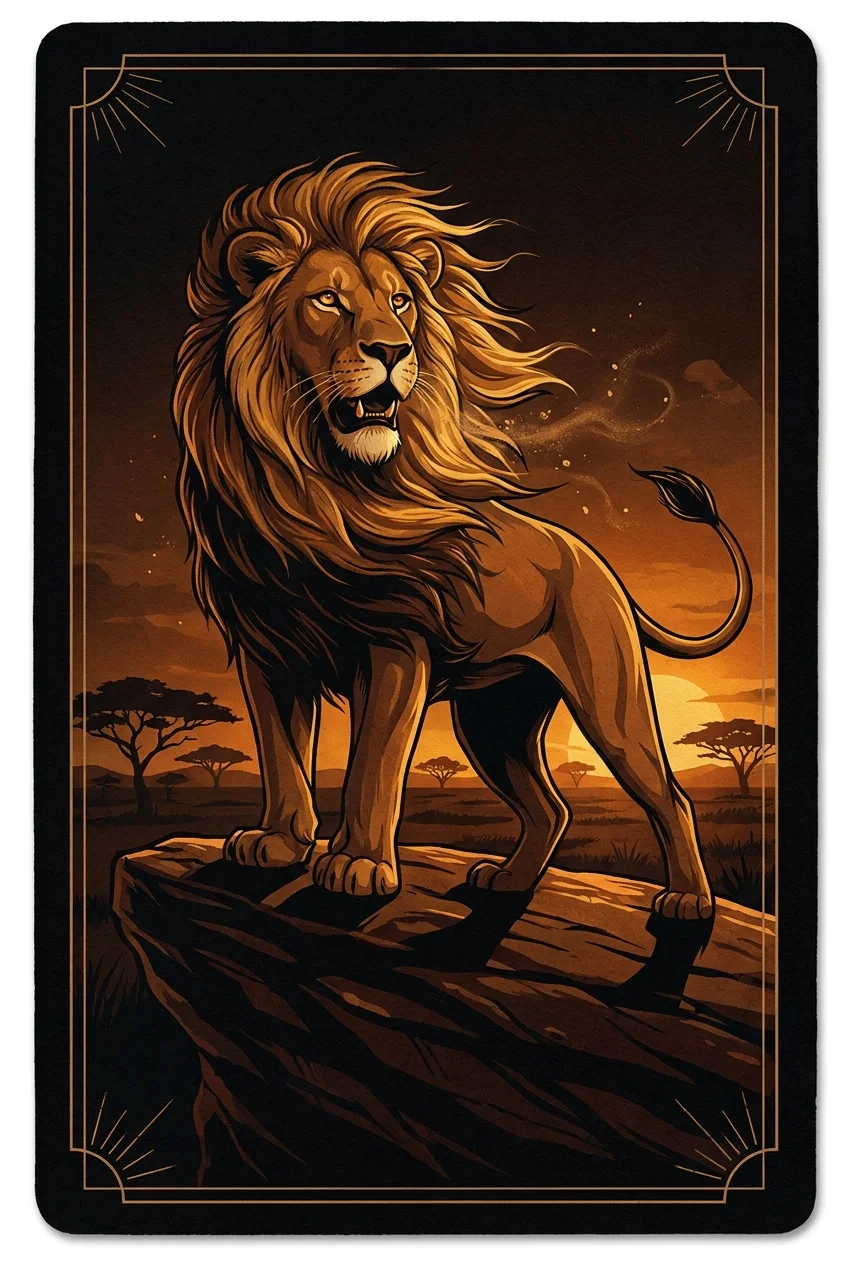
Lion
fire"You don't arrive. You occur."
Lion doesn't hunt every day — that's the secret most people miss. This is an animal of devastating patience punctuated by absolute commitment. Sovereign by nature, not by effort. The Lion's presence reorganizes rooms before it speaks, and it knows this about itself without needing to perform it.
Symbolism: Across Egyptian, Mesopotamian, and East African traditions, Lion was the throne-animal — the creature whose energy consecrated leadership. Sekhmet, the Egyptian lion-goddess, embodied both destruction and healing. In Heraldic European tradition, Lion represented courage and justice. In West African Sundiata mythology, the Lion became the founding spirit of empire. Unlike Wolf (earned authority), Lion's power is ontological: it doesn't need to be proven. The sun is its element, the midday blaze its most natural hour.
Shadow: When unchallenged too long, Lion becomes indolent — a sovereign who's forgotten how to be tested. Ego calcification. Assumes the room agrees.
When it appears: Appears when you're being called into a leadership role you've been avoiding, or when you've been diminishing yourself to fit smaller containers.
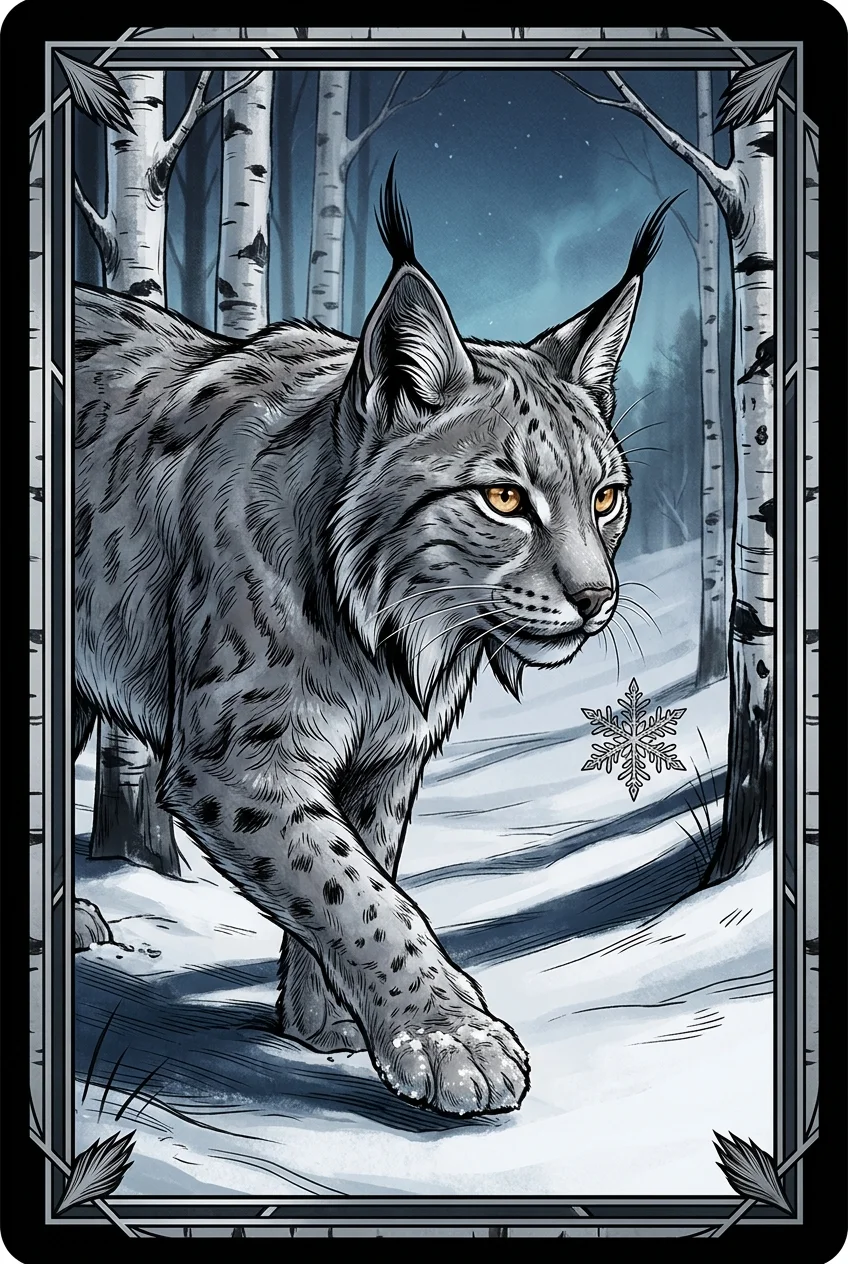
Lynx
shadow"You know what they haven't told you yet."
Lynx is the forest's secret-keeper — the animal with the densest fur, the most silent movement, and an ability to see in darkness so acute that it became, in mythology, the animal of second sight. Lynx people often know things they have no logical reason to know. They see through persona with an ease that unsettles the people who are most invested in their own.
Symbolism: In medieval European symbolism, the Lynx was so associated with penetrating sight that it could see through walls; to "have the eyes of a lynx" meant supernatural perception. In Native American traditions of the Northwest and Great Lakes, Lynx was the keeper of the forest's deep secrets — the medicine animal of truth-telling and the unveiling of what is hidden. In Finnish mythology, the Lynx was associated with the forest spirit and with the ability to move between the visible and invisible worlds.
Shadow: The knowledge that can't be shared. Lynx can become isolated by what it sees — carrying information that would change things if delivered correctly, but never quite finding the door.
When it appears: Arrives when you've been doubting your perception — when what you know and what you're being told don't match, and you need confidence in your own sight.
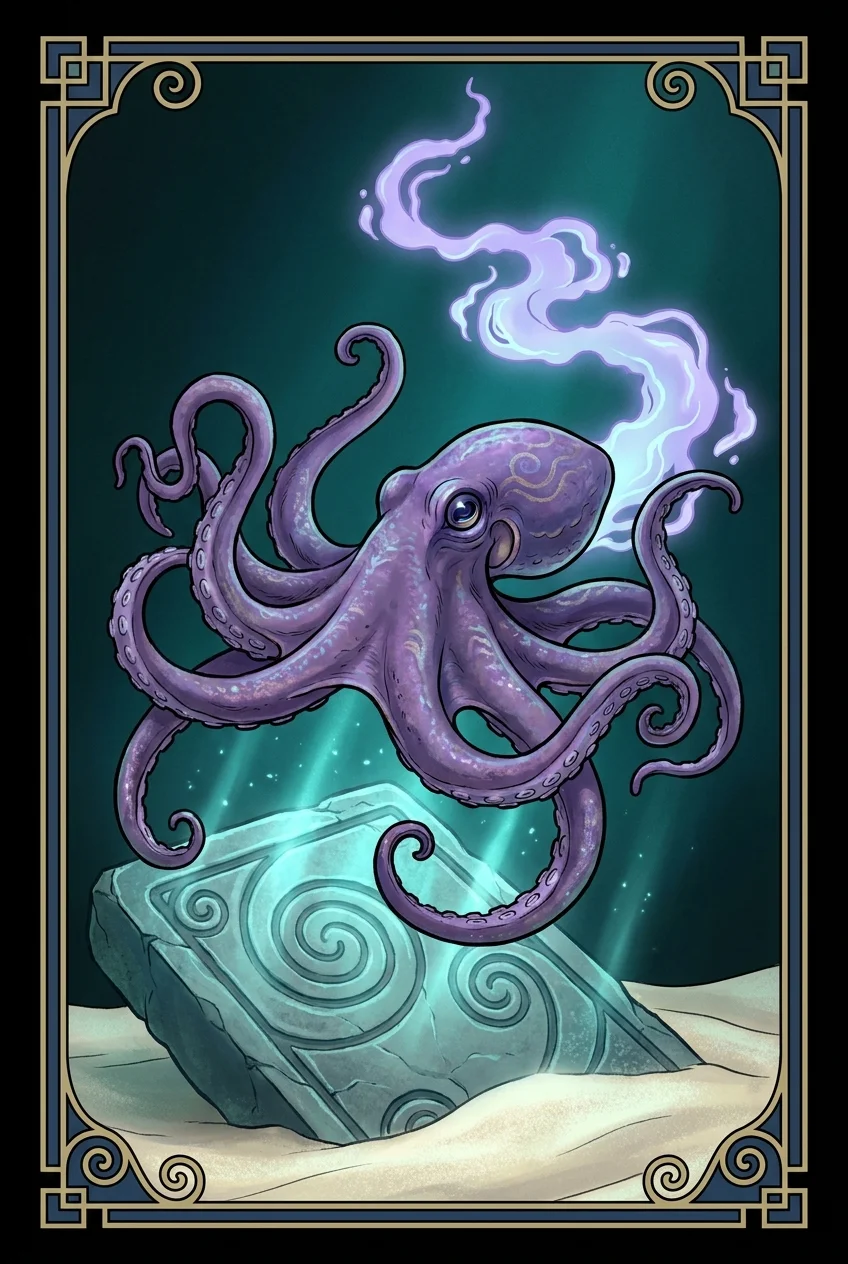
Octopus
water (shadow-tinged)"You think in eight directions simultaneously."
Octopus is the alien intelligence among us — a creature with neurons distributed through its arms, capable of tasting with its skin, seeing color despite being colorblind, and solving problems that require object permanence and tool use with a brain that evolved completely separately from vertebrate minds. Octopus people have a quality that makes others feel they're only ever getting one face at a time.
Symbolism: The Kraken of Norse mythology — the monstrous many-armed sea creature — is Octopus at its most cosmic, the intelligence beneath the surface that could swallow ships whole. In Pacific Island traditions, the octopus was associated with the sea god Kanaloa (Hawaiian), representing the deep unconscious and the regenerative power of darkness. The octopus's ability to detach and regenerate its arms became a symbol of sacrifice for survival — what you surrender to keep moving.
Shadow: Too many selves. The constant adaptation can erode a stable identity — not knowing who you are when no audience is watching.
When it appears: Arrives when conventional thinking has failed — when you need a radically different kind of intelligence. Also appears when identity feels fragmented and needs reweaving.
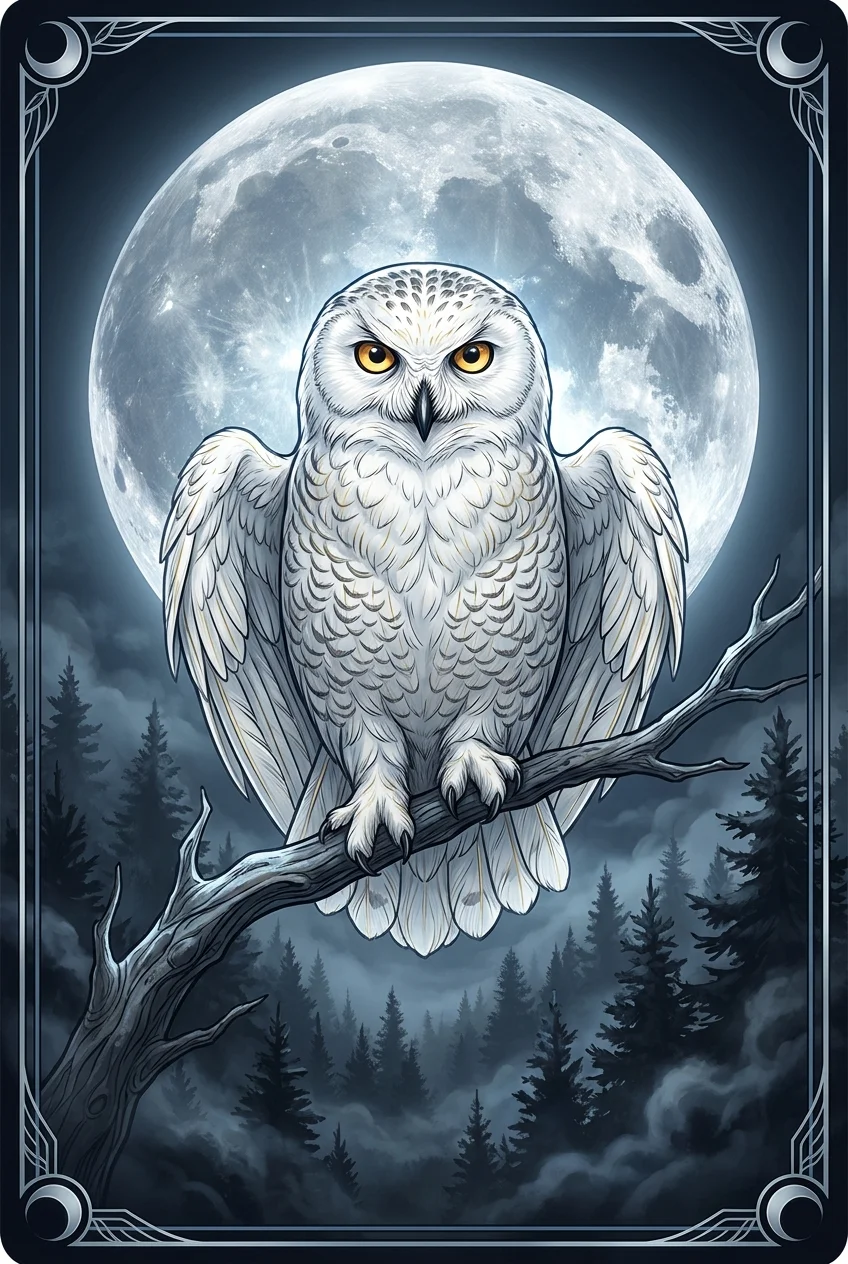
Owl
sky (shadow-touched)"You see everything they thought the dark hid."
Owl is the animal of the space between breaths — the silence that contains the sound, the face that turns 270 degrees because it needs no blind spots. Owl people often know things they cannot explain knowing, have dreams that function as information, and carry a stillness in social settings that others experience as either profoundly comforting or faintly unnerving.
Symbolism: In Greek tradition, Owl was Athena's companion and sacred bird — the symbol of rational wisdom and the ability to see what is hidden. In many Indigenous traditions, Owl is the harbinger of death — not death as tragedy but as transition, the creature that announces the thinning of the veil. In Celtic mythology, Owl was called the "night eagle" and was associated with the crone aspect of the goddess and with secrets that needed keeping. Owls in Aztec tradition were associated with the god of death, Mictlantecuhtli. Across cultures, Owl lives at the edge of the known.
Shadow: Can become the eternal watcher who never acts — so attuned to seeing that it forgets to participate. Detachment performing as depth.
When it appears: Arrives at crossroads involving endings — death, divorce, major dissolution — when what's needed is not comfort but clear sight.
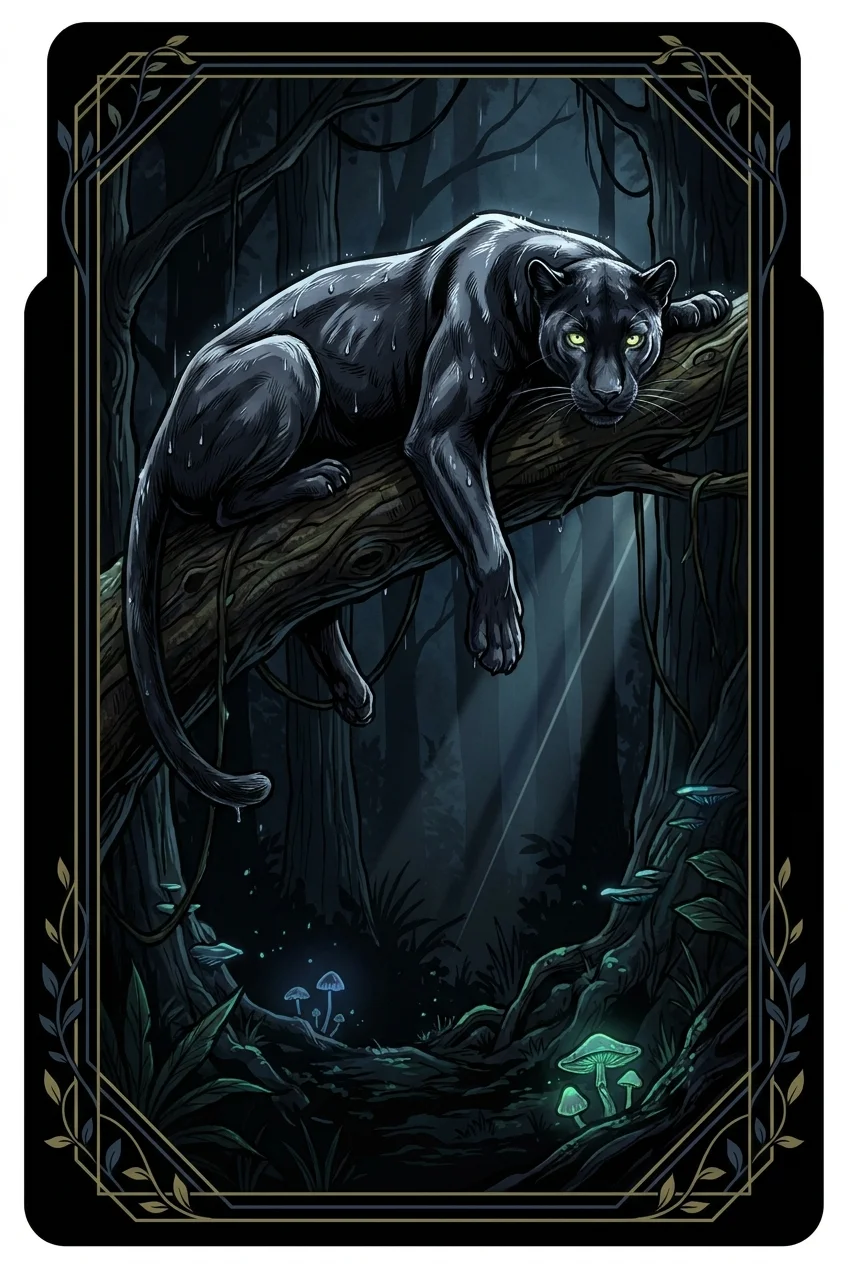
Panther
shadow"You move through the world like a secret."
Panther is darkness that breathes — the ink-black animal of mystery, silence, and a magnetism so complete it doesn't need to announce itself. Those guided by Panther often have a double life not because they're hiding but because they genuinely exist on frequencies others can't register. The Panther doesn't roar. It doesn't need to.
Symbolism: The black panther is not a separate species but a melanistic variant — same creature, more concentrated. This is Panther's spiritual truth: the same as others, just turned up. In Mayan tradition, Jaguar (the New World panther) was the god of the underworld and the night sun — the solar force moving through darkness. In African traditions, leopard cults wielded enormous political power, their members invisible within society while controlling its shape from shadow. Panther is the ruler of what cannot be seen.
Shadow: Can become a ghost — so skilled at the unseen that they vanish from their own life. Intimacy kept perpetually at the threshold.
When it appears: Arrives in liminal moments — transitions, endings, initiations. Appears when the visible world is insufficient and the hidden dimension needs acknowledgment.
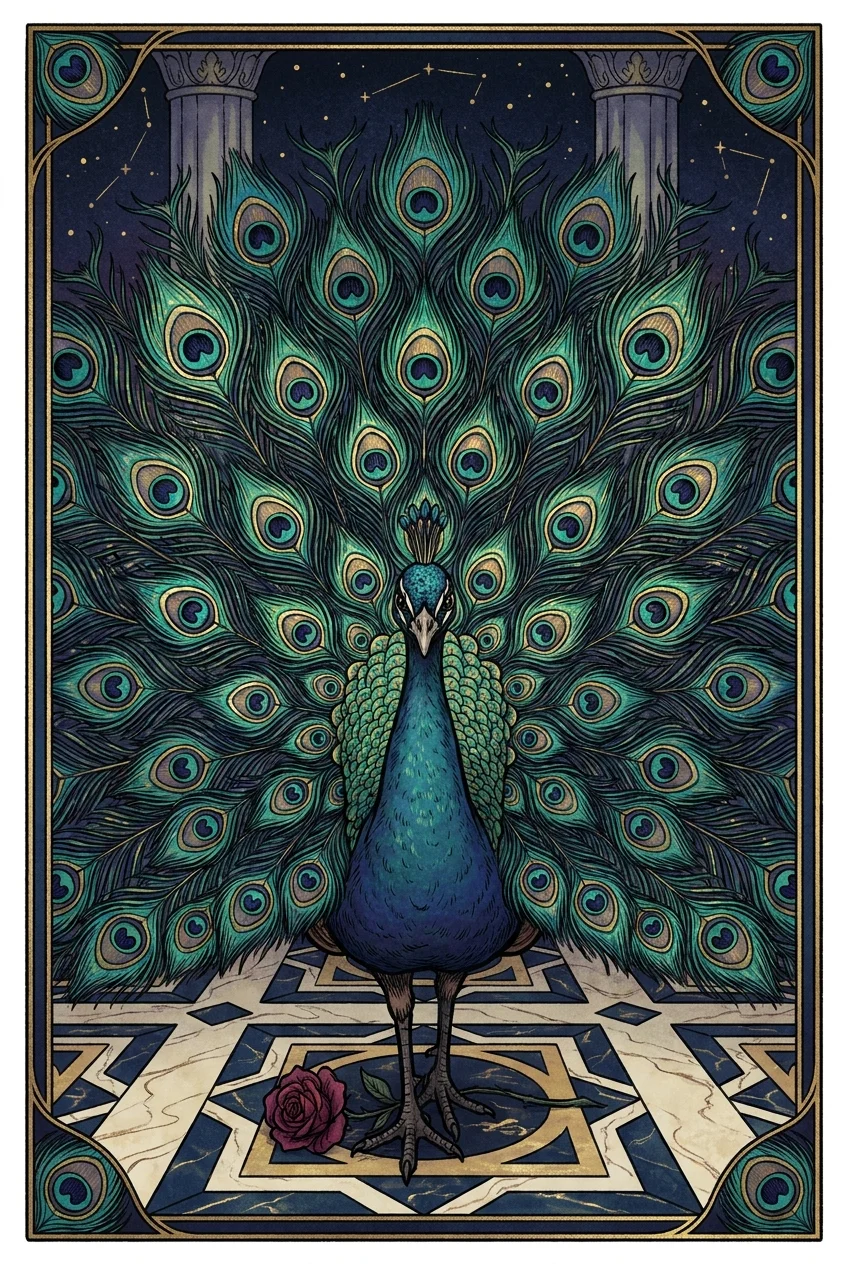
Peacock
fire"Your display is a declaration, not a performance."
Peacock is the animal that evolved beauty as a weapon — the tail that announces I am healthy enough to be this visible, this vulnerable, and you still can't catch me. There is nothing passive about Peacock. The display is confidence materialized, the willingness to be seen completely, the refusal to make yourself smaller for comfort's sake.
Symbolism: In Hinduism, the peacock is the vahana (vehicle/mount) of Kartikeya, the god of war, and is sacred to Saraswati, goddess of the arts. The "thousand eyes" of the peacock's tail are associated with omniscience and divine watchfulness. In Greek mythology, the peacock was Hera's sacred bird — the eyes in the tail were the eyes of Argus, her hundred-eyed giant, transformed into the bird's plumage. In Persian poetry, Peacock is associated with paradise. In Christian iconography, Peacock's renewal of its tail symbolized resurrection.
Shadow: Display mistaken for depth. Can confuse visibility with meaning, presence with impact — the tail spread so wide that the actual creature disappears behind it.
When it appears: Arrives when you've been hiding, minimizing, dulling yourself to avoid someone else's discomfort. Or when you're being called to claim your full aesthetic power.
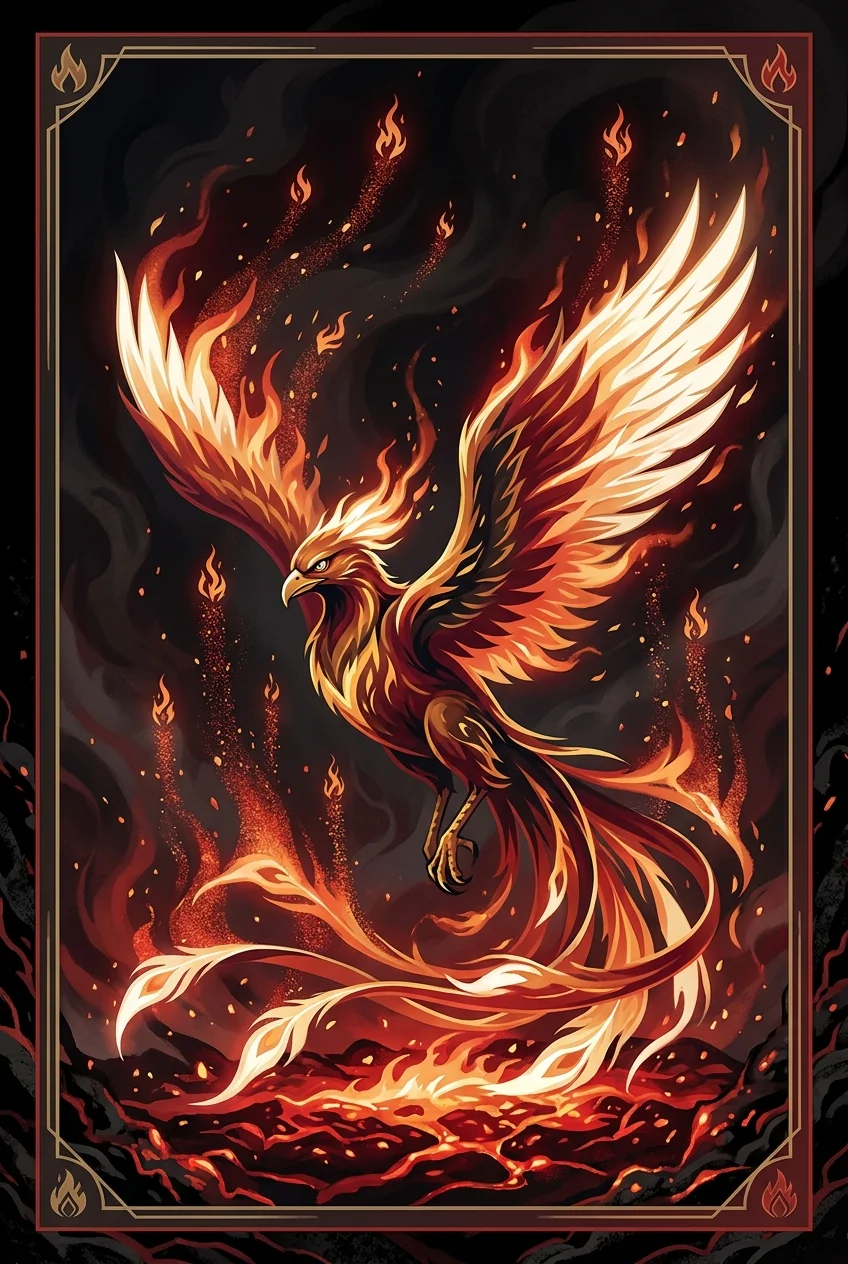
Phoenix
fire"The fire is not the end. It was always the beginning."
Phoenix is the only mythological animal in this taxonomy because no biological creature is needed — the archetype is too real to require a body. Phoenix is what happens when destruction has been total and something rises anyway: not rebuilding, not recovering, but transmuting. Phoenix people have usually been reduced to ash at least once and have learned to recognize what they gained in the burning.
Symbolism: The Phoenix appears across Egyptian (Bennu bird, sacred to Ra and Osiris), Greek, Roman, Chinese (Fenghuang), Persian (Simurgh), and Arabian mythology — the fire-bird that dies and is reborn from its own ashes. In alchemical tradition, the Phoenix symbolizes the final stage of transformation (rubedo — the reddening), the moment when base matter has been fully transmuted to gold. In early Christian tradition, Phoenix became a symbol of resurrection. The Bennu bird of Egyptian cosmology was a self-created being — the first thing that existed, standing on the primordial mound at the moment of creation.
Shadow: Pyromaniac spirituality — can develop a compulsive relationship with burning, creating crises because the rising feels more real than the stable life.
When it appears: Arrives at the absolute nadir — when the fire is active and total, or immediately after, when you're covered in ash and deciding what you are now.
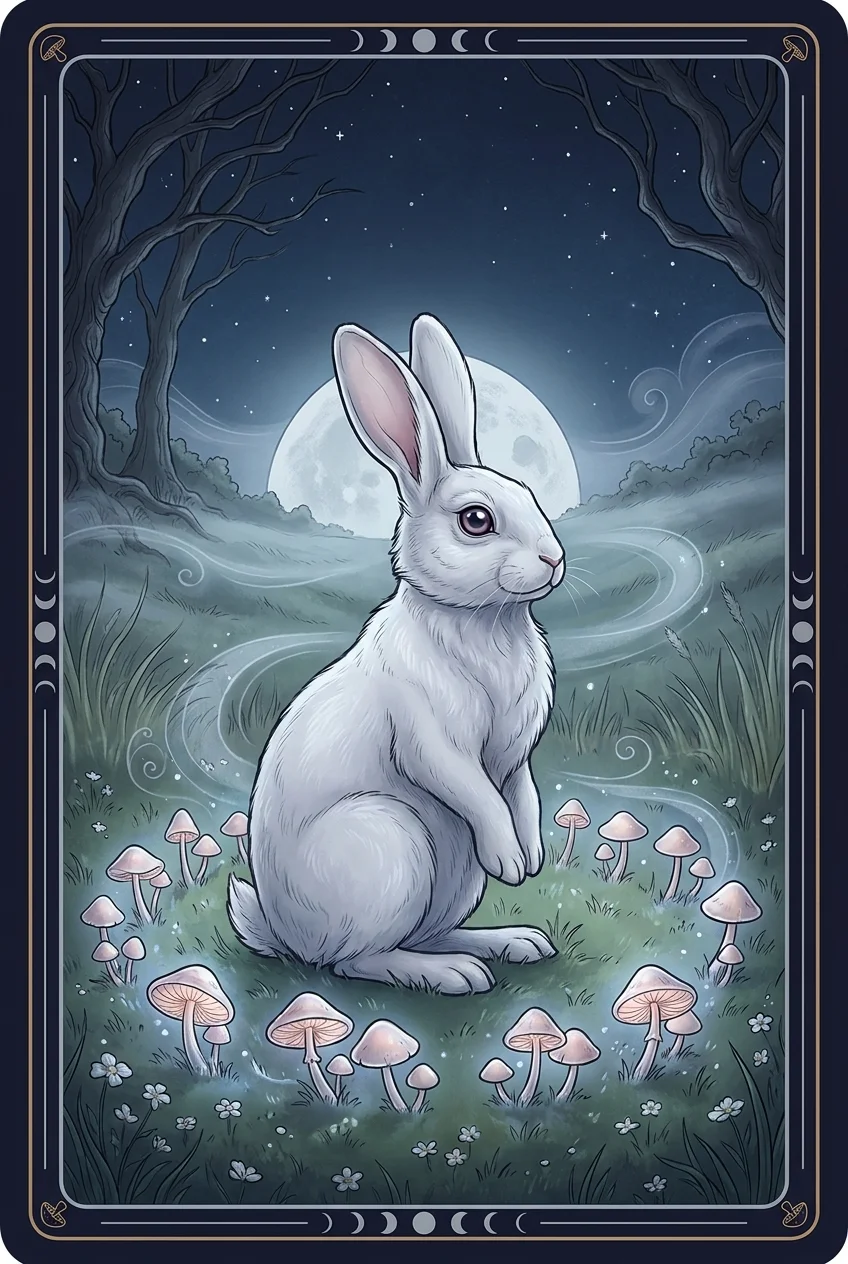
Rabbit
earth"You survive the world by knowing all of it at once."
Rabbit's eyes are positioned on the sides of its head to give it nearly 360-degree vision — the prey animal's adaptation that makes it, paradoxically, one of the most perceptive creatures alive. Rabbit knows what fear tastes like and moves anyway, zigging in patterns that baffle pursuit, reproducing with extraordinary abundance in the face of constant threat. Rabbit is not timid. Rabbit is the survivor who learned to outmaneuver.
Symbolism: In West African and African American folklore traditions, Br'er Rabbit is the ultimate trickster-survivor — the small creature that outfoxes (literally) the more powerful through wit and audacity. In Chinese cosmology, the Moon Rabbit is the companion of Chang'e, pounding the elixir of immortality — Rabbit as keeper of sacred, cyclical knowledge. In Celtic tradition, the hare (Rabbit's ancestor) was the sacred animal of the spring goddess Ēostre — fertility, new beginnings, the inexhaustible return of life.
Shadow: Fear as the operating system. Can make decisions from threat-perception that has long outlasted the original threat — trapped in the zigging when stillness is what's needed.
When it appears: Appears when fear is running the show — or when abundance is trying to break through and anxiety is blocking it.
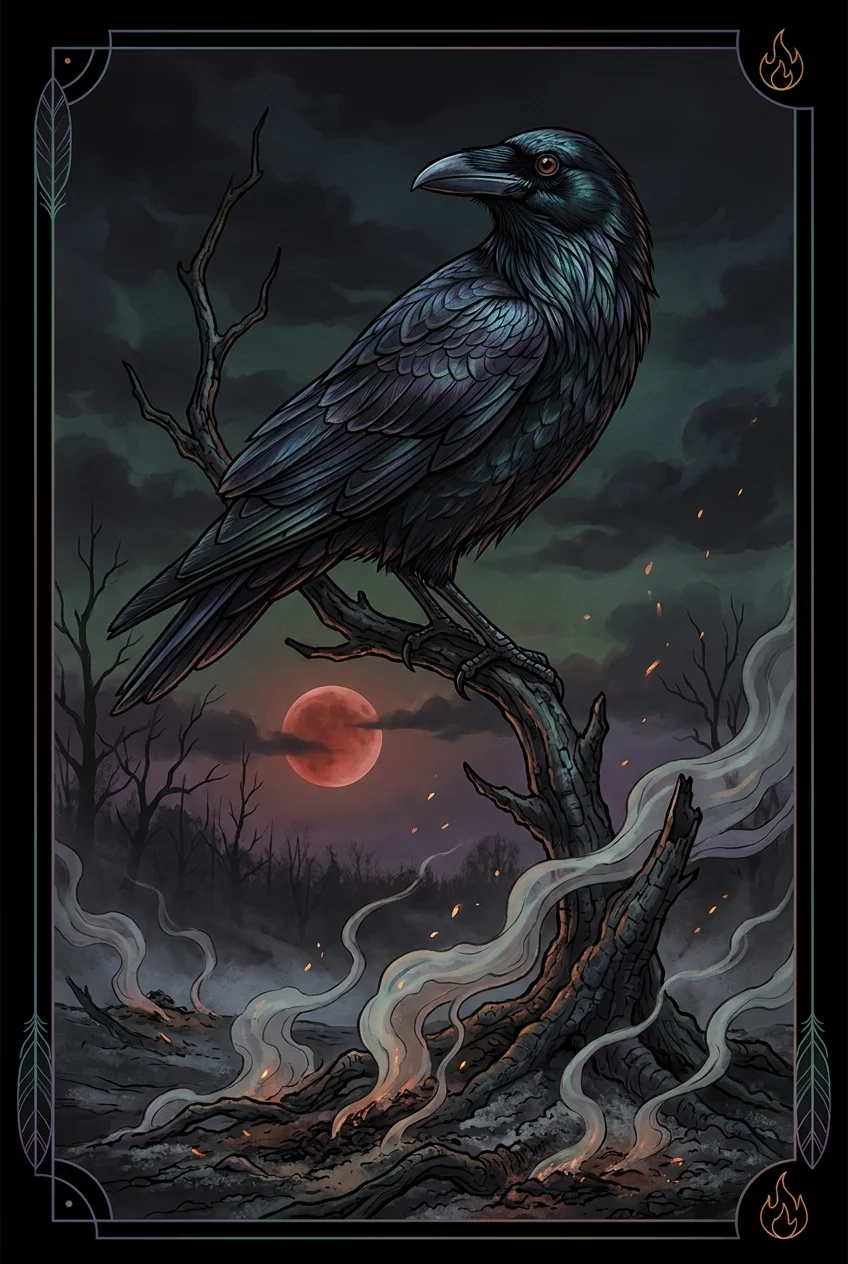
Raven
sky (shadow)"You carry light in your beak and use it when you choose."
Raven is the trickster-shaman — the creature that stole fire (in Pacific Northwest mythology) and brought it to humanity, that plays in wind currents for pure joy, that performs funerals and solves puzzles and holds an entire mythology on its black feathers. Raven is intelligence without innocence: it has seen everything, judged none of it, and finds the whole spectacle endlessly interesting.
Symbolism: In Haida and Tlingit Pacific Northwest traditions, Raven is the creator of the world — or at minimum the creature who brought light, water, and fire to beings who lived in darkness. Raven is sacred, irreverent, and necessary: the transformation agent. In Norse tradition, Odin's two ravens flew across the world each day and returned with all knowledge — Raven as the intelligence of omniscience. In Celtic mythology, Morrigan the war goddess appeared as a raven on the shoulder of dying warriors. Raven crosses every boundary, including the one between life and death.
Shadow: The trickster who never comes down from the bit — perpetual irony as armor, meaning held at distance to avoid being changed by it.
When it appears: Arrives when you need to break a pattern through wit rather than force — or when you're being called to use your intelligence in service of transformation.
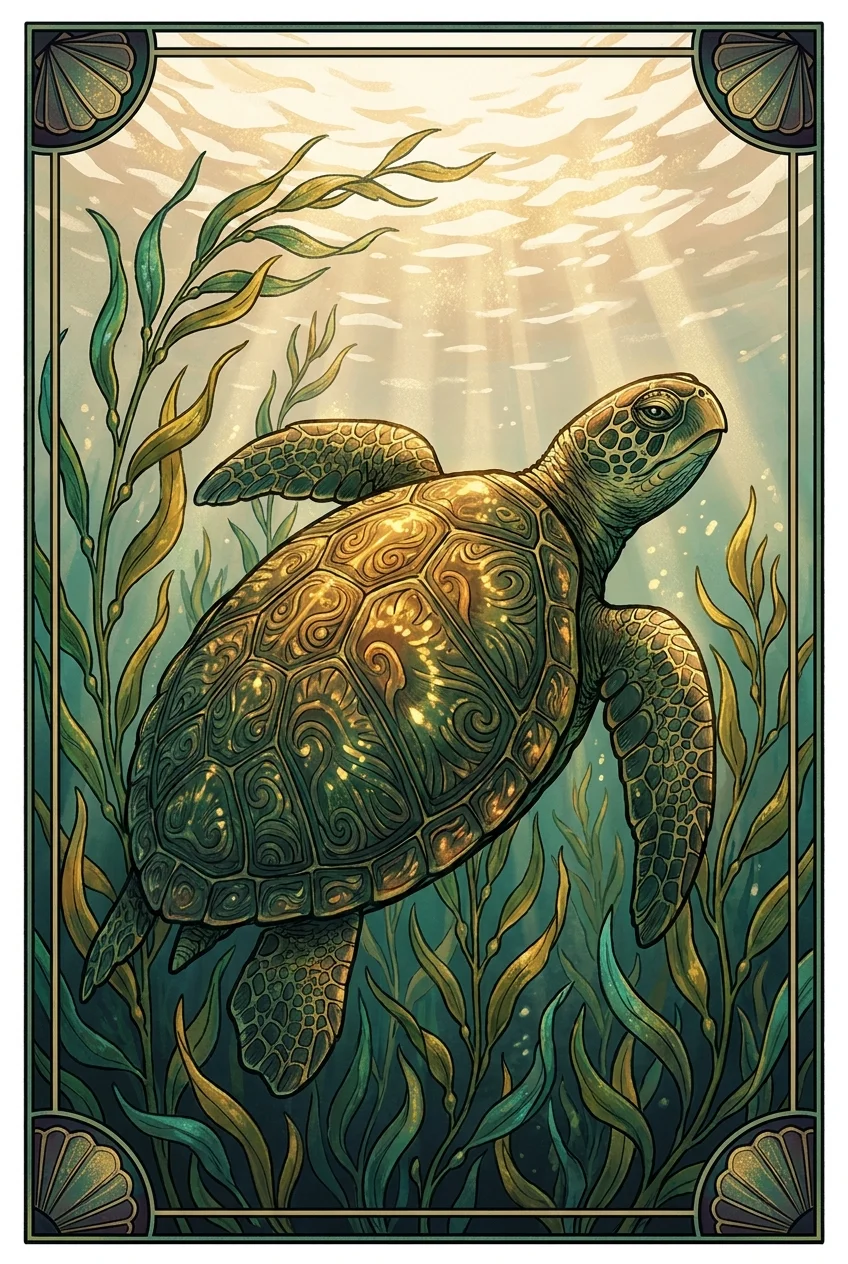
Sea Turtle
water (earth-anchored)"You have always known the way home."
Sea Turtle navigates by the magnetic field of the Earth itself — returns, after decades in the open ocean, to the exact beach where it was born. This is ancient knowing: not information but orientation, the bone-deep compass that doesn't waver even when the path is invisible. Turtle energy is not slow; it's patient, which is entirely different.
Symbolism: In Hindu cosmology, the world rests on the back of a giant turtle (Kurma, the second avatar of Vishnu). In many Indigenous North American traditions, North America itself is called "Turtle Island" — the landmass that emerged from the primordial waters on the back of the original turtle. In Chinese cosmology, the Black Tortoise is one of the four celestial guardians, associated with the north, winter, and water. Sea Turtle's ability to navigate thousands of miles and return home is perhaps the most profound embodiment of ancestral memory in the living world.
Shadow: Can become genuinely immovable — the shell that protects also isolates. Rigidity dressed as wisdom.
When it appears: Arrives when you've lost your bearings — when you need to stop consulting external maps and trust your own magnetic knowing.
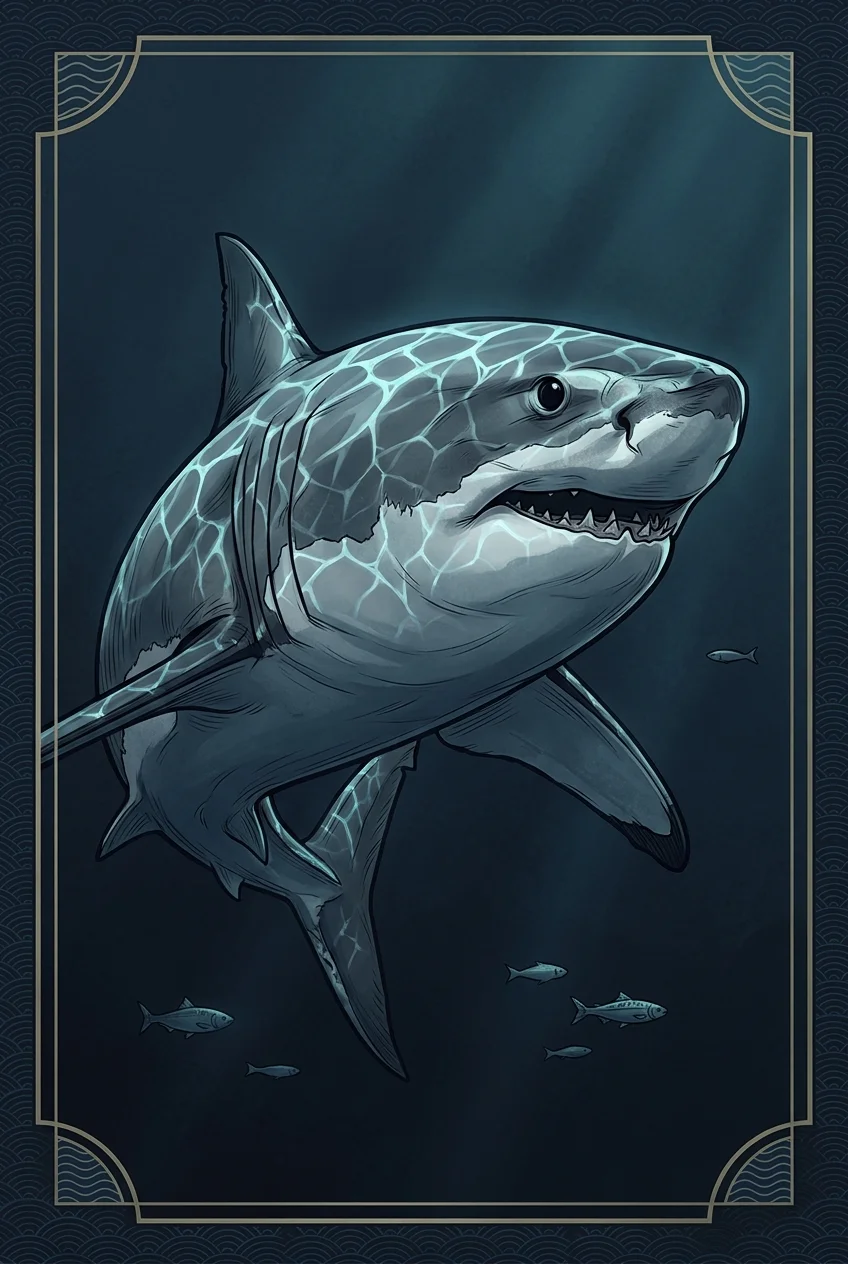
Shark
water"You were built for the current, not the shore."
Shark cannot stop moving — not because it's relentless but because movement is how it breathes. This is the animal of momentum, of life that requires forward motion to remain alive. Shark energy is not cruelty; it's the pure efficiency of a creature so perfectly adapted that nothing has needed to change in 450 million years.
Symbolism: In Hawaiian mythology, Shark was the King of the Sea and an ancestral guardian (aumakua) — a feared and beloved protector of fishing families. In Aboriginal Australian tradition, certain sharks were totem animals representing ancestral power and navigational knowledge. The Great White was not named as a villain until Jaws (1975) — before that, sharks were respected as ocean sovereigns. The shark's skeleton is cartilage, not bone — flexible, not rigid, another spiritual dimension of this animal.
Shadow: Inability to rest. Keeps moving into situations that don't require the apex predator it is — the hammer that sees every problem as a nail.
When it appears: Arrives when you've been too stationary, too comfortable in shallow water — or when forward momentum is the only thing that will work.
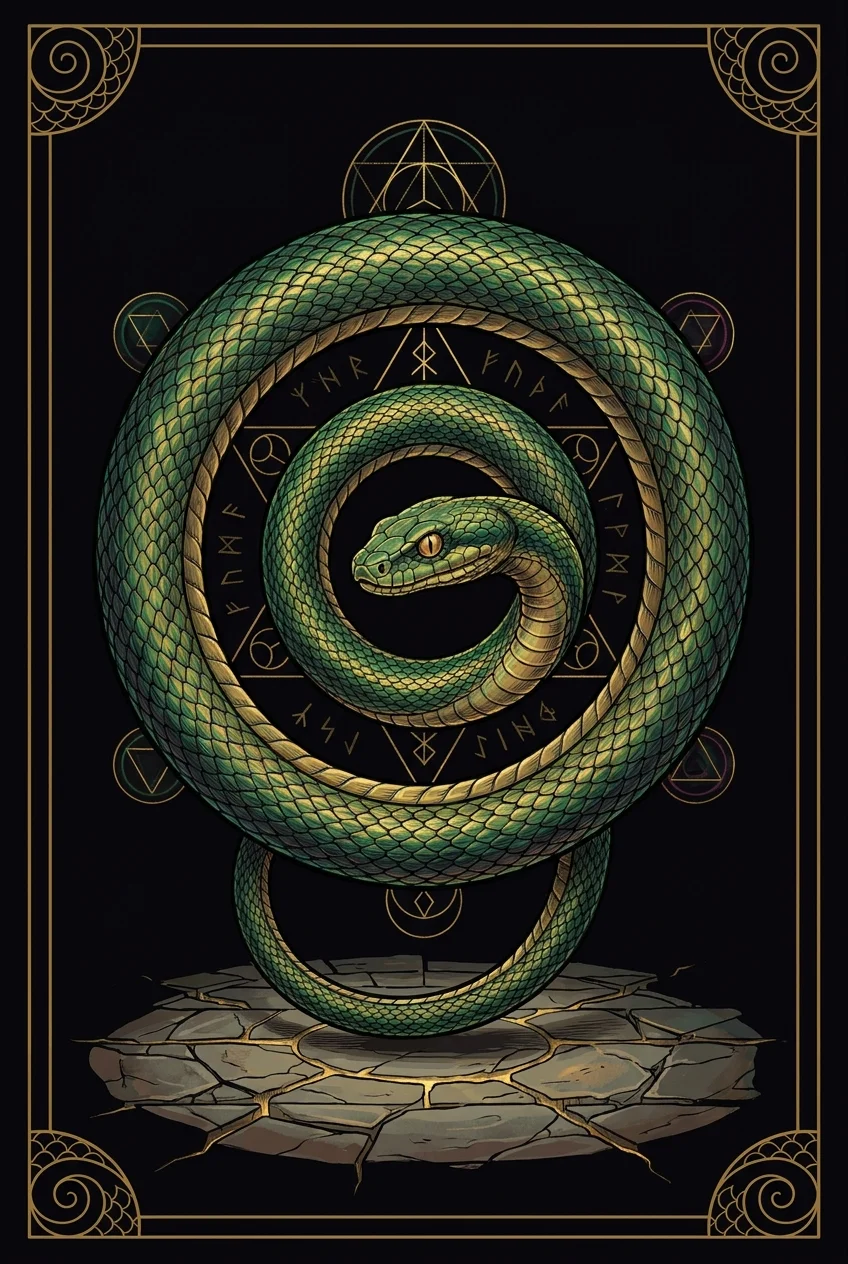
Snake
earth/shadow"You shed what others cling to."
Snake is transformation's most biological metaphor — the animal that literally sheds its skin and emerges new, that moves without limbs through every element, that produces venom that is also medicine in different doses. Snake energy is about the knowledge that feels dangerous: the truth underneath the truth, the system underneath the story. Snake people often carry knowledge that makes others uncomfortable.
Symbolism: The snake is perhaps the most symbolically overloaded creature in human mythology. In Judeo-Christian tradition, the serpent in the Garden carries knowledge that was not supposed to be distributed. In Greco-Roman tradition, Asclepius's snake-entwined staff (the caduceus and the Rod of Asclepius) represents the healing arts — venom as medicine, death as transformation. In Hindu tradition, Kundalini shakti is a serpent coiled at the base of the spine, the sleeping potential of the life force. In Aboriginal Australian tradition, the Rainbow Serpent is a creator deity who shaped the landscape and gave water. In Aztec cosmology, Quetzalcoatl (the feathered serpent) was the god of wind, learning, and civilization.
Shadow: The wound that poisons indiscriminately. When Snake feels threatened, the venom isn't discerning — everyone in range gets dosed.
When it appears: Arrives at initiations and threshold moments — any time you're being called to shed a previous identity that has become a cage.
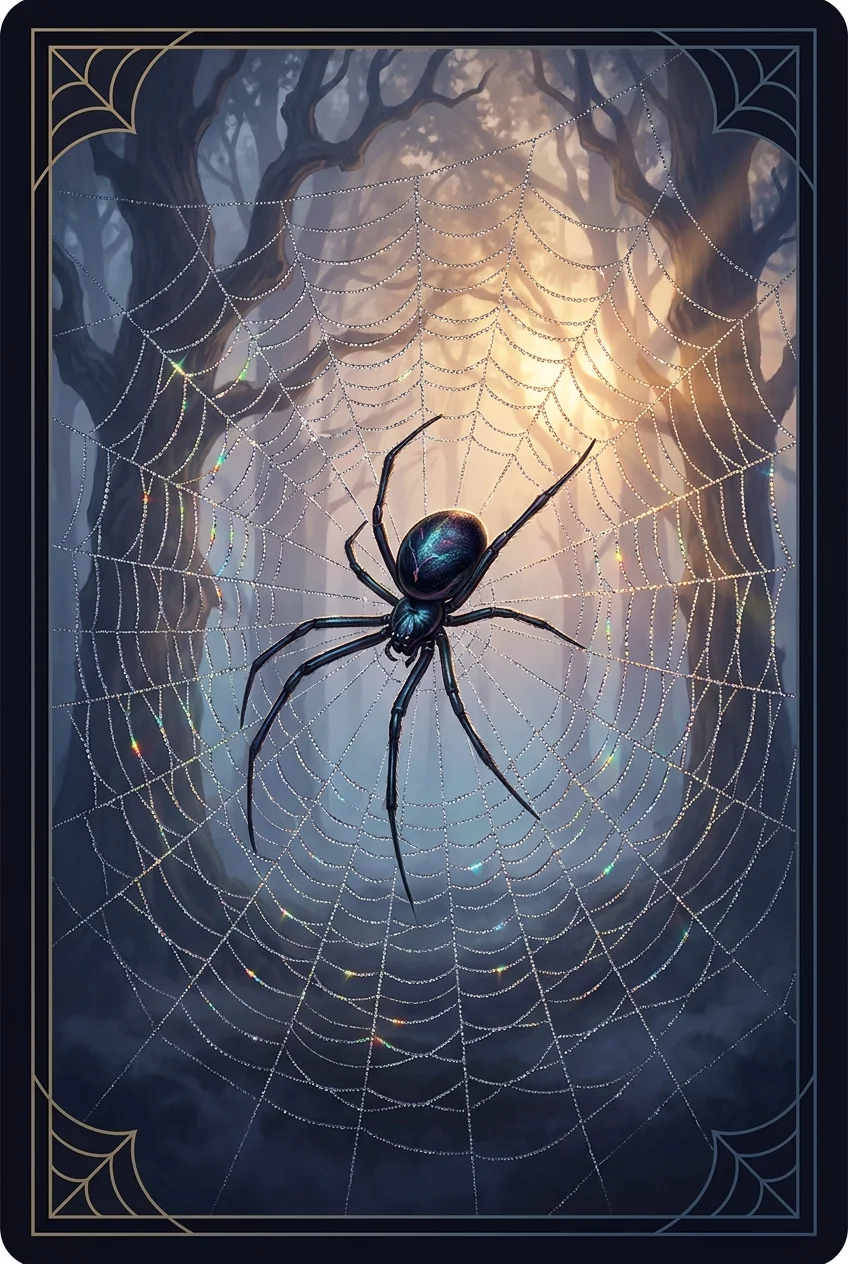
Spider
shadow (earth-anchored)"You weave the world you want to live in."
Spider doesn't find its web — it creates it, strand by patient strand, from its own body. Then it waits at the center of its creation, feeling every vibration of every thread. Spider people are the architects of their own reality, often quietly, often in the margins, building structures of extraordinary elegance that others walk into without understanding who built them.
Symbolism: In West African Akan tradition, Anansi the spider is the keeper of all stories — he acquired them from the sky god Nyame and distributed them to humanity. Stories are Spider's web. In Pueblo creation mythology, Grandmother Spider — Spider Woman — created the world by singing it and weaving it simultaneously. In Norse mythology, the Norns weave fate at the base of Yggdrasil. In Hindu tradition, the world itself is sometimes described as Indra's Net — an infinite web in which each junction is a jewel that reflects every other jewel.
Shadow: The web as trap for the weaver. Can become so enmeshed in its own constructions that escape — from a relationship, a pattern, a worldview — becomes impossible.
When it appears: Arrives when you're being called to create something structural — a life, a system, a relationship — that will outlast the effort of making it.
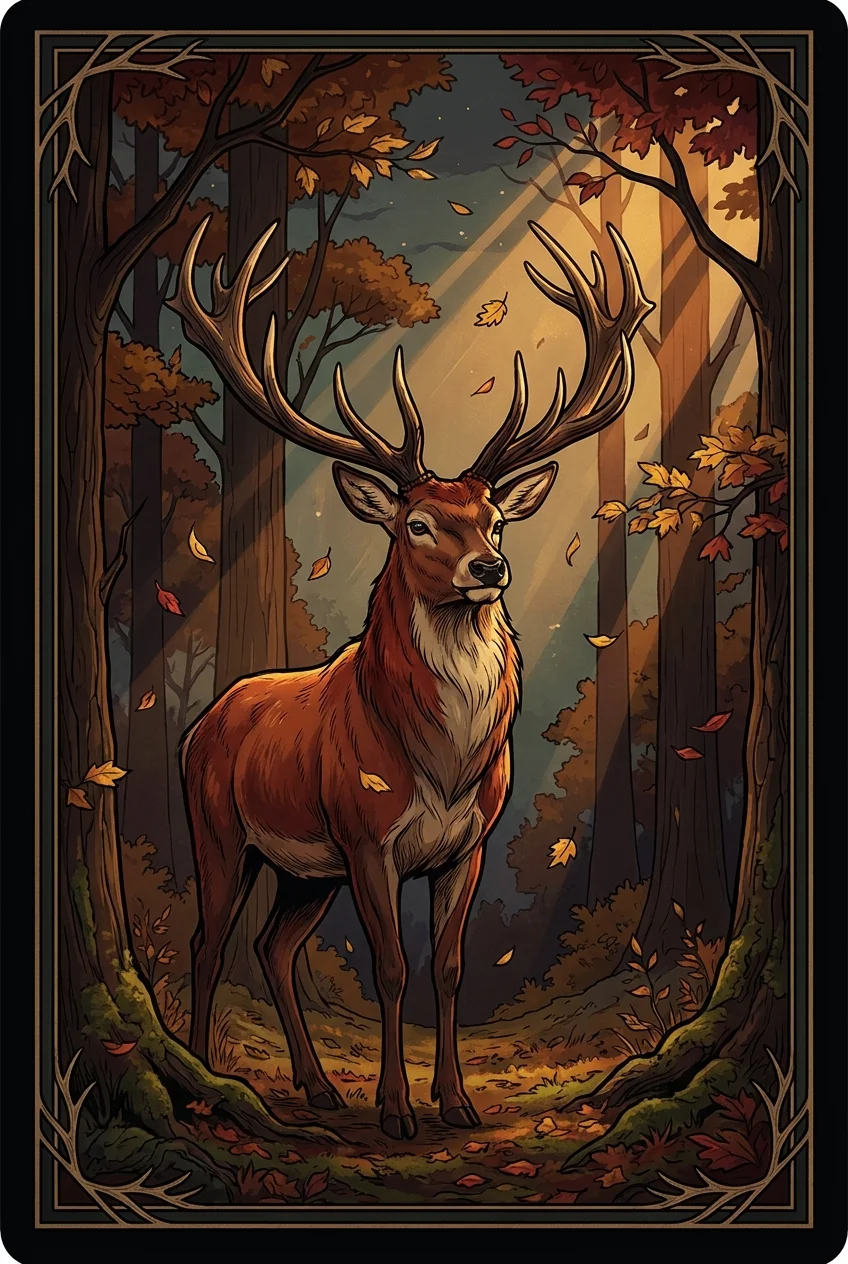
Stag
earth"You walk into the clearing and everything quiets."
Stag is the king of the forest in its most ceremonial form — antlered crown grown annually, shed and regrown, carrying the year's growth in calcified bone on its head. Stag doesn't fight until it must, and when it does, the rack of antlers is the most alarming weapon in the wood. This is masculine sovereignty in its deepest, most renewable form: authority that is earned, displayed with full presence, and capable of defense.
Symbolism: In Celtic mythology, the stag was the lord of the forest and the companion of Cernunnos, the antlered god who ruled the in-between — between civilization and wild, life and death, summer and winter. The white stag in Arthurian legend was an animal that couldn't be caught but whose pursuit led knights into transformative adventures. In Shinto, deer are messengers of the gods and guardians of sacred sites — the deer of Nara are considered divine protectors. In Norse tradition, four stags grazed in Yggdrasil's branches, representing the four winds.
Shadow: The rut. When Stag's competitive instinct becomes unmoored from purpose, it battles everything — the challenge as reflex rather than necessity.
When it appears: Arrives when you're being called into a more ceremonial relationship with your own authority — or when you need to display rather than minimize the crown you've grown.
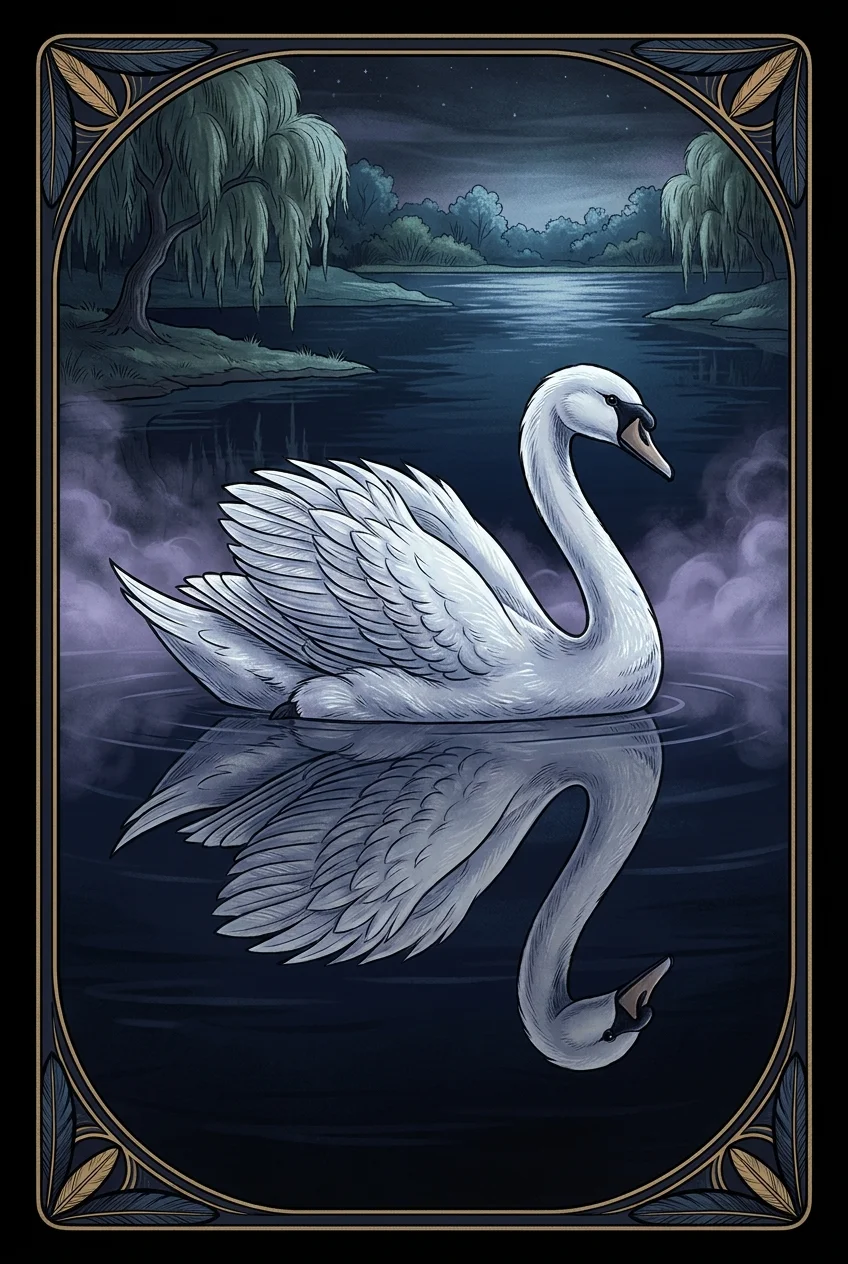
Swan
water"You became this through something no one saw."
Swan is transformation made permanent — the creature that undergoes its change completely and then carries the proof of it for the rest of its life. What most people see is grace; what they don't see is the decades of ungainly becoming that preceded it. Swan people have usually survived something that was supposed to break them, and they know exactly how much they cost.
Symbolism: In Celtic mythology, swans were shapeshifters — humans transformed by magic, carrying the double nature of divine and animal. The Children of Lir, transformed into swans for 900 years, are one of the Three Sorrows of Irish mythology. In Hindu tradition, the hamsa (swan) is associated with Brahma and Saraswati, the god and goddess of creation and knowledge — the swan's ability to separate milk from water symbolized discernment. In Norse mythology, Valkyries could take swan form.
Shadow: Swan wounding — the grace turns brittle when tested, because it was built on survival rather than stability. Beauty as armor.
When it appears: Arrives in the aftermath of a long becoming — when you're ready to claim who you've been turning into, or when you need to recognize your own transformation.
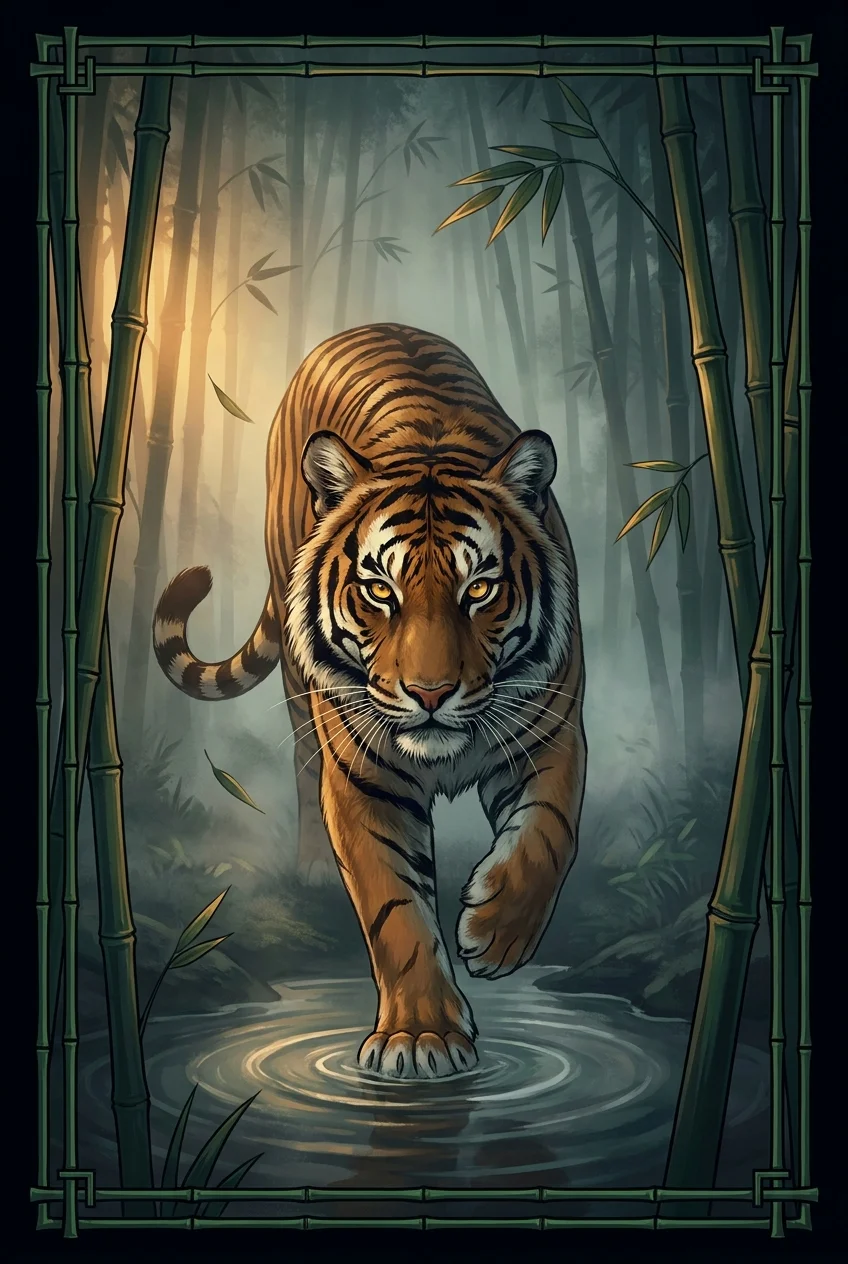
Tiger
fire (shadow-lit)"You do not stalk. You simply become inevitable."
Where Lion is solar, Tiger is lunar — a striped darkness moving through gold light, supremely alone and at peace with it. Tiger is the animal that didn't need a pack to become apex. This is solitary mastery: self-taught, self-contained, terrifyingly focused when something finally catches its attention.
Symbolism: In Hindu cosmology, Durga rides a tiger — power as vehicle, not enemy. In Chinese astrology and Five Elements theory, Tiger rules the wood element and spring, embodying sudden force and new beginnings. Siberian shamanic traditions held the Tiger as a spirit of the forest that mediated between human settlements and the wild unknown. Where Lion is civic power, Tiger is the edge of the map — where civilization runs out and something older begins.
Shadow: Can become utterly inaccessible — a beauty that nothing can reach. Intimacy-avoidance dressed as self-sufficiency.
When it appears: Arrives in periods of radical solitude, when you've been thrown back on your own resources — or when you need to stop softening your edges to be liked.
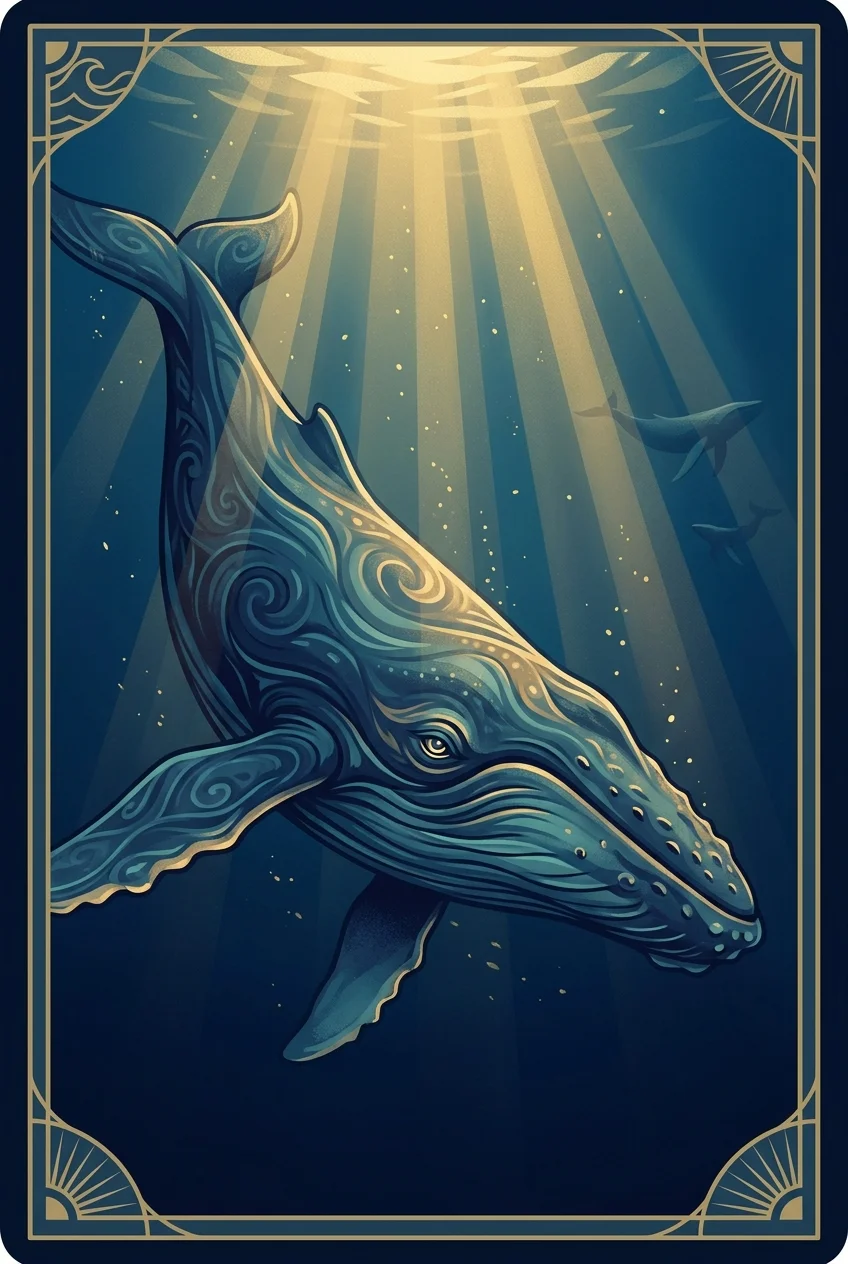
Whale
water"You carry songs that predate language."
Whale is the oldest voice in the living world — a creature that communicates across hundreds of miles through a medium we cannot enter, carrying songs that change and evolve like culture itself. This is depth made animal: a consciousness that lives in the full dark and the breaking surface simultaneously, navigating by sound and memory and grief.
Symbolism: Whale is the creature of the world-ocean across nearly every maritime culture. In the Bible, the whale is the darkness inside which transformation occurs (Jonah). In Norse mythology, the sea itself was a whale's body. For Pacific Northwest Coast peoples, Orca (killer whale) is among the most sacred animals — a chief of the sea, leader of communities, mirror of human clan structure. Maori oral tradition holds that certain whales are ancestors. Whale's song is not simply sound but memory — a culture transmitted through vibration.
Shadow: Can become submerged to the point of isolation — depth that no one can reach, beauty that no one is equipped for. Loneliness at scale.
When it appears: Appears in profound life transitions — grief, initiation, identity dissolution. When you need to dive rather than stay on the surface.
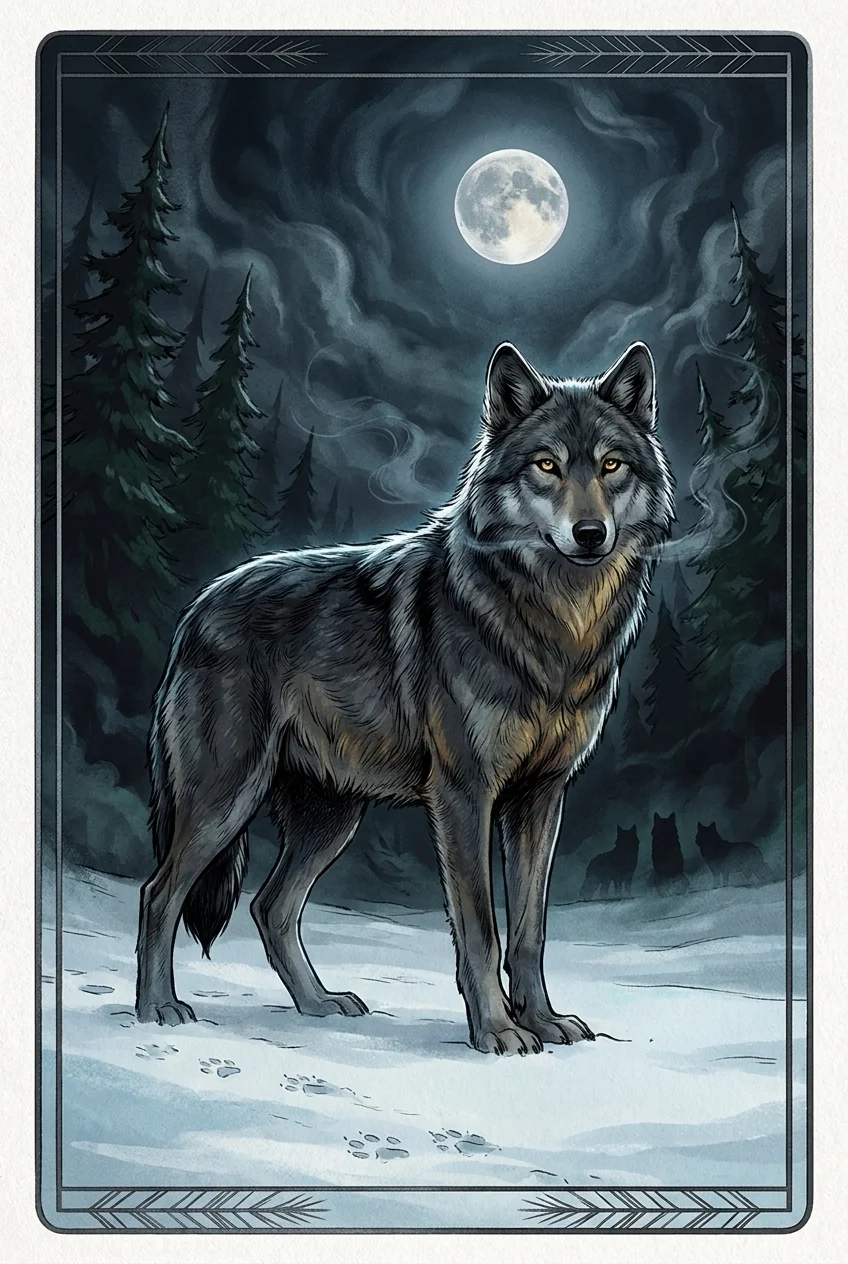
Wolf
earth"You were born knowing how to run in the dark."
The Wolf moves through the world with its nose before its eyes — reading the invisible map of scent, pressure, and belonging that most people never learn exists. This is an animal of deep loyalty and deeper loneliness, the kind that comes from loving a pack so completely that solitude feels like a wound. Being guided by Wolf means you know things before you can explain them, and you've learned to trust that knowing even when it costs you.
Symbolism: In Norse tradition, Odin kept two wolves — Geri and Freki — as companions, symbols of the insatiable hunger for knowledge and conquest. Indigenous Plains traditions honored Wolf as the original teacher, the one who modeled family loyalty and coordinated hunting to early human societies. In Celtic mythology, Wolf was associated with Cernunnos and the wildwood — the part of the self that civilization couldn't tame. Across cultures, Wolf sits at the threshold of domesticity and wilderness, civilized and feral, us and other.
Shadow: Turns feral when the pack dissolves. Without belonging, Wolf can become territorial to the point of destruction — howling at nothing, guarding nothing, threatening everything.
When it appears: Appears when your pack has splintered or when you're being asked to run alone for the first time. Also shows up when you've been too domesticated — when something in you has started to chew on its own leash.
How to Read Your Result Correctly
Your spirit animal isn't an aspiration. It's a recognition — the moment you read a description and felt something settle rather than something excite. The settling is the sign.
The shadow side is not a warning to avoid. It's the part of the animal that has already been active in your life, often for a long time, often without your awareness. The shadow isn't the problem. Unconscious shadow is the problem. Reading the shadow is half the work — naming what was already operating gives you the choice to work with it consciously.
If your result surprised you, read it anyway. The animals that feel unfamiliar are sometimes the ones that have been operating beneath the floor of your self-concept — the energy you have, the pattern you live, the thing you've been embarrassed to claim.
If your result felt obvious, read it more carefully. What you know about yourself is the beginning, not the completion. The descriptions here are calibrated to surface specific shadow patterns and specific conditions of appearance — not just generic vibes.
Frequently Asked Questions
What's the difference between a spirit animal, totem, and power animal?+
Spirit animal generally refers to a single animal guide identified through resonance — a quiz, a recurring dream, an animal that keeps showing up in your life. Totem is more specifically lineage-based: an animal inherited through family, clan, or culture. Power animal is the term used in shamanic practice — an animal you've been gifted (or earned) as ally, especially in journey work, often acquired through deliberate ceremony. In modern usage the terms blur, and any of them works for what this directory describes.
Can someone have multiple spirit animals?+
Yes. Most people have a primary animal and one or two secondary animals. The primary tends to carry you through a life phase — sometimes a decade or more. Secondary animals shift more fluidly with what you're moving through. Some traditions also recognize lifetime totem animals (an animal that stays from birth to death) plus situational guides (different animals for different chapters).
How do I know if I've identified the right animal?+
Three signs. (1) Visceral recognition — your nervous system responds to the description before your mind does. Something settles. (2) The shadow side lands too — if both the gifts and the shadow expression feel accurate, you've been seen completely. (3) Recurrence in your life: the animal has been showing up in dreams, synchronicities, or art that won't leave you alone. The recurrence is the signature of an active guide.
Is it cultural appropriation to use the term 'spirit animal'?+
It's a real concern. The exact phrase comes from Indigenous American traditions where it has specific spiritual and ceremonial meaning, and using it casually (especially with cultural attachments — feathers, headdresses, ceremonies) can be appropriative. The underlying concept of animal archetypes, however, appears across nearly every continent's wisdom traditions — Norse, Celtic, West African, Hindu, Egyptian, Pacific Islander, East Asian. This guide draws from that broader cross-cultural body of knowledge and treats animals as psychological archetypes rather than appropriated sacred objects.
Can my spirit animal change over time?+
Yes, often dramatically. The Deer who became a Bear after motherhood, the Wolf who softened into a Dolphin after burnout, the Owl who transformed into a Phoenix after deep loss — these arcs are common. Your dominant animal usually carries you through a phase, then a different animal arrives for the next one. The progression itself often tells the real story of your life.
What animals appear at major life transitions?+
Owl appears at endings — death, divorce, major dissolution. Phoenix appears at the absolute nadir, when you've been reduced to ash. Snake appears when you're shedding an old identity. Whale appears in initiation periods involving deep grief. Bear appears when you need to go inward. Each animal has specific conditions under which its medicine activates.
Why does this directory use 37 animals?+
Because flattening dozens of distinct energies into 12 cartoon options ('what's your spirit animal: Wolf or Dolphin?') misses the precision the framework was designed for. Wolf and Coyote aren't the same animal. Tiger and Lion aren't interchangeable. The 37-animal directory covers the full elemental spectrum (earth, water, sky, fire, shadow), the full behavioral range (predator, prey, social, solitary, mythological), and includes both common animals (Wolf, Bear, Owl) and rarer ones (Phoenix, Octopus, Whale) so the result actually means something.
Want to know yours?
Take the 28-question Lore Spirit Animal Quiz. AI-personalized reading at the end. ~6 minutes.
Take the Quiz →What's Your Spirit Animal? →
Same quiz, second-person framing. Plus when each animal calls you.
What's My Spirit Animal? →
First-person framing. How to read your result correctly — element, shadow, when-it-appears.