Which Goddess Am I?
Not a personality quiz. A real reading drawn from Bolen's 7 Greek goddesses (Aphrodite, Artemis, Athena, Demeter, Hera, Hestia, Persephone) and 5 extended dark feminine archetypes (Hecate, Lilith, Kali, Sophia, Brigid).
22 questions. A primary archetype and a shadow archetype. A personalized reading at the end, written based on what you actually answered.
No signup. No email. No spam. Just the reading.
What Is a Goddess Archetype?
A goddess archetype is a recurring pattern in the feminine psyche that's been documented across mythology, depth psychology, and cross-cultural ritual practice for thousands of years. Jungian analyst Jean Shinoda Bolen formalized the modern framework in Goddesses in Everywoman (1984), using the Olympian goddesses as archetypal templates for the major patterns women embody and move through.
Bolen identified 7 primary patterns from Greek mythology, splitting them into three groups: the Virgin Goddesses (Artemis, Athena, Hestia) — self-contained, focused, oriented inward; the Vulnerable Goddesses (Hera, Demeter, Persephone) — defined by relationship and transformation through it; and the Alchemical Goddess (Aphrodite) — the transformer in a category of her own.
The 5 extended archetypes (Hecate, Lilith, Kali, Sophia, Brigid) cover territory Bolen's frame doesn't fully address — the shadow feminine, sexual sovereignty, righteous destruction, gnostic knowing, and the creative-destructive fire. They draw on Esther Harding's work on lunar femininity, modern feminist spirituality, and cross-cultural goddess mythology.
The 12 Goddesses by Bolen's Categories
Four groupings that map the full feminine psychological landscape.
Self-contained, inward-focused, not defined by relationship.
- ·Artemis (huntress, sisterhood)
- ·Athena (strategy, wisdom)
- ·Hestia (hearth, sanctuary)
Defined by relationship, transformed through it.
- ·Hera (queen, partnership)
- ·Demeter (mother, nurturance)
- ·Persephone (duality, underworld journey)
Transforms herself and everyone she touches.
- ·Aphrodite (love, sensuality, alchemy)
Shadow, sovereignty, righteous fire, hidden wisdom.
- ·Hecate (crossroads, witchcraft)
- ·Lilith (defiance, sexual sovereignty)
- ·Kali (destroyer-creator)
- ·Sophia (gnostic wisdom)
- ·Brigid (fire, healing, threshold)
Every Goddess Explained
Tagline, description, mythology, shadow, and modern signs for each.
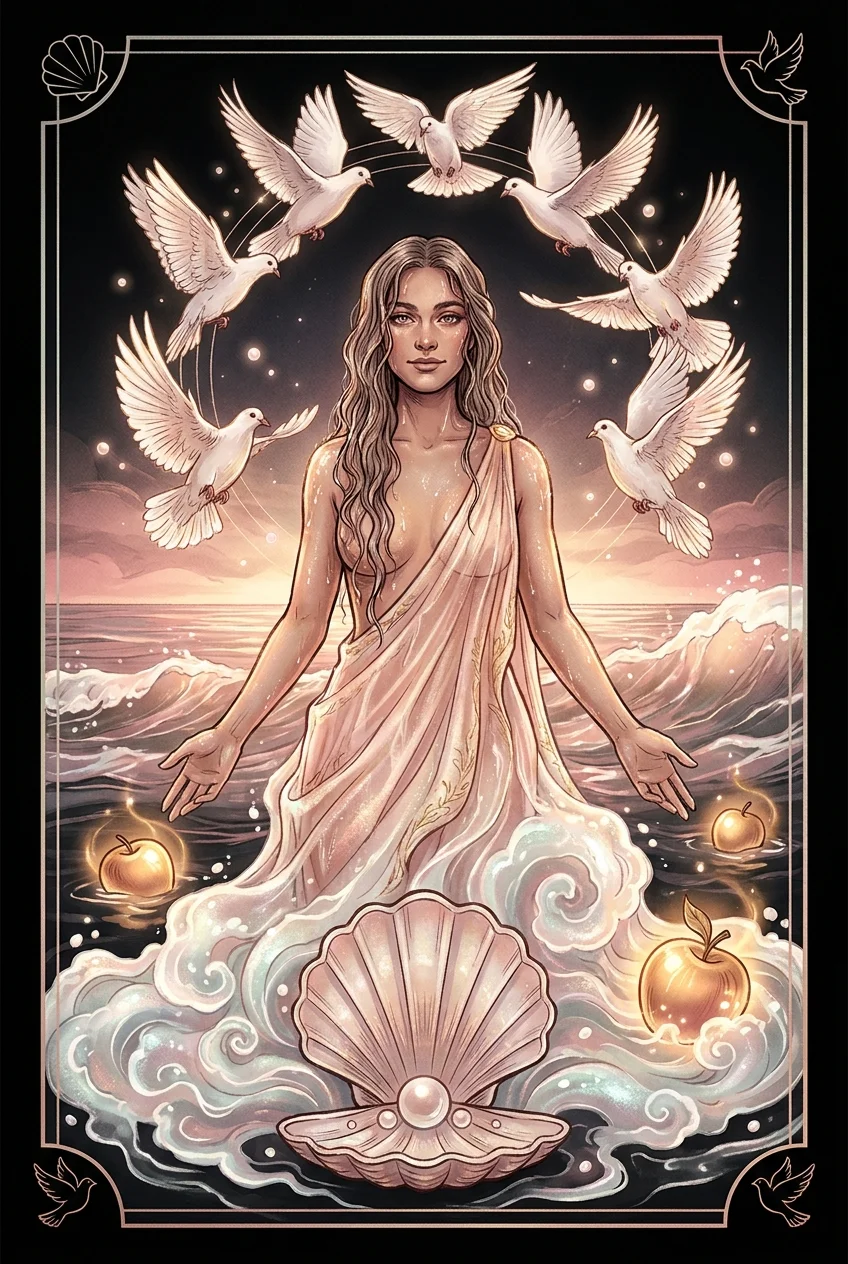
The Aphrodite
"She doesn't chase beauty — she is the current that pulls everything toward her."
Aphrodite is the force of creative magnetism made flesh — the alchemical spark that transmutes every encounter into something irreversible. In Bolen's framework, she sits apart from the other goddesses as neither purely "virgin" (self-contained) nor "vulnerable" (defined by relationship) — she is alchemical, transforming herself and everyone she touches. Psychologically, the Aphrodite woman moves through life generating intensity: in work, in love, in the room she walks into. In 2026, she is the woman whose creative output feels charged, who falls deep and surfaces different, who confuses people by being both fully present and somehow always in motion.
Aphrodite's affair with Ares, the god of war, reveals her deepest pattern: she is drawn to heat, to force, to whatever threatens to consume her — and the union of love and war produces Harmonia, wholeness born from opposites. She doesn't choose safe. She chooses electric.
When Aphrodite is unintegrated, she becomes an addict to intensity — chasing new encounters because the old ones have cooled, confusing desire with direction. She can lose herself in other people's energy fields, surface from each entanglement less whole than before, and mistake drama for depth.
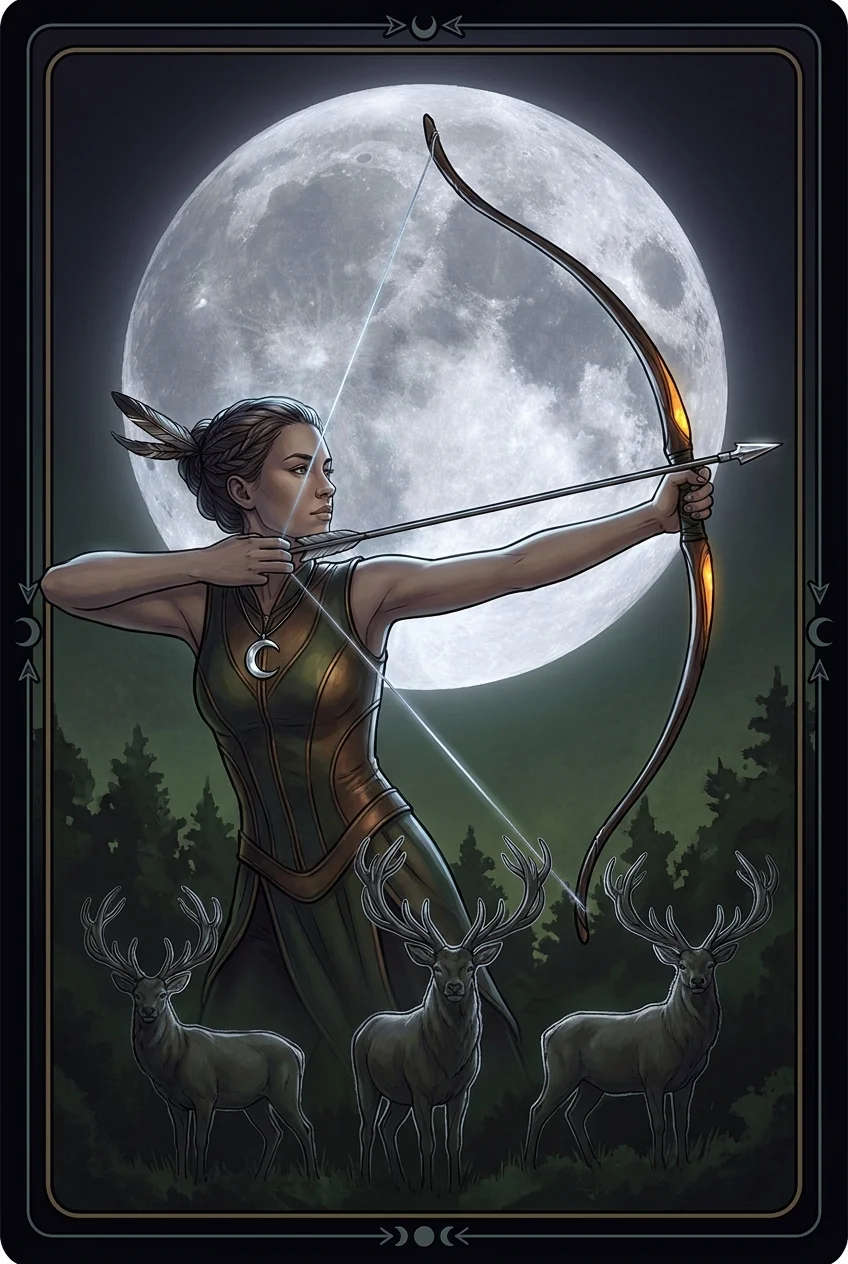
The Artemis
"She left the city a long time ago. She's not coming back."
Artemis is the goddess of the untamed threshold — the wilderness, the hunt, the body that answers to no one. Bolen identifies her as a "virgin goddess" not in the literal sense but in the original: she is psychologically intact, self-contained, not completed by any man. The Artemis woman is ferociously goal-directed, most alive in pursuit, and fiercely protective of her autonomy. In 2026, she is the woman who solo-travels to places that scare her, who built her life on her own terms before anyone offered help, who has a small fierce sisterhood and zero patience for people who waste her time.
Actaeon accidentally glimpsed Artemis bathing in the forest — and she turned him into a stag, torn apart by his own hounds. The myth says: her interior world is not for the uninvited. The cost of violating her sovereignty is absolute. She does not warn. She transforms.
When Artemis refuses to integrate her vulnerability, she becomes cold in her certainty — righteous, isolated, unable to receive help or love without interpreting it as a trap. She hunts down those who offend her with disproportionate force. She can mistake emotional unavailability for independence.
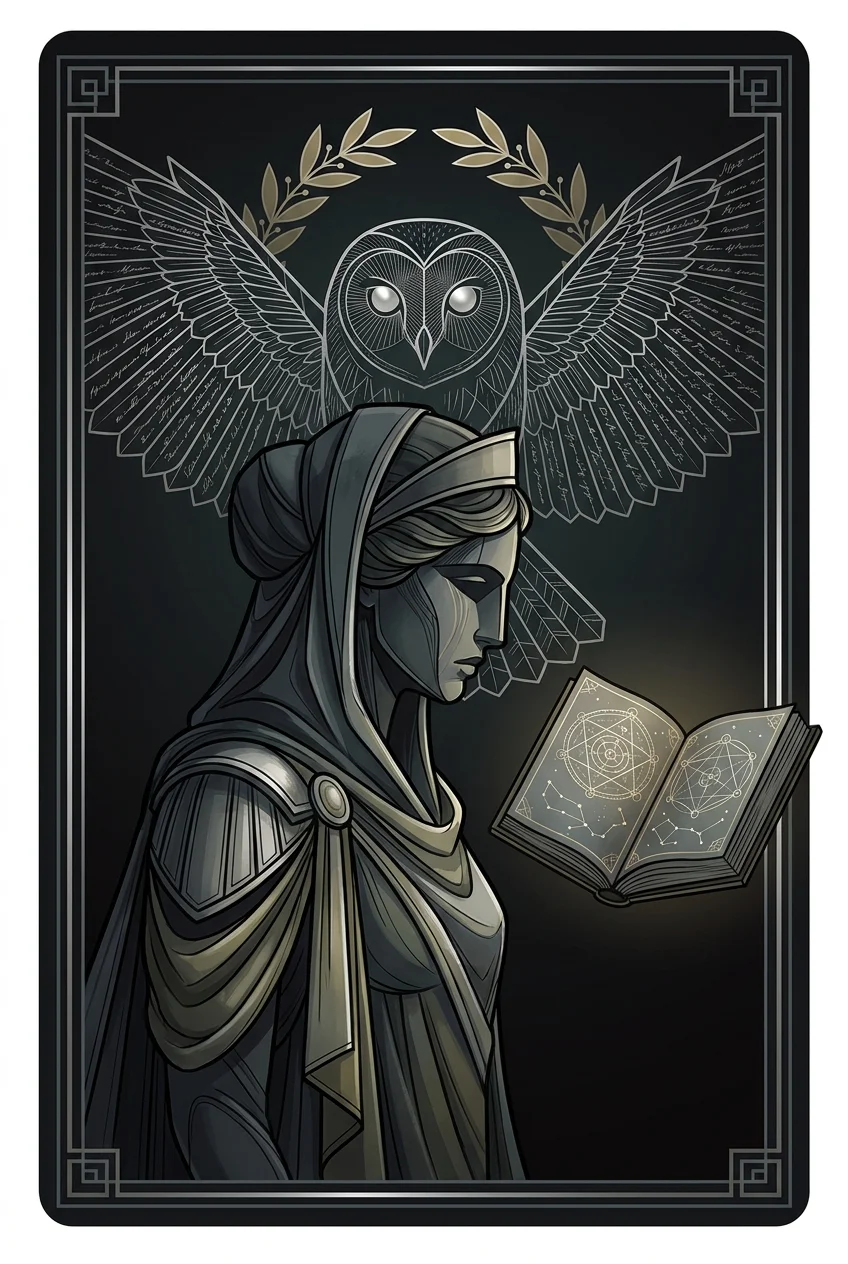
The Athena
"She already mapped three exits before she walked in the door."
Athena is the goddess of strategy, civilization, and practical intelligence — she emerged fully armed from her father's head, born already knowing the rules of the game. In Bolen's psychology, she is the "father's daughter," aligned with logos and institutional power, instinctively fluent in systems that were built by and for men. The Athena woman is the one who out-thinks the room, earns her seat at tables others were not invited to, and advises the most powerful people in her world. In 2026, she is the woman who builds companies, writes the policy, sits in the Senate — who sometimes feels more at home with spreadsheets than with her own body.
Athena sprung from Zeus's forehead, fully formed in battle armor — bypassing the mother entirely. This myth encodes her deepest wound: the disavowal of the feminine lineage, the need to be born of and for the father, the suspicion that softness is weakness. She is always, at some level, proving she deserved the armor.
When Athena is unintegrated, she suppresses everything that can't be argued or optimized — emotion, instinct, the body, other women. She can become a mirror for male power rather than a force in her own right, defending systems that diminish her because she's mastered them. Her intellect becomes armor against feeling.
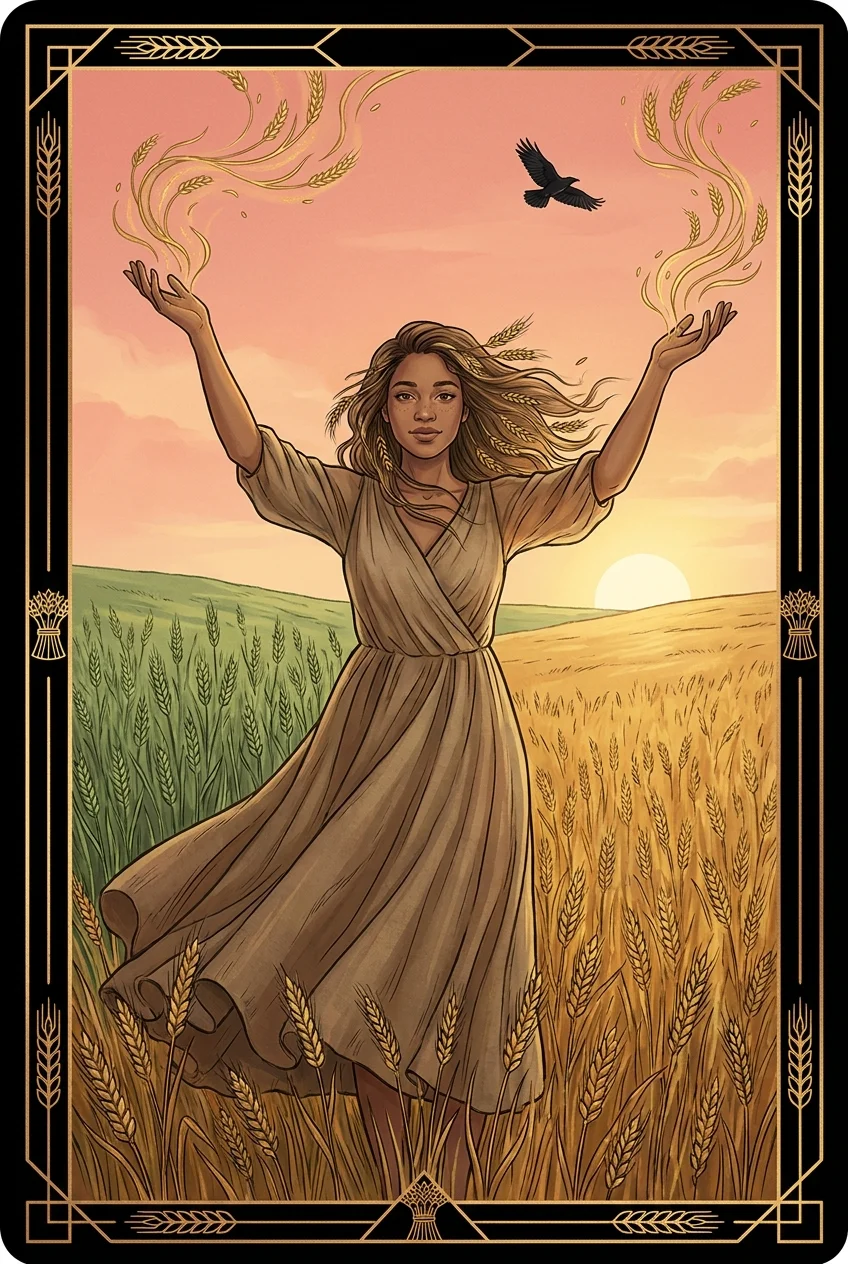
The Demeter
"She gave until the earth stopped growing. Then she gave more."
Demeter is the mother of mothers — the goddess whose love literally feeds the world, and whose grief literally ends it. In Bolen's framework, she is the "vulnerable goddess" most defined by what she gives; her identity organized around nurturing, sustaining, and bringing things to fruition. The Demeter woman is the one everyone calls first, who brings food to the funeral, who creates warmth in every room she enters — and who is last to notice when she is running on empty. In 2026, she is the friend who handles everyone's emotional emergencies, the one who makes being cared for feel safe — and who has a grief she's been carrying too long.
When Persephone was taken to the underworld, Demeter refused to let anything grow — plunging the world into winter — until her daughter was returned. The myth reveals that even divine nurturing has a price: the one who feeds the world can also starve it, when pushed past her limit of loss.
When Demeter is unintegrated, her love becomes ownership. She gives to control, stays to the point of martyrdom, and her grief calcifies into depression when those she loves individuate or leave. She can parent-ify every relationship, creating people who need her so she doesn't have to face the emptiness beneath the giving.
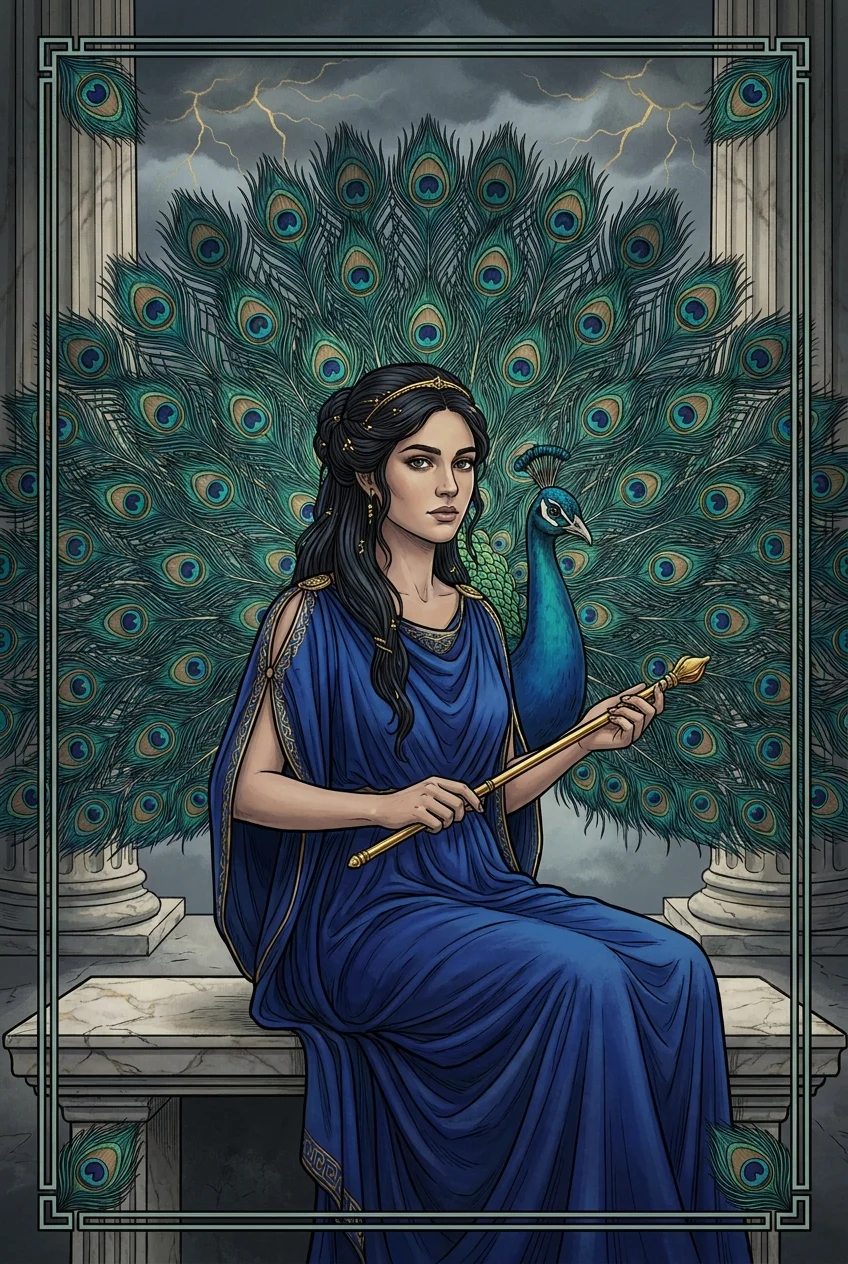
The Hera
"She wasn't made to be a queen. She is one. There's a difference."
Hera is the goddess of sacred partnership and institutional power — queen of Olympus not as Zeus's decoration but as his necessary other half, the one who holds the formal dignity he repeatedly dishonors. In Bolen's psychology, she is the "vulnerable goddess" most organized around the bond itself — marriage, alliance, the covenant that confers meaning. The Hera woman doesn't want a relationship; she wants a legacy. She builds through partnership, leads through loyalty, and her wound is the one that comes when the person she chose to build with chooses otherwise. In 2026, she is the woman who married an empire, who holds everything together — and whose jealousy, when it erupts, shocks everyone who forgot about the queen beneath the composure.
Zeus's infidelities were endless — and Hera's vengeance was legendary, always targeting the other women, the illegitimate children, the collateral. The myth doesn't make her a villain; it makes her a woman whose power was real, whose contract was broken, and whose fury had nowhere legitimate to go. She is the original wife who couldn't divorce.
Hera's shadow is consuming jealousy — not the small kind, but the mythic kind. When her bond is threatened or dishonored, she doesn't break; she hunts. She can become a woman whose entire energy is organized around punishing betrayal, who mistakes the covenant for the identity, who cannot conceive of herself outside the alliance she built.
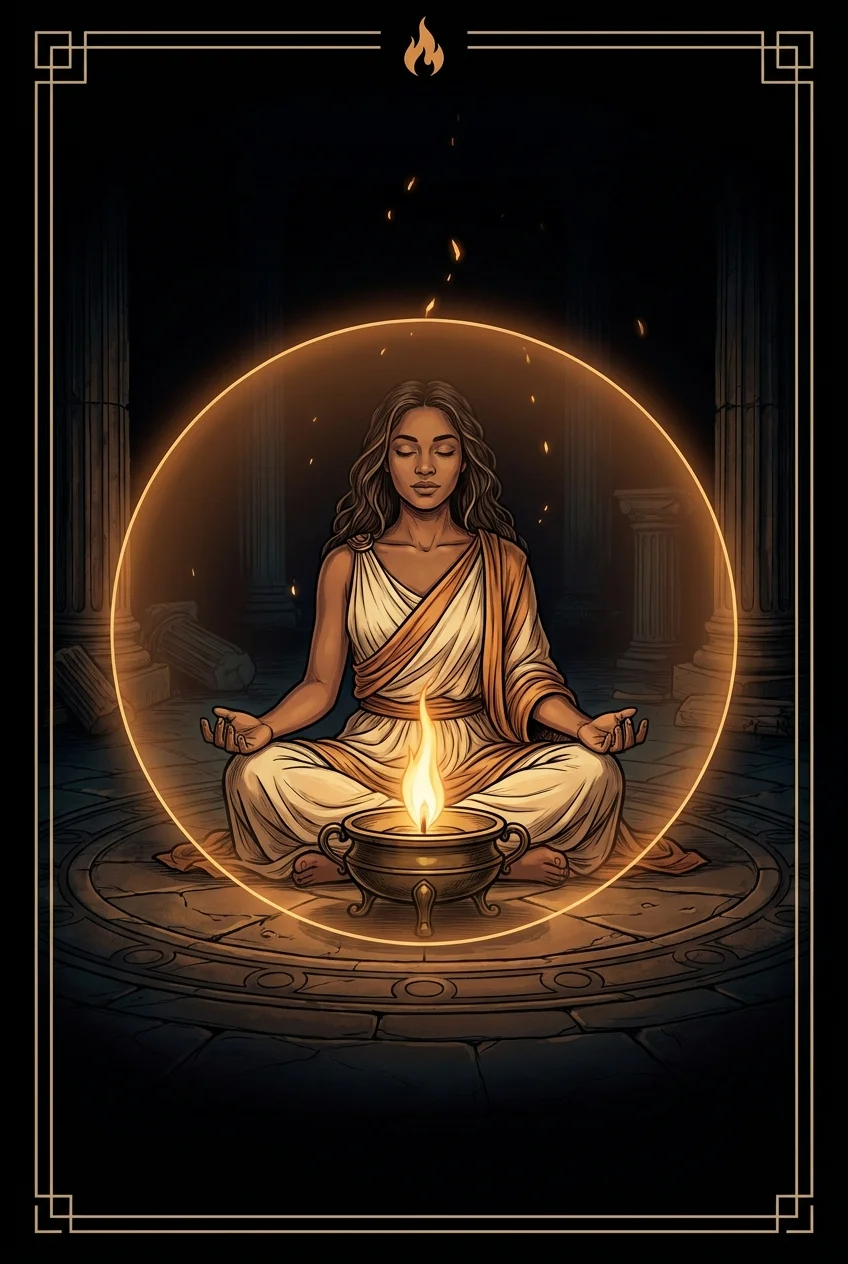
The Hestia
"She's not hiding. She's the still point everything else revolves around."
Hestia is the goddess of the sacred hearth — the least visible of the Olympians and the one without whom none of it holds together. She gave up her seat on Olympus to Dionysus without a fight, retreating to the center of every home, every temple, every human gathering as the flame that makes it home. In Bolen's framework, she is the third "virgin goddess" — the most inward, the most self-sufficient, the most psychologically complete in her own company. The Hestia woman is often misread as passive, when what she actually is — is centered. She does not scatter herself. In 2026, she is the woman who made her apartment into a sanctuary, who creates peace by being peaceful, who has a rich interior life that very few people have seen.
Hestia was the first to be swallowed by Kronos and the last to be disgorged — she has always been the first and the last, the alpha and omega of the household. She is the one who holds the center while everyone else performs their drama. The myth encodes her gift: she survives by being essential and unnoticed.
When Hestia is unintegrated, her interiority becomes disappearance — she fades from the world, becomes invisible to herself, tends everyone else's hearth while her own goes cold. She can mistake withdrawal for wisdom, loneliness for solitude, and fade from relationships without ever quite leaving them.
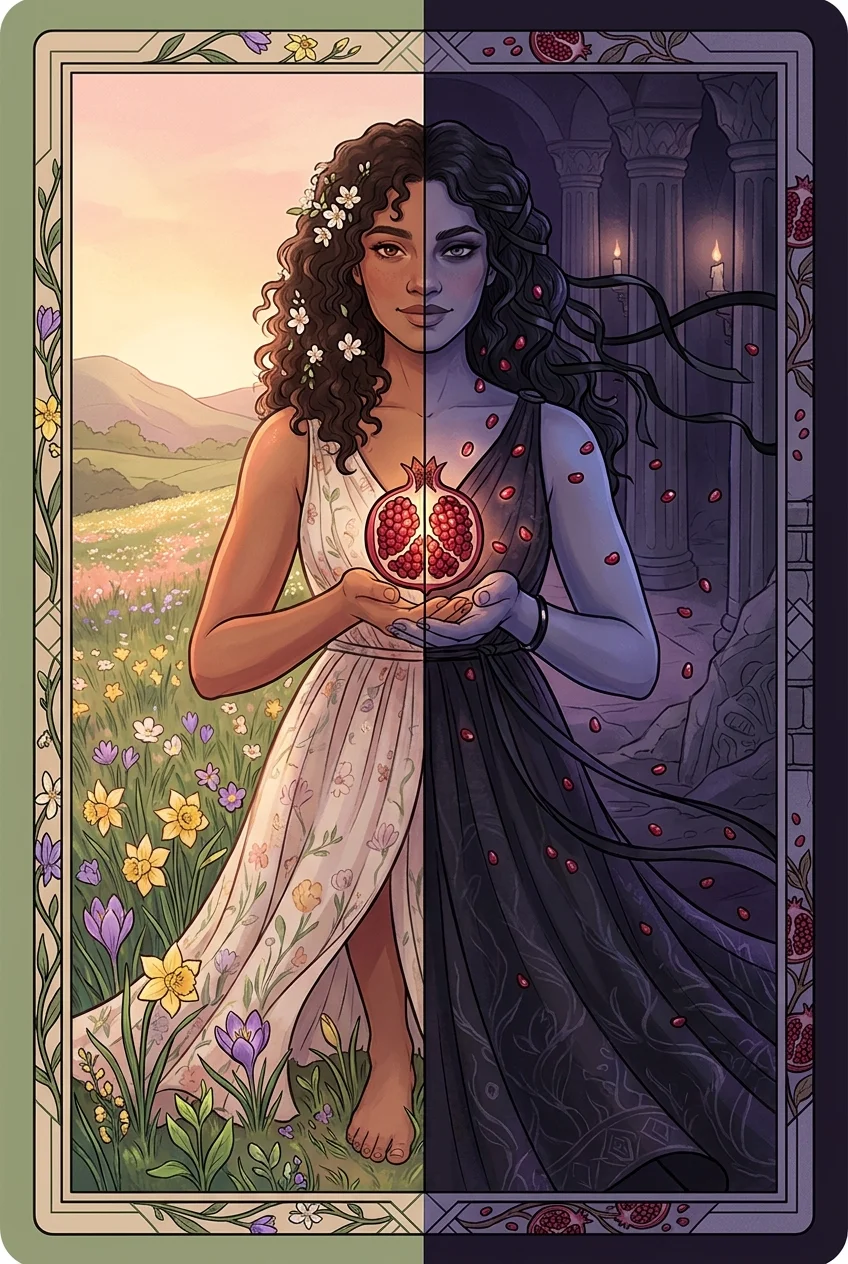
The Persephone
"She went to the underworld. She came back. She left part of herself there on purpose."
Persephone begins as the Kore — the innocent maiden gathering flowers who does not see what's coming — and becomes, through descent, the Queen of the Underworld who can move freely between worlds. Bolen's most psychologically complex archetype, Persephone encodes the journey from naive openness to earned sovereignty — from being taken to choosing to return. The Persephone woman often has a history of being pulled under (by grief, by depression, by a consuming relationship) and surfacing different, in ways she struggles to explain. In 2026, she is the woman whose sadness has always had a beauty to it, who is most alive in the liminal spaces, who can hold space for the dying and the desperate because she has been there herself.
The myth's crucial ambiguity: did Persephone eat the pomegranate seeds by mistake, or did she eat them knowing what it meant — that she would never fully return to the sunlit world? Later Orphic traditions suggest she chose. The whole arc turns on that question: was this done to you, or did some part of you recognize that you needed the underworld more than the meadow?
The unintegrated Persephone never quite leaves the underworld — she becomes passive, available to be taken again, loyal to men or systems that pull her down, confused about whether she's choosing her darkness or just repeating a descent. She can mistake her depth for damage, her multiplicity for instability.
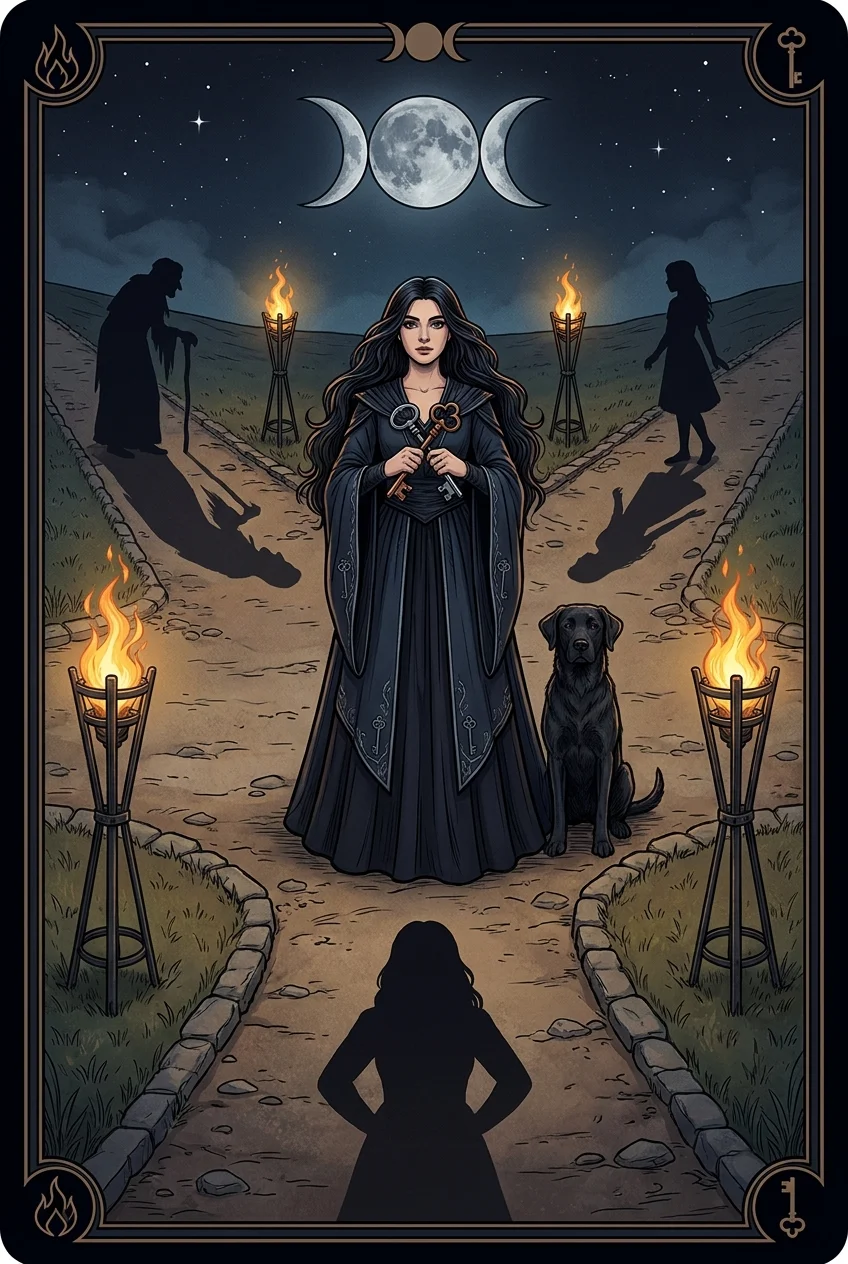
The Hecate
"She holds the torch at the crossroads. She doesn't tell you which road. She shows you what lives on both."
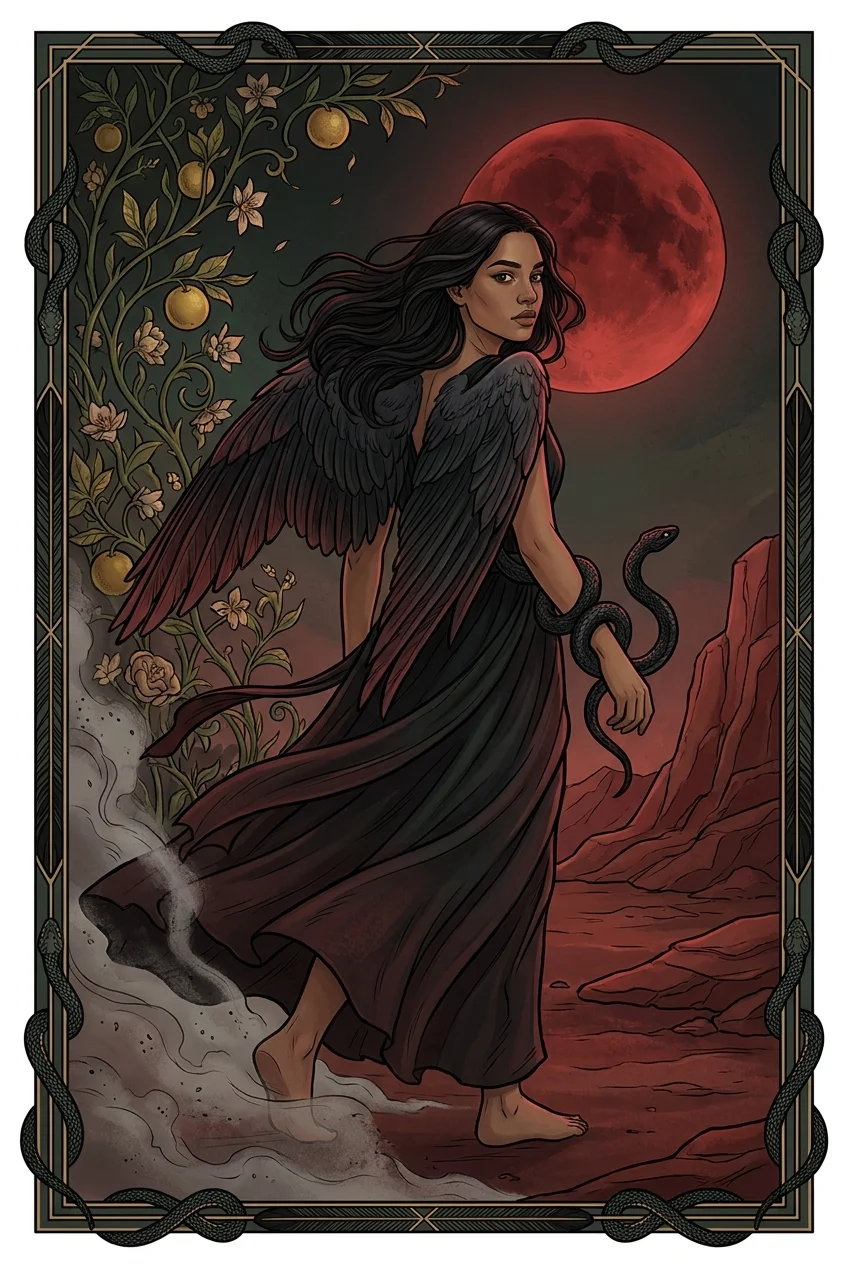
Hecate is the goddess of the in-between — the crossroads, the threshold between worlds, the keeper of what cannot be named in daylight. Pre-patriarchal sources describe her as a triple goddess of sky, earth, and sea; she was the one who came with torches when Persephone was taken, the only one who saw and knew and chose to act. Psychologically, the Hecate woman lives at the edge of things — she was the strange child, the one who knew things she shouldn't know, who is most herself in the dark, in the liminal hour before dawn. In 2026, she is the witch on TikTok who doesn't need the aesthetic because the knowledge is real.
When Persephone was abducted, all of Olympus mourned — but only Hecate came with torches to search. She was the only witness who held the knowledge and then used it. Her deepest pattern: she sees what others cannot bear to see, and she uses that sight in service, not in hiding.
When Hecate is unintegrated, she uses her seeing as a weapon — knowing becomes control, shadow work becomes a way to avoid joy, the liminal becomes a permanent residence. She can become the woman who is always in crisis or always managing someone else's, who mistakes darkness for depth, who cannot cross over into the light she's been guarding.
The Lilith
"She left paradise when they told her she had to kneel. She's never been sorry."
Lilith, Adam's first wife in the Kabbalistic tradition, refused to lie beneath him because she was made from the same earth, in the same moment, as his equal. She uttered the name of God — the ineffable — and exiled herself rather than submit. The Lilith archetype is the refusal made sovereign: the woman who knows her worth not because she was given it, but because she refused to wait for it to be recognized. Psychologically, she carries every part of the feminine that patriarchy called demonic: sexual agency, rage, independence that owes no explanation. In 2026, she is the woman who walked out of the marriage, the job, the religion — who called it sovereignty before anyone had that word for it.
She spoke the name of God and flew. The myth's power is not in what she rejected, but in what she required it to cost: she chose the wilderness over the contained life. She did not wait to be freed. She freed herself.
When Lilith is unintegrated, the refusal becomes her entire identity — she is against everything, defined only by what she won't become, unable to choose anything because every choice feels like submission. Her sexuality becomes weaponized, her rage becomes indiscriminate, her exile becomes isolation she calls freedom.
The Kali
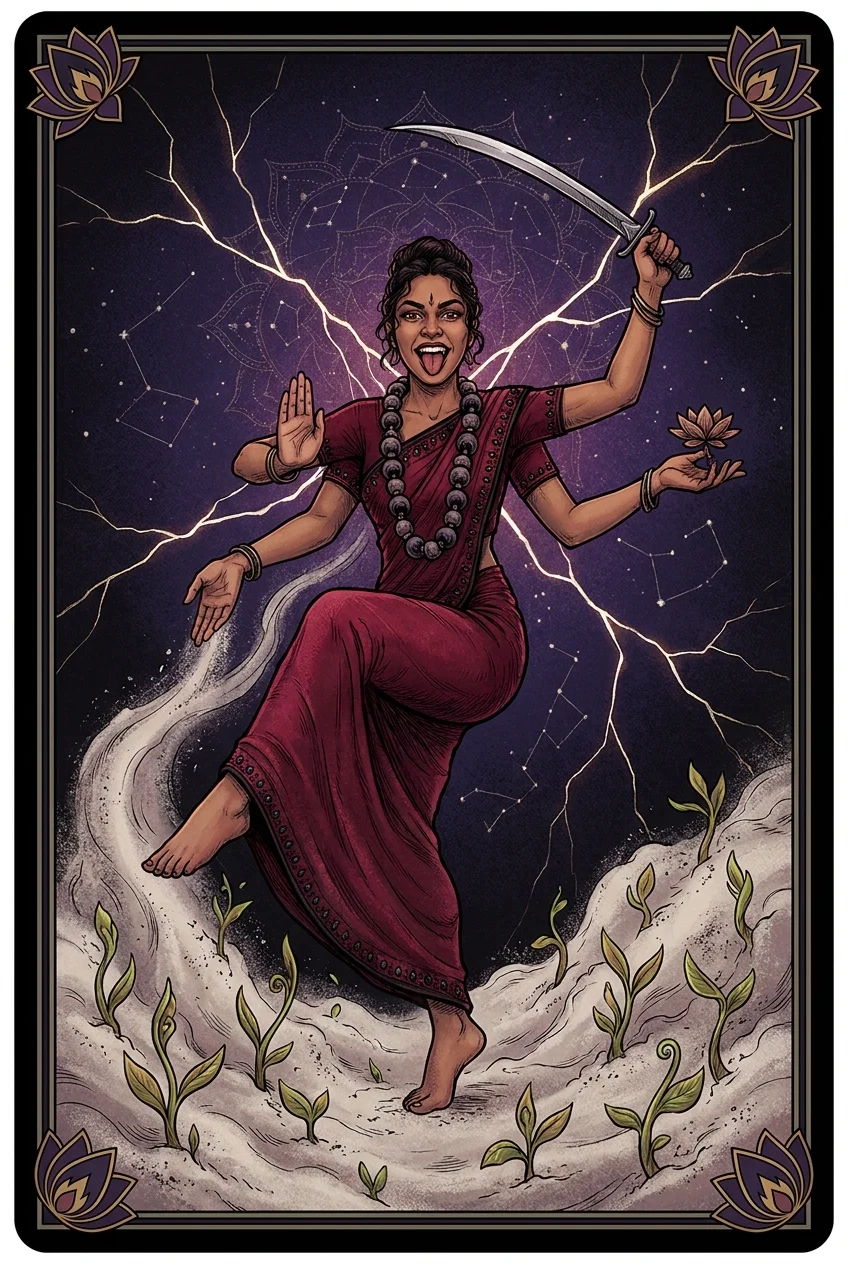
"She didn't set the world on fire. She burned what was already dead so something real could breathe."
Kali is the Hindu goddess of time, death, and liberation — depicted with a severed head in her hand and a garland of skulls, tongue extended, standing on the prostrate body of Shiva. She is terrifying and she is the mother. She is the destroyer and the one who makes destruction holy. Psychologically, the Kali woman has access to a quality of rage that is not reactive but true — she destroys what has stopped serving life, not what hurt her feelings. In 2026, she is the woman who burned her entire career down to build something she actually believed in, who ended a decade-long relationship with two sentences, who has a tattoo where the scar used to be.
Kali defeated the demon Raktabija whose every drop of blood generated a new demon — so she drank every drop before it could touch the earth. The myth encodes her gift: she can consume the thing that would replicate forever if left unchecked. She ends what others cannot even touch without making worse.
When Kali is unintegrated, the destroyer cannot stop — she tears down relationships, opportunities, and her own peace with the same indiscriminate hunger. She can become addicted to the feeling of burning things down, confusing destruction with transformation, leaving nothing to grow in the ash.
The Sophia
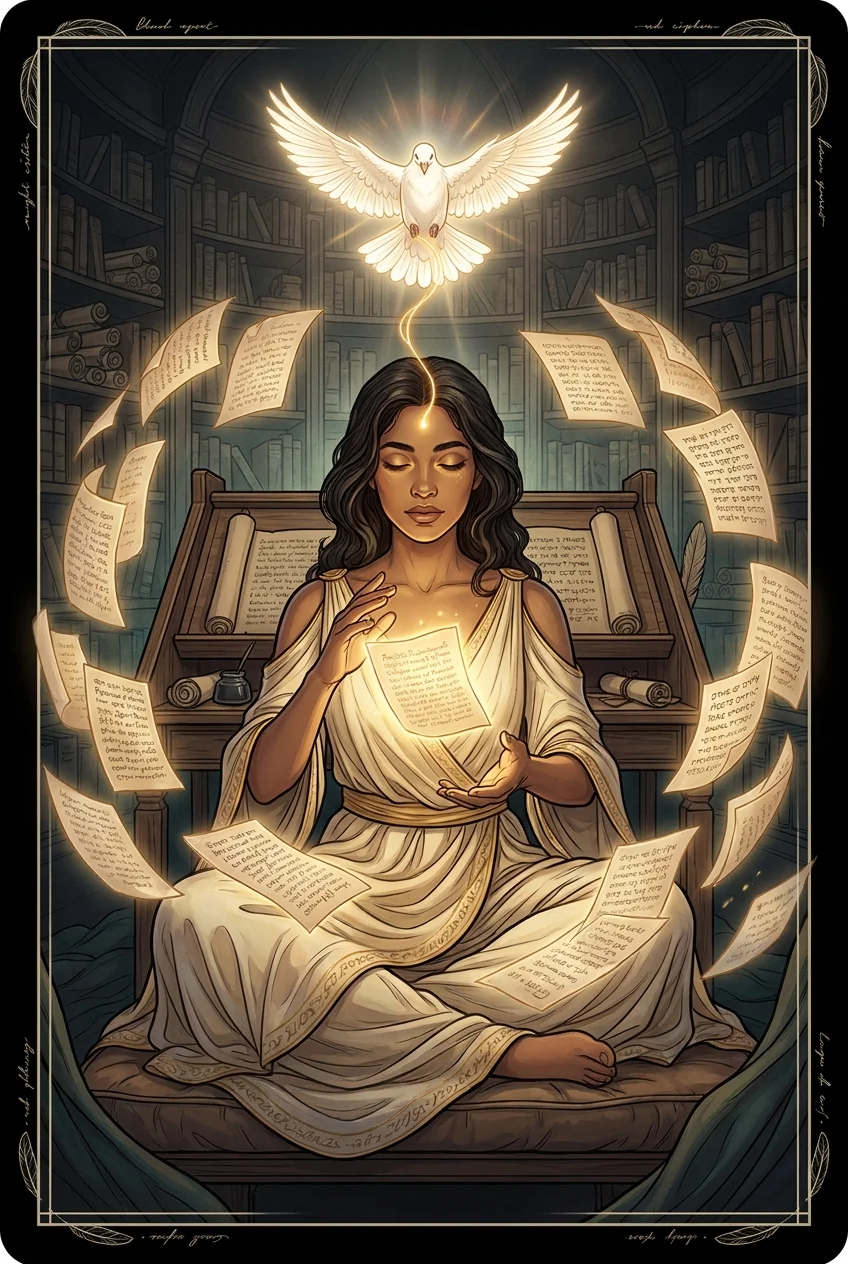
"She knows what she knows not from study but from having been lost inside the light."
Sophia is the Gnostic personification of divine wisdom — the youngest Aeon, who fell from the Pleroma (the fullness of divine being) out of an overwhelming desire to know the unknowable directly, and in doing so, created the material world. Her fall is not failure; it is the cosmic story of consciousness seeking itself. Jung linked her to the highest expression of the anima — the soul's wisdom, earned through suffering and returned to wholeness. Psychologically, the Sophia woman has always had a relationship to knowledge that feels mystical rather than academic — she seeks the hidden pattern beneath the visible, the meaning behind the event, the divine intelligence running through all of it. In 2026, she is the woman writing the book that doesn't have a genre yet.
Sophia's desire to know the Monad (God) directly caused her to fall out of the Pleroma — and in her falling, she unknowingly created the Demiurge, the blind god who thinks he made the world alone. The myth encodes her pattern: the desire for direct knowledge, unmediated by anyone else's permission, always costs something — and always creates something she didn't plan.
When Sophia is unintegrated, she confuses gnosis with escapism — she chases the mystical to avoid the embodied, intellectualizes the sacred to avoid the immediate, and her wisdom becomes a floating palace no one else can enter. She can become the woman who is always seeking, never landing.
The Brigid
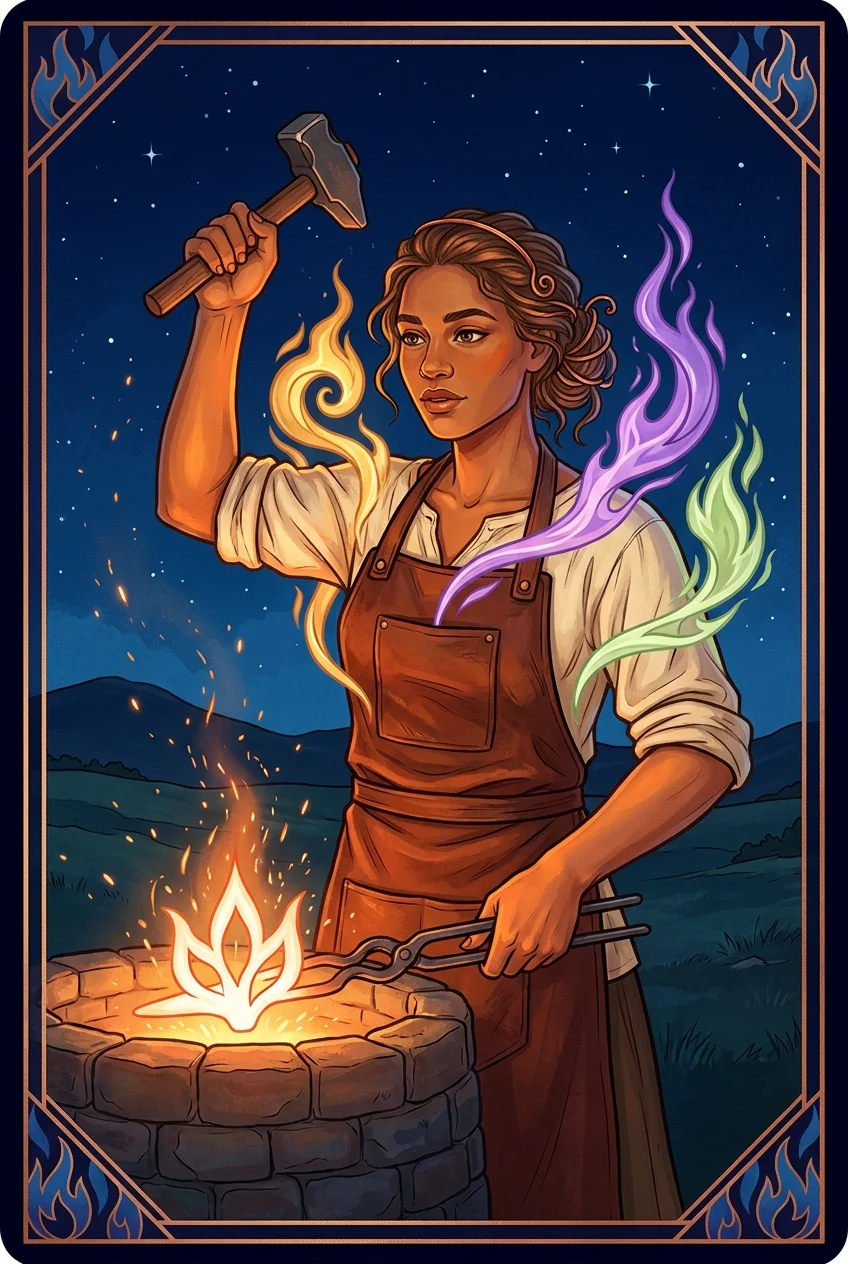
"She tends the fire that heals and the fire that forges. She knows they're the same flame."
Brigid is the Celtic triple goddess of poetry, healing, and the forge — the three fires that run through human civilization: the fire of inspiration, the fire of the hearth, and the fire of transformation through craft. She is born at the threshold, literally — in Irish mythology, at the exact liminal moment between night and day — and she lives there, always the figure who stands between worlds. Unlike Hecate's dark crossroads, Brigid's threshold is lit: she is the dawn goddess, the Imbolc flame, the sacred fire that the Brigidine nuns in Kildare kept burning for fifteen hundred years. Psychologically, she is the woman who heals through making — through writing, smithcraft, music, medicine — who holds the wound and the tool simultaneously. In 2026, she is the healer-artist, the nurse who writes poetry, the metalsmith who counsels her community.
Brigid is said to be born at the crack of dawn, a pillar of fire ascending from her head to heaven — she arrived already lit. Her sacred flame at Kildare burned continuously for over a millennium, tended first by nineteen priestesses and then by Christian nuns who simply continued the practice, because the flame was real regardless of the tradition around it. The myth encodes her deepest gift: she transcends the frameworks that try to contain her, because the fire is older than the institution.
When Brigid is unintegrated, she burns out — she tends everyone else's fire while hers goes cold. She can sacrifice her creative life to the service function, become the healer who cannot heal herself, the poet who stopped writing because everyone needed something more urgent than the poem.
Goddess Archetype Vocabulary
The terminology underneath the framework.
A recurring pattern in the feminine psyche, drawn from mythological figures who embody specific psychological dynamics. Made canonical by Jean Shinoda Bolen in 1984.
Not chastity — psychological self-containment. The Virgin goddesses are 'one-in-themselves,' oriented around their own pursuits rather than defined by relationship.
Goddess archetypes whose stories center on transformation through relationship — partnership, motherhood, abduction, return. Hera, Demeter, Persephone.
Aphrodite specifically — she transforms herself and everyone she touches without being defined by them. Bolen places her in a category of one.
The shadow, oracular, sovereign-rage, destroyer-creator territory of feminine power. Hecate, Lilith, Kali, Sophia, Brigid. Less domesticated than Bolen's 7.
The traditional triple-goddess framework describing how feminine archetypes transform across life stages. Modern variants: Maiden / Wild Woman / Sage.
Jung's term for the feminine principle in the psyche of all genders. Goddess archetypes are anima archetypes — they appear in everyone's inner landscape regardless of gender identity.
The psychological work of recognizing and incorporating the unintegrated aspects of an archetype. Persephone's shadow integration is the descent. Aphrodite's is recognizing intensity-addiction.
Tips for an Accurate Read
If you're a Hestia who admires Athenas, pick Hestia answers. The quiz reads who you are when no one's watching, not who you wish you were on Instagram. Honest answers produce real results.
Your relationship to other women is a primary diagnostic. Artemis protects fiercely. Hera measures strategically. Persephone sees through. Hecate witnesses without flinching. Aphrodite has been worshipped and resented in equal measure.
If you got Lilith, Kali, or Hecate, the result probably feels right and slightly uncomfortable. Don't paper over the discomfort. The dark feminine archetypes are accurate when they show up — and they show up specifically when their territory is active in your life.
Goddess archetypes shift dramatically through life stages. The Aphrodite who became a Demeter after motherhood, the Athena who became a Hecate after retirement. Take it after every big arc and watch the transformation.
Frequently Asked Questions
What goddess archetypes does this quiz use?+
It's built on Jean Shinoda Bolen's 7 Greek goddess framework (Aphrodite, Artemis, Athena, Demeter, Hera, Hestia, Persephone) plus 5 extended dark feminine archetypes (Hecate, Lilith, Kali, Sophia, Brigid). 12 total possible results.
Why these 12 specifically?+
Bolen's 7 are the canonical psychological archetypes — every aspect of feminine identity in Western mythology can be traced through them. The extended 5 cover the shadow/oracular/destroyer-creator territory that Bolen's frame doesn't fully address. Together they map the full spectrum of feminine power without flattening it into a single 'archetype' or moralizing about which is best.
What's the difference between Virgin and Vulnerable goddesses in Bolen's framework?+
Bolen split the 7 Greek goddesses into three groups. The 'Virgin' goddesses (Artemis, Athena, Hestia) are self-contained — focused inward, oriented around their own pursuits, not defined by relationship. The 'Vulnerable' goddesses (Hera, Demeter, Persephone) are defined by relationship and undergo transformation through it. The 'Alchemical' goddess (Aphrodite) sits apart — she transforms herself and everyone she touches.
Why does the AI reading feel personalized?+
Your specific quiz answers are passed to a generative AI that writes a 200-word reading referencing what you actually said. It's not a paragraph from a database — it's a reading written for you, from you.
Can my goddess archetype change over time?+
Most women carry a primary archetype that's stable across years, with secondary archetypes that shift with life stage. The Maiden / Mother / Crone framework (or modern variants like Maiden / Wild Woman / Sage) describes how primary archetypes can transform. A woman who was Aphrodite in her 20s may be Hera or Demeter in her 30s, then Hecate or Sophia in her 60s.
Why are dark feminine archetypes important?+
Bolen's 7 are predominantly 'light' archetypes that fit reasonably within conventional life. The dark feminine archetypes (Hecate, Lilith, Kali, Sophia, Brigid) cover righteous rage, sexual sovereignty, shadow wisdom, gnostic knowing, and creative-destructive fire. For women whose lives don't fit conventional structures, the dark archetypes are often more accurate descriptors of where the actual power lives.
Is this connected to the Lore app?+
Each goddess archetype maps to one of Lore's 5 psychological archetypes — Sovereign, Ronin, Oracle, Outlaw, or Muse. Lore is the deeper experience: archetype-based daily readings, AI Sage chat, cinematic portraits. The quiz is fully free and standalone.
See yourself fully in Lore
Your goddess archetype maps to one of Lore's 5 psychological archetypes. Daily readings, AI Sage chat, cinematic portraits — the full framework.