What's My Spirit Animal?
Not a Buzzfeed quiz. A real reading drawn from 37 animal spirits — Wolf, Lion, Tiger, Eagle, Owl, Raven, Whale, Octopus, Dragon, Phoenix, and 27 more. The animal that's already been guiding you, finally named.
28 questions. A primary animal and a secondary spirit. A personalized reading at the end, written based on what you actually answered.
No signup. No email. No spam. Just the reading.
What Is a Spirit Animal?
The phrase "spirit animal" has been flattened by internet culture into a punchline — "coffee is my spirit animal" — but the original concept ran much deeper. In shamanic and animist traditions across nearly every inhabited continent, the idea of an animal guide wasn't a personality quiz. It was a serious metaphysical proposition: each human life has an animal intelligence running parallel to it, something that can be consulted when the purely human mind reaches its edge.
What these traditions understood — and what depth psychology later confirmed — is that animal archetypes are not metaphors. They are functional patterns. The Wolf doesn't represent loyalty the way a red light represents stop. The Wolf IS loyalty, fierceness, and belonging expressed as a living system, and when that system resonates with your psychology, something precise has been named.
The 37 animals in this quiz aren't made up. They're drawn from real cross-cultural mythology — Norse, Celtic, Indigenous American, West African, Pacific Islander, Hindu, Egyptian, Chinese — and from depth-psychological work on animal archetypes. Each one represents a distinct psychological pattern with its own shadow, its own gifts, and the specific conditions under which it appears in a life.
The 37 Animals by Group
Six categories that capture the elemental and behavioral spectrum.
The Most Common Animals
Swipe through the most-pulled spirit animals. Each card includes its symbolism, shadow side, and the Lore archetype it maps to.
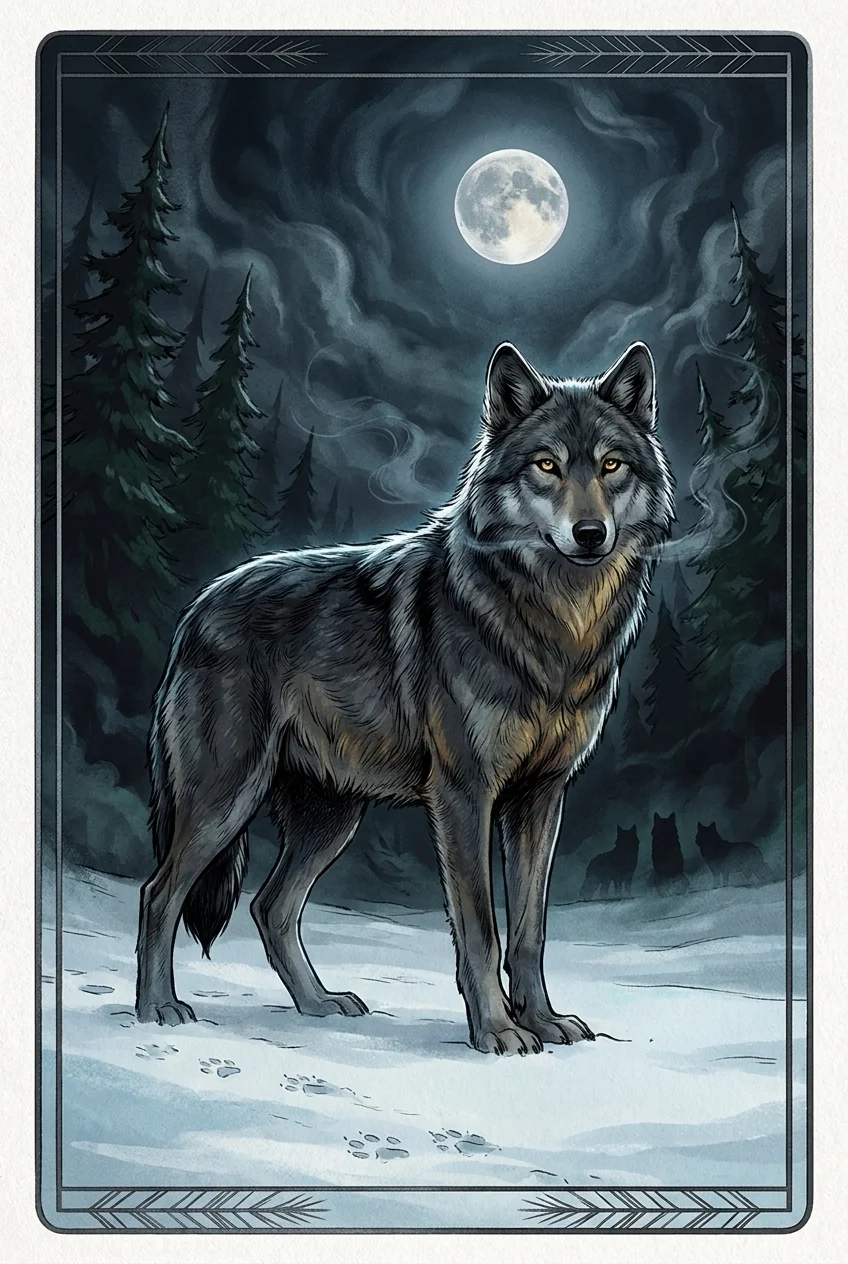
Wolf
"You were born knowing how to run in the dark."
The Wolf moves through the world with its nose before its eyes — reading the invisible map of scent, pressure, and belonging that most people never learn exists. This is an animal of deep loyalty and deeper loneliness, the kind that comes from loving a pack so completely that solitude feels like a wound. Being guided by Wolf means you know things before you can explain them, and you've learned to trust that knowing even when it costs you.
In Norse tradition, Odin kept two wolves — Geri and Freki — as companions, symbols of the insatiable hunger for knowledge and conquest. Indigenous Plains traditions honored Wolf as the original teacher, the one who modeled family loyalty and coordinated hunting to early human societies. In Celtic mythology, Wolf was associated with Cernunnos and the wildwood — the part of the self that civilization couldn't tame. Across cultures, Wolf sits at the threshold of domesticity and wilderness, civilized and feral, us and other.
Turns feral when the pack dissolves. Without belonging, Wolf can become territorial to the point of destruction — howling at nothing, guarding nothing, threatening everything.
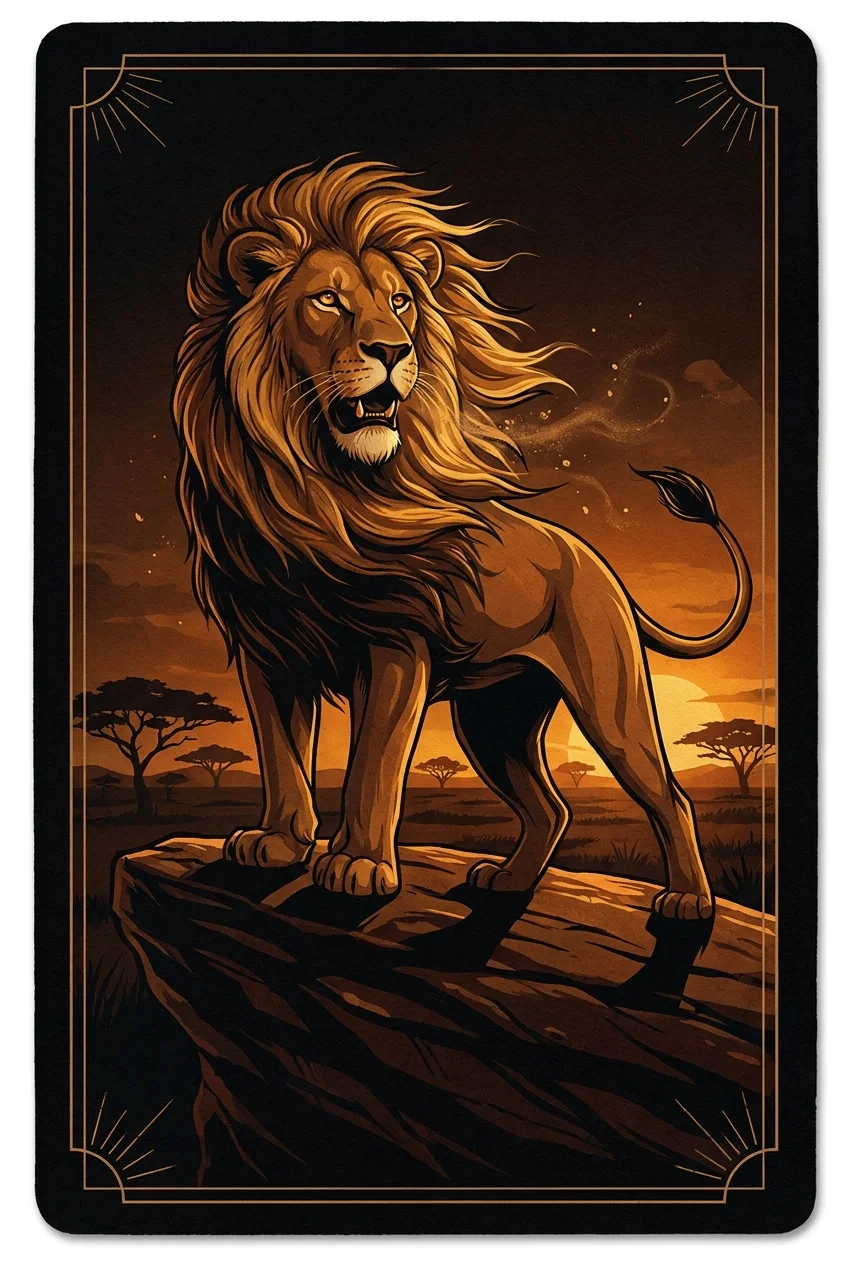
Lion
"You don't arrive. You occur."
Lion doesn't hunt every day — that's the secret most people miss. This is an animal of devastating patience punctuated by absolute commitment. Sovereign by nature, not by effort. The Lion's presence reorganizes rooms before it speaks, and it knows this about itself without needing to perform it.
Across Egyptian, Mesopotamian, and East African traditions, Lion was the throne-animal — the creature whose energy consecrated leadership. Sekhmet, the Egyptian lion-goddess, embodied both destruction and healing. In Heraldic European tradition, Lion represented courage and justice. In West African Sundiata mythology, the Lion became the founding spirit of empire. Unlike Wolf (earned authority), Lion's power is ontological: it doesn't need to be proven. The sun is its element, the midday blaze its most natural hour.
When unchallenged too long, Lion becomes indolent — a sovereign who's forgotten how to be tested. Ego calcification. Assumes the room agrees.
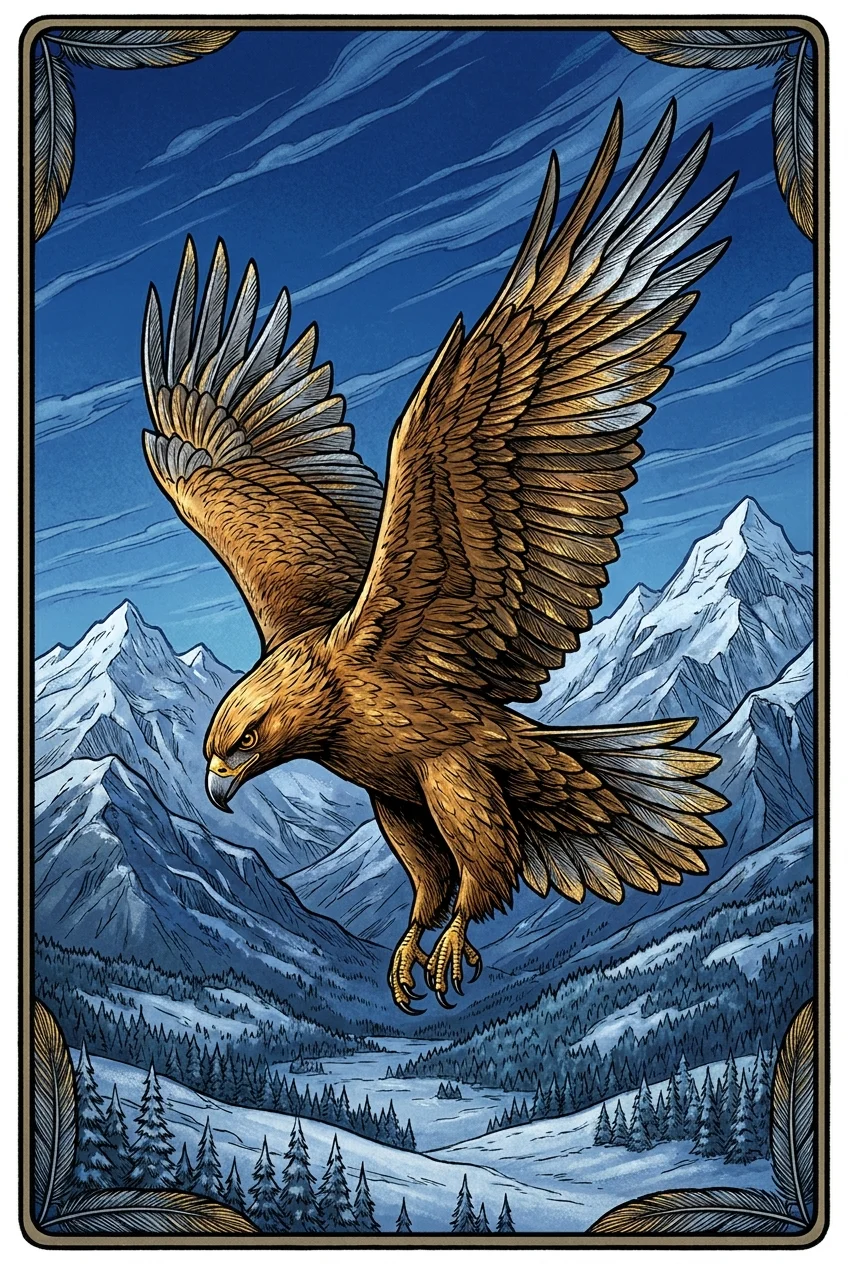
Eagle
"You see the whole field before anyone else has looked up."
Eagle lives at the intersection of sky and ground — able to perceive what others cannot, yet capable of dropping with lethal precision when the moment demands it. This is the animal of the long view, the strategist who holds still while others scatter, then acts with a timing that looks like luck to everyone else.
Across North American Indigenous traditions, Eagle carries prayers to the Great Spirit and symbolizes connection between earth and sky, human intention and divine response. In Aztec cosmology, the founding of Tenochtitlán was marked by an eagle on a cactus. Rome's legions carried eagle standards as symbols of sovereign authority. In Norse tradition, an eagle sat atop Yggdrasil, the world tree — the watcher at the axis of all things. Eagle's feathers are sacred objects in many traditions, used only in ceremony.
Can become airborne permanently — so identified with the high view that it loses touch with the human-scale mess where actual life happens.
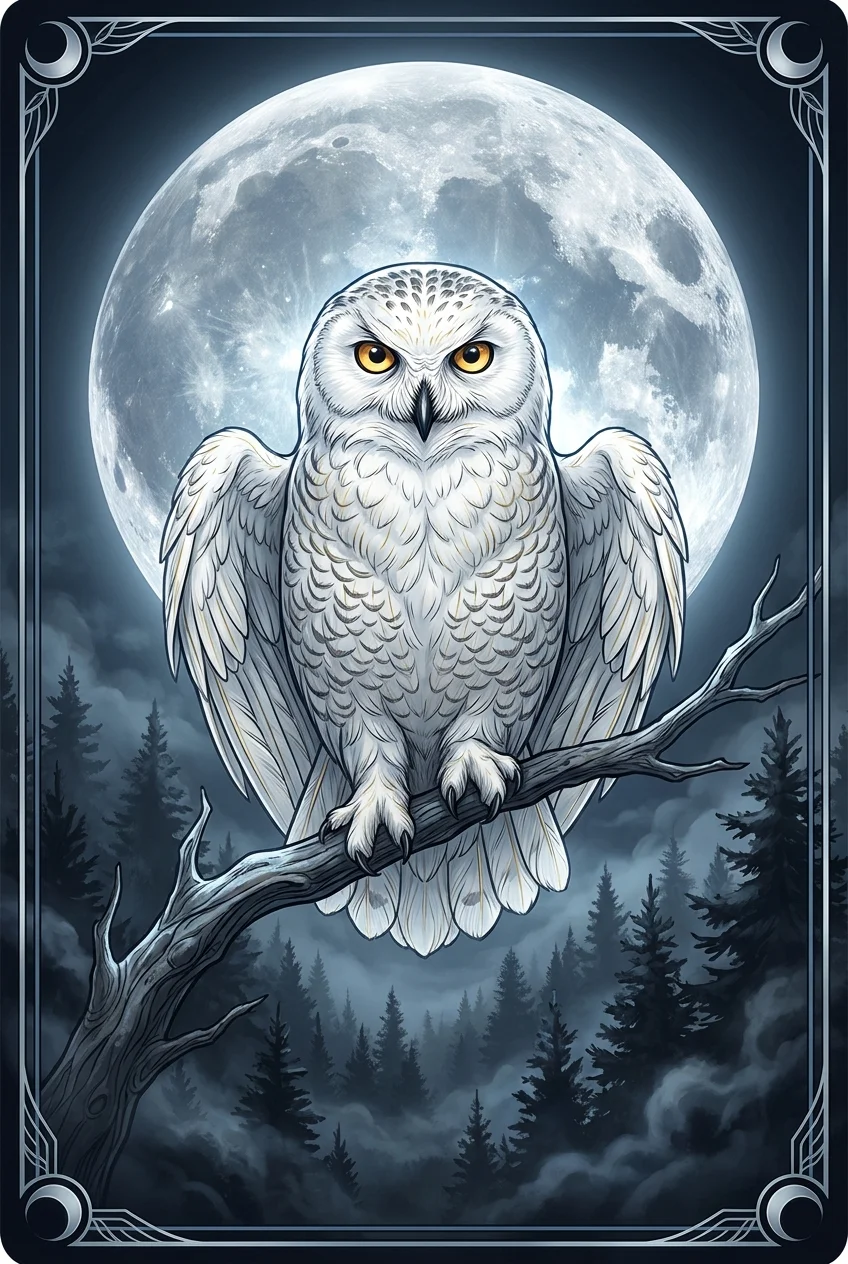
Owl
"You see everything they thought the dark hid."
Owl is the animal of the space between breaths — the silence that contains the sound, the face that turns 270 degrees because it needs no blind spots. Owl people often know things they cannot explain knowing, have dreams that function as information, and carry a stillness in social settings that others experience as either profoundly comforting or faintly unnerving.
In Greek tradition, Owl was Athena's companion and sacred bird — the symbol of rational wisdom and the ability to see what is hidden. In many Indigenous traditions, Owl is the harbinger of death — not death as tragedy but as transition, the creature that announces the thinning of the veil. In Celtic mythology, Owl was called the "night eagle" and was associated with the crone aspect of the goddess and with secrets that needed keeping. Owls in Aztec tradition were associated with the god of death, Mictlantecuhtli. Across cultures, Owl lives at the edge of the known.
Can become the eternal watcher who never acts — so attuned to seeing that it forgets to participate. Detachment performing as depth.
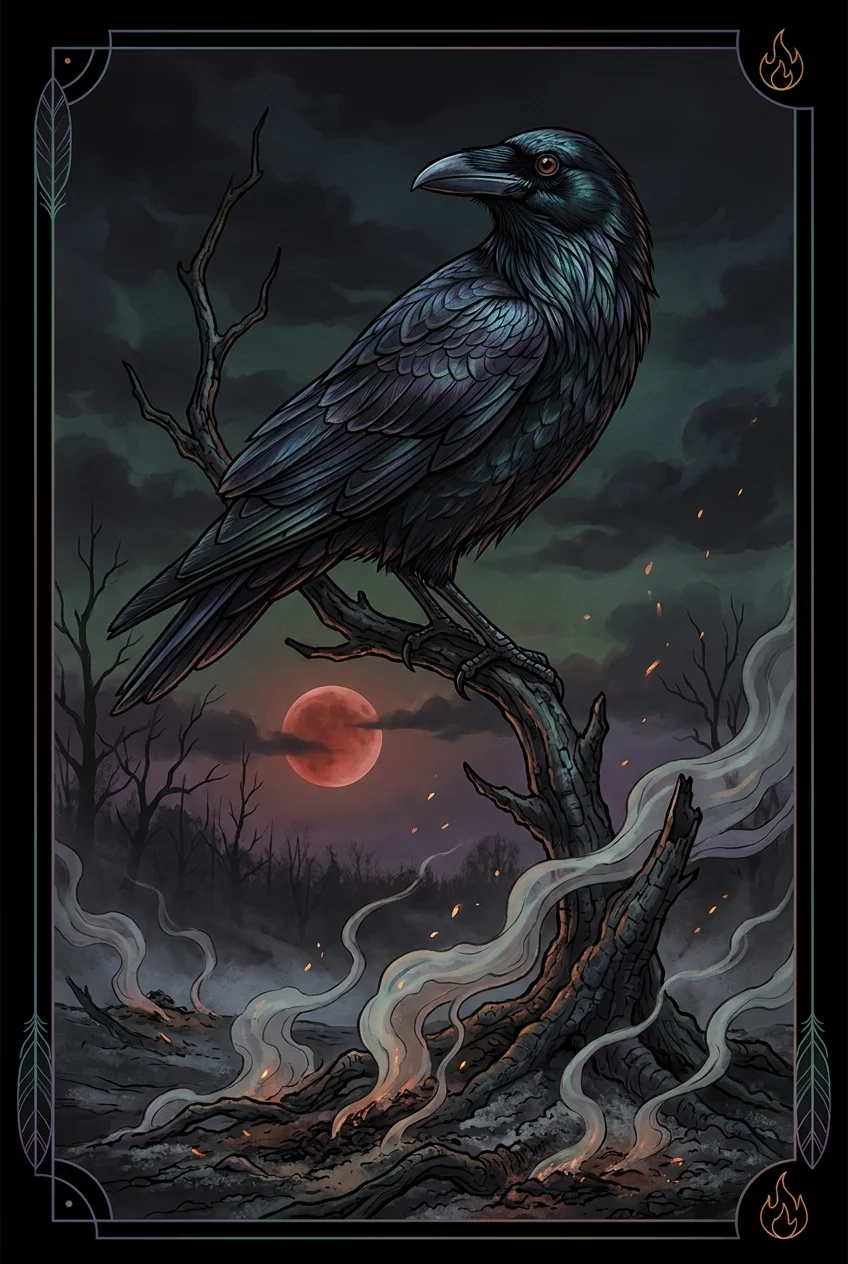
Raven
"You carry light in your beak and use it when you choose."
Raven is the trickster-shaman — the creature that stole fire (in Pacific Northwest mythology) and brought it to humanity, that plays in wind currents for pure joy, that performs funerals and solves puzzles and holds an entire mythology on its black feathers. Raven is intelligence without innocence: it has seen everything, judged none of it, and finds the whole spectacle endlessly interesting.
In Haida and Tlingit Pacific Northwest traditions, Raven is the creator of the world — or at minimum the creature who brought light, water, and fire to beings who lived in darkness. Raven is sacred, irreverent, and necessary: the transformation agent. In Norse tradition, Odin's two ravens flew across the world each day and returned with all knowledge — Raven as the intelligence of omniscience. In Celtic mythology, Morrigan the war goddess appeared as a raven on the shoulder of dying warriors. Raven crosses every boundary, including the one between life and death.
The trickster who never comes down from the bit — perpetual irony as armor, meaning held at distance to avoid being changed by it.
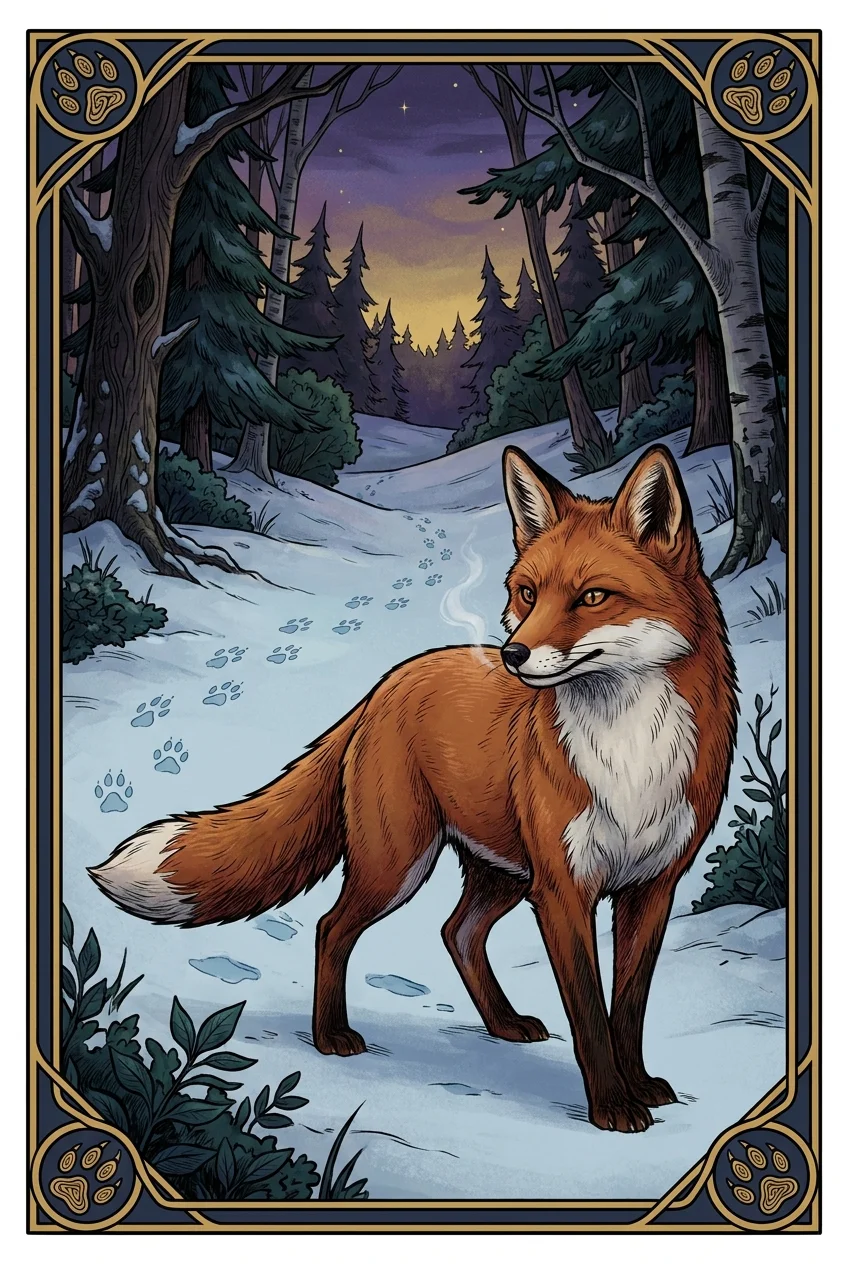
Fox
"You solved the puzzle before they knew there was one."
Fox is intelligence in its most seductive form — quick, slant-eyed, and absolutely delighted by the game. Where Wolf hunts with loyalty and Eagle with vision, Fox hunts with wit, adaptability, and a talent for making the other party think they're winning. This isn't deception — it's the joy of the clever path, the side door, the answer that makes everyone gasp.
In Japanese Shinto tradition, the kitsune (fox) is a sacred messenger of Inari, the god of rice and prosperity — a shapeshifter who accumulates magical tails with age and wisdom. In Celtic tradition, Fox was the guide through the underworld, leading souls through the maze of the afterlife. Across West African, Native American, and East Asian traditions, Fox appears as the trickster — the figure who disrupts hierarchy and exposes pretension. Trickster mythology is sacred mythology: the Fox breaks what needs to break.
Can lose themselves in the performance of cleverness. Might manipulate from habit even when transparency would serve better.
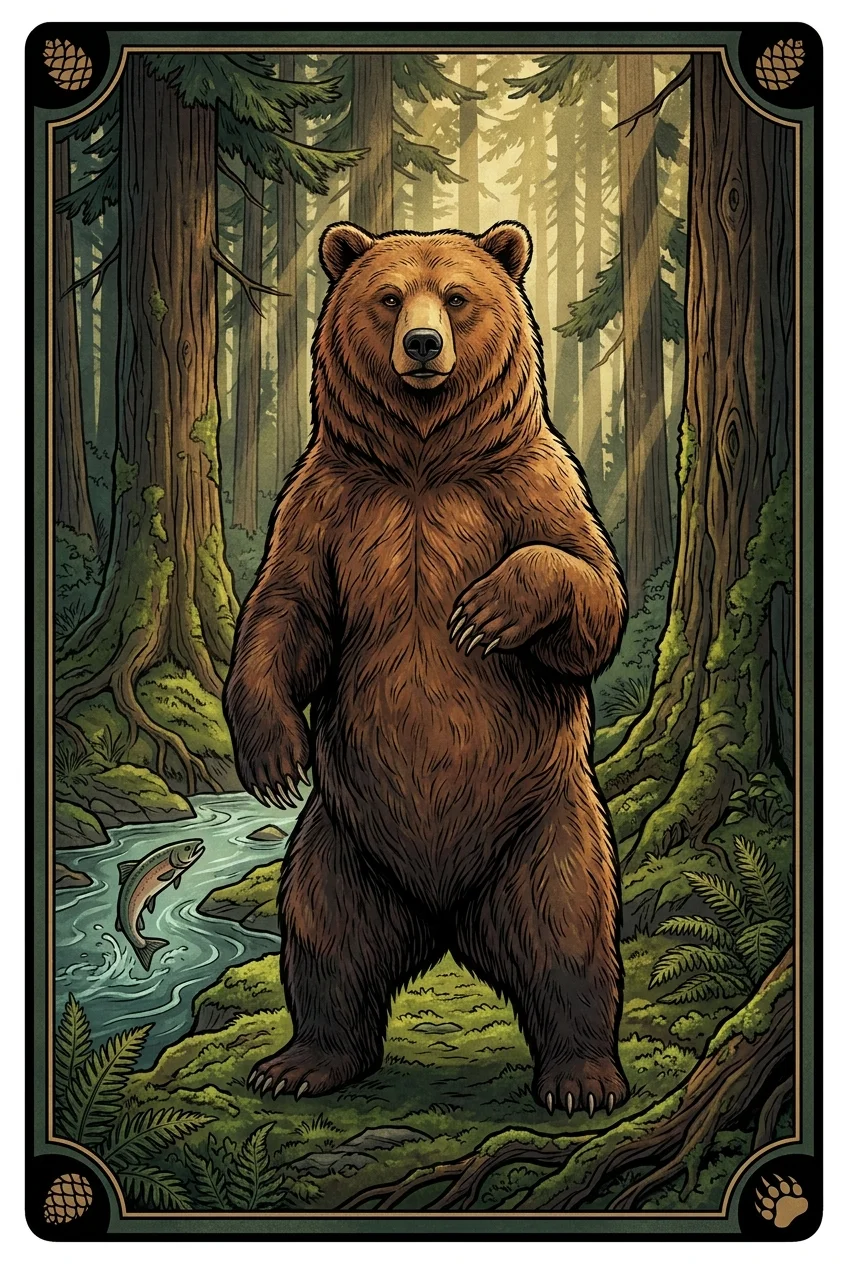
Bear
"You are the mountain that learned to breathe."
Bear is slowness deployed as power — a creature that knows how to be enormous without apology, how to take up space because taking up space is its nature. This is winter in animal form: rest as strategy, quiet as preparation, the kind of stillness that contains everything it needs. Bear people often carry grief as a companion because they feel things at an amplitude most animals cannot survive.
Bear is one of the most sacred animals in circumpolar shamanic traditions from Lapland to Siberia to North America's northwest coast. The bear ceremonial (wearing bear skins, ingesting bear fat) was a way of accessing primal healing and ferocity. In Norse mythology, Odin had bear associations; berserkers wore bear skins to channel warrior spirits. In Arthurian tradition, the name Arthur itself may derive from the Celtic word for bear. Bear is medicine for the winter soul — the creature that survives darkness by becoming it.
Hibernation as avoidance. When hurt, Bear can disappear so deeply that connection is severed — mistaking withdrawal for healing.
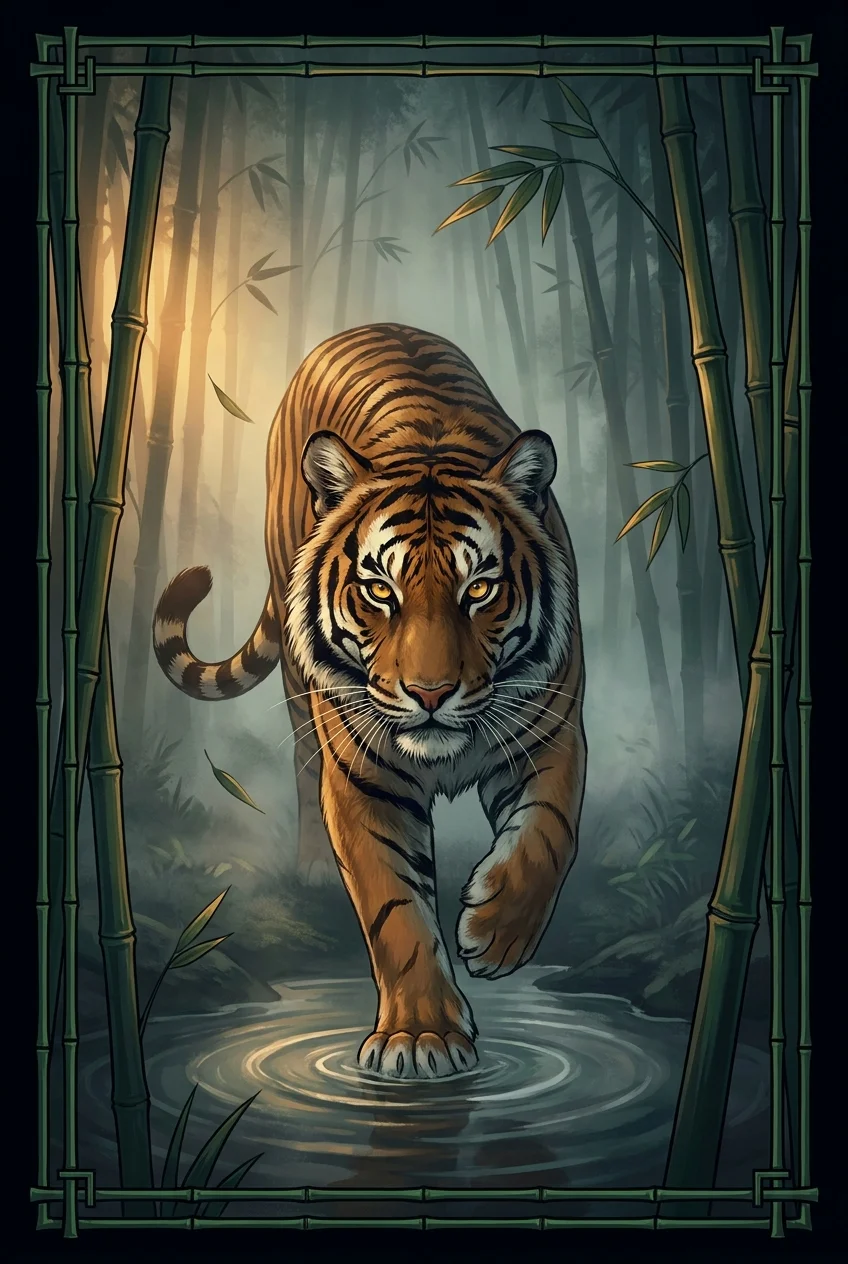
Tiger
"You do not stalk. You simply become inevitable."
Where Lion is solar, Tiger is lunar — a striped darkness moving through gold light, supremely alone and at peace with it. Tiger is the animal that didn't need a pack to become apex. This is solitary mastery: self-taught, self-contained, terrifyingly focused when something finally catches its attention.
In Hindu cosmology, Durga rides a tiger — power as vehicle, not enemy. In Chinese astrology and Five Elements theory, Tiger rules the wood element and spring, embodying sudden force and new beginnings. Siberian shamanic traditions held the Tiger as a spirit of the forest that mediated between human settlements and the wild unknown. Where Lion is civic power, Tiger is the edge of the map — where civilization runs out and something older begins.
Can become utterly inaccessible — a beauty that nothing can reach. Intimacy-avoidance dressed as self-sufficiency.
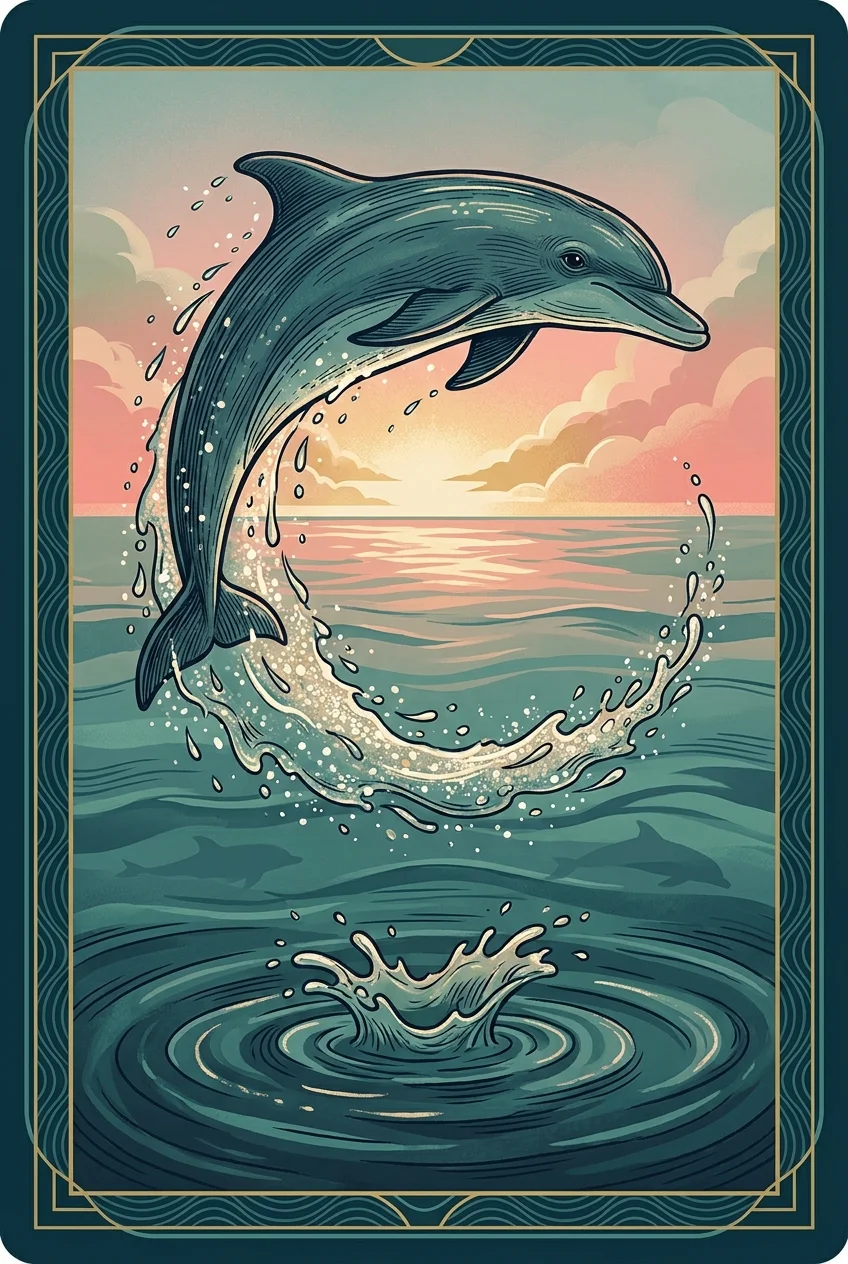
Dolphin
"You turn the ocean into a conversation."
Dolphin is joy weaponized — an intelligence so fluid and social that it experiences the world as a collaborative game rather than a survival exercise. This is not naivety; Dolphins are strategic, sophisticated, and occasionally ruthless. But their native state is play, and play is how they access everything: information, bonding, problem-solving, ecstasy.
In ancient Greek tradition, Dolphins were sacred to Apollo and Poseidon alike — bridging sun and sea, reason and feeling. Greek sailors saw dolphins as good omens, believing them to be transformed humans or the souls of the drowned made playful. In Celtic mythology, Dolphins were guides to the Otherworld. In many Pacific Island traditions, Dolphin was a navigator spirit, teaching humans how to read ocean currents. The Hindu river dolphin (Susu) was associated with the Ganges goddess Ganga.
Avoidance of depth in favor of perpetual movement. Play can become a refusal to sit still long enough for real reckoning.
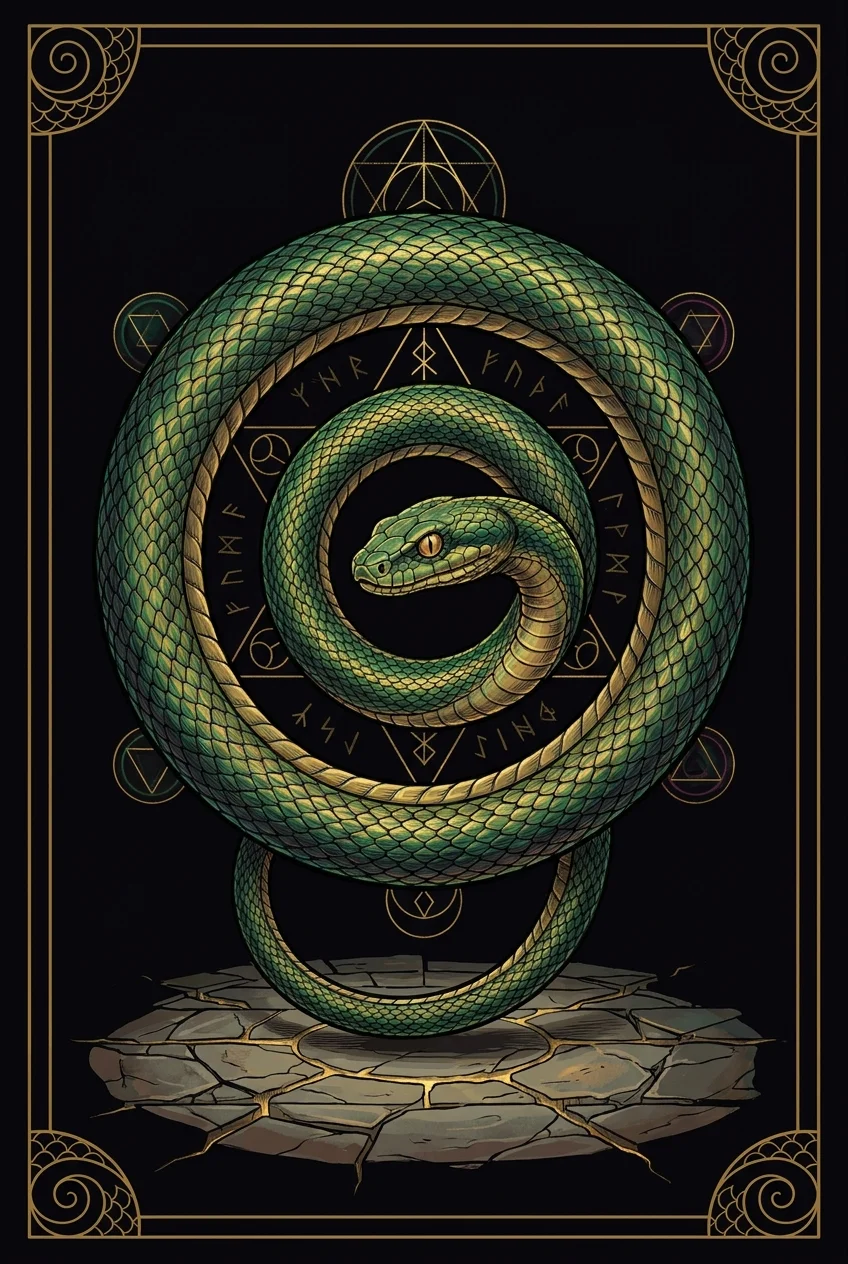
Snake
"You shed what others cling to."
Snake is transformation's most biological metaphor — the animal that literally sheds its skin and emerges new, that moves without limbs through every element, that produces venom that is also medicine in different doses. Snake energy is about the knowledge that feels dangerous: the truth underneath the truth, the system underneath the story. Snake people often carry knowledge that makes others uncomfortable.
The snake is perhaps the most symbolically overloaded creature in human mythology. In Judeo-Christian tradition, the serpent in the Garden carries knowledge that was not supposed to be distributed. In Greco-Roman tradition, Asclepius's snake-entwined staff (the caduceus and the Rod of Asclepius) represents the healing arts — venom as medicine, death as transformation. In Hindu tradition, Kundalini shakti is a serpent coiled at the base of the spine, the sleeping potential of the life force. In Aboriginal Australian tradition, the Rainbow Serpent is a creator deity who shaped the landscape and gave water. In Aztec cosmology, Quetzalcoatl (the feathered serpent) was the god of wind, learning, and civilization.
The wound that poisons indiscriminately. When Snake feels threatened, the venom isn't discerning — everyone in range gets dosed.
Full A–Z directory of all 37 animals at animal-meanings-a-z.
Spirit Animal Vocabulary
The terminology underneath the practice. Knowing the language sharpens the result.
The recognition that everything — animals, plants, places, weather — has its own awareness or spirit. The foundation of nearly every traditional spirit animal framework.
An animal that serves as guide, ancestor, or emblem for a specific person, family, or clan. In many Indigenous traditions, totem animals are inherited by lineage rather than identified through quiz.
Specifically used in shamanic practice — the animal you've been gifted (or have earned) as ally, especially in journey work. Often acquired through deliberate ceremony.
Broader than animal — any non-human intelligence (animal, ancestor, deity) that aids the practitioner. Spirit animals are a subcategory.
Which of the four (or five) elements an animal aligns with — earth, water, sky/air, fire, or shadow/spirit. Used to group spirit animals by their energetic register.
A class of animal spirits whose role is disruption-as-teaching — Coyote, Raven, Fox, Crow, Spider in various mythologies. They break what's calcified so something new can form.
Animals at the top of their food chain, often associated with sovereign or solitary archetypes (Lion, Tiger, Eagle, Shark, Wolf-as-pack).
Animals associated with thresholds — between life and death, day and night, water and land. Owl, Raven, Snake, Frog, Octopus, Sea Turtle. Often the medicine of major transitions.
An animal spirit (or physical animal) bonded to a specific practitioner. Origin in European witchcraft. Cats, owls, ravens, dogs are classic. Different from a one-time spirit-animal encounter.
An animal or spirit that guides the dead. Owls, ravens, dogs, deer, dolphins, swans. Often shows up at major life transitions.
How the Quiz Scores
Each question has 5 options weighted toward 1–3 specific animals. Across 28 questions you build a distribution that captures your elemental affinity, conflict style, social tendencies, and seasonal resonance.
The animal with the highest total wins as primary. The runner-up is shown as your secondary spirit — the energy running underneath. You also see its element and which Lore archetype it maps to.
Your specific quiz answers go to a generative AI that writes a 200-word reading referencing what you actually said. Not a paragraph from a database — a reading written for you, in this moment.
Tips for an Accurate Read
A few things to know before you take it.
If you know you're more Rabbit than Wolf, pick Rabbit. The quiz reads your real nervous system, not your aspirational social-media self. The Rabbit who tells the truth about being Rabbit is more powerful than the Rabbit pretending to be a Wolf.
If an option lands as obviously you within the first 1-2 seconds of reading, that's the right answer. The quiz is calibrated to default state. Overthinking degrades accuracy.
If your primary is Wolf but the secondary is Octopus, the Octopus is real. Most people operate from a public-facing primary with a private secondary that emerges in solitude or with chosen people. The two together name the actual psychological territory.
Spirit animals shift through life. The Deer who became a Bear after motherhood, the Wolf who softened into a Dolphin after burnout. The quiz is a snapshot of where you are now, not where you'll always be.
Frequently Asked Questions
How accurate is this spirit animal quiz?+
It's built on 37 distinct animal spirits — broader than the typical 12-option Buzzfeed format — and 28 weighted questions sort across element affinity, behavioral type, conflict style, and seasonal resonance. After scoring, an AI generates a personalized 200-word reading referencing your specific answers.
Why does the AI reading feel personalized?+
Each result triggers a real-time AI generation using your specific quiz answers. The reading is written for you, not pulled from a database. You'll see your specific responses reflected back in the reading itself.
What's a spirit animal really mean?+
The phrase has been flattened by internet culture, but the original concept ran deeper. In shamanic and animist traditions across nearly every continent, an animal guide was a serious metaphysical proposition — a parallel intelligence that could be consulted when the purely human mind reached its edge. Animal archetypes aren't metaphors; they're functional patterns. The Wolf doesn't 'represent' loyalty in the way a red light represents stop. The Wolf IS loyalty, fierceness, and belonging expressed as a living system.
What's the secondary spirit animal in the result?+
Most people score highly on a primary animal AND a secondary one. The secondary is often the spirit that's been operating beneath the surface — the energy you use in private, the pattern that shows up under stress, the side of you that emerges with people you trust.
Why 37 animals and not 12?+
Because most spirit animal quizzes flatten dozens of distinct energies into a few cartoon archetypes. Wolf, Coyote, and Fox aren't the same animal. Tiger, Lion, and Cougar aren't interchangeable. The 37-animal framework lets the result actually mean something. We grouped them across categories — predators, sea creatures, birds, land mammals, reptiles, insects, mythological — to capture the full elemental and behavioral spectrum.
Can my spirit animal change?+
Yes. Animal guides shift through life stages, often dramatically. The Deer who became a Bear after motherhood, the Wolf who softened into a Dolphin after burnout, the Owl who transformed into a Phoenix after deep loss — these arcs are common. Your dominant animal usually carries you through a phase, then a different animal arrives for the next one. Take the quiz again in a year.
Is this connected to the Lore app?+
Each animal maps to one of Lore's 5 psychological archetypes — Sovereign, Ronin, Oracle, Outlaw, or Muse. Lore is the deeper experience: archetype-based daily readings, AI Sage chat, cinematic portraits. The quiz is fully free and standalone.
See yourself fully in Lore
Your spirit animal maps to one of Lore's 5 psychological archetypes. Daily Sage readings, cinematic portraits, the full framework.