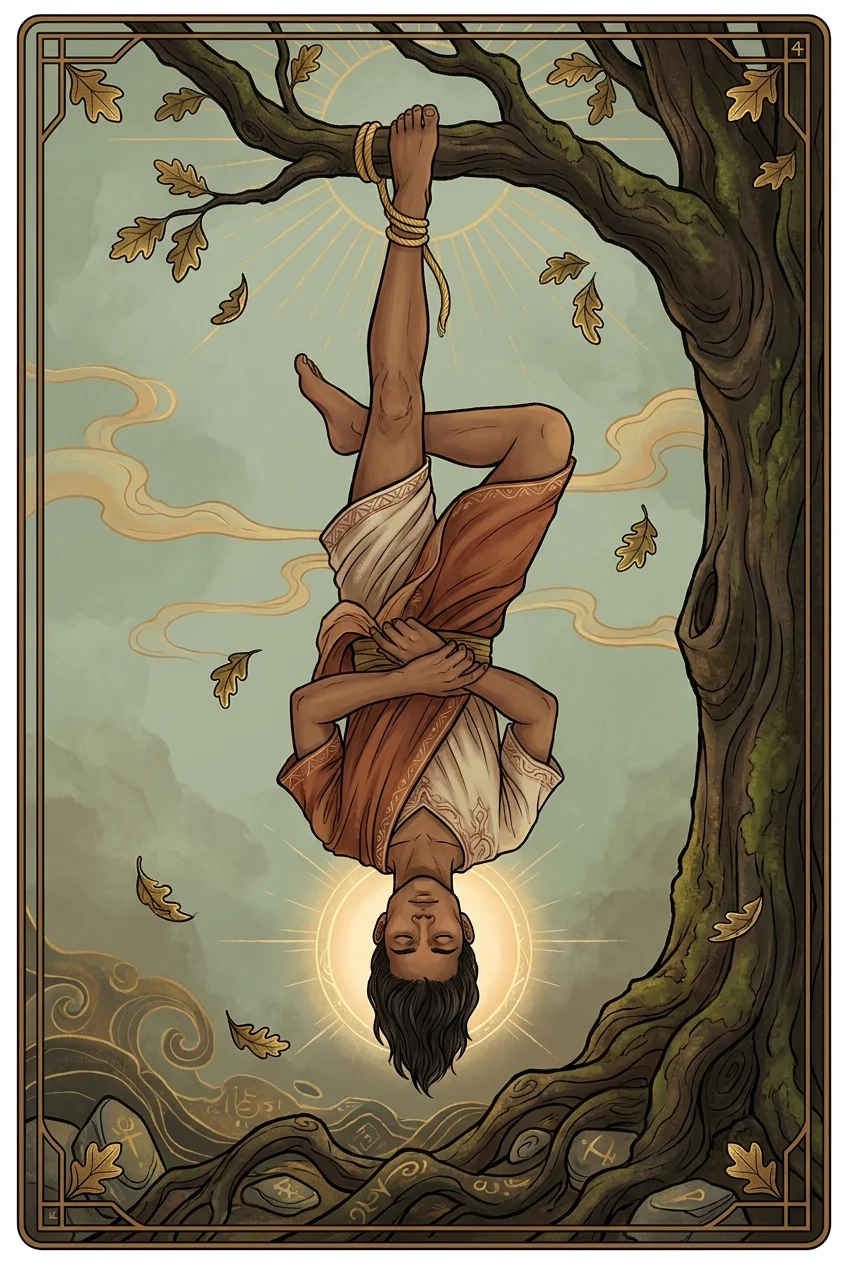
The Hanged Man
"He hung himself there. That's the part nobody mentions."
willing surrender, inverted perspective, productive pause, liminal state, transformation through suspension, sacrifice as strategy ---
"What would you see if you stopped moving long enough to look at your life from a completely different angle?"
Core Meaning
The Hanged Man is voluntary suspension. Not the pause forced on you by circumstances you couldn't control, but the deliberate choice to stop — to remove yourself from the forward momentum of your life and hang, inverted, until the view changes. This requires a radical trust in the process: the willingness to look stupid, stalled, upside down, from the outside, in order to gain what can only be gained from stillness and inversion.
Pollack draws a direct line between The Hanged Man and Odin, who hung himself on Yggdrasil for nine days — no food, no water, no rescue — in order to receive the gift of the runes. The runes didn't come because Odin was clever or prepared or especially deserving. They came because he was willing to endure the position long enough. Sacrifice is the word often used for this card, but Pollack's reading is more nuanced: what's being sacrificed is not something valuable, but something that was *in the way*. The old frame. The old strategy. The old self that kept moving to avoid having to see.
Crowley names this card "The Hanged Man — The Spirit of the Mighty Waters" in his Thoth deck, associating it with the element of water and the dissolution of boundaries. The hanged position is not punishment. It is immersion.
willing pause, inverted perspective, surrender as strategy, liminal state, letting go of control, sacrifice of what no longer serves, gestation
forced stagnation, martyrdom, pointless sacrifice, refusing to pause, going through the motions of surrender without actually releasing
Upright Meaning
The Hanged Man upright is the card of productive suspension — the phase of your project, your relationship, your life where forward motion is not the answer. Something has reached the point where pushing is counterproductive and the only available advancement is a change of perspective. The card is asking: can you stop long enough to see this differently?
The inversion is literal and metaphorical. When you hang upside down, all your assumptions reorganize. What seemed heavy becomes light. What seemed like the foundation is now in the air. A problem that looked impossible from the standard angle can appear suddenly, completely soluble from a different vantage. This doesn't happen because you thought harder about it. It happened because you changed your position.
The halo is important. The Hanged Man is illuminated, not suffering. He is in a state of grace — which doesn't mean comfortable, but means aligned with what is required. The figure who has made the surrender is receiving something unavailable to the figure who has not. What he's receiving can't be named in advance. That's part of the deal.
This card appears when someone needs to voluntarily stop a forward drive that has become compulsive. The project that keeps getting pushed. The relationship that keeps getting analyzed. The life that keeps getting optimized. At some point, the motion itself has become the avoidance, and stillness is the only medicine. The Hanged Man knows this and hangs himself there anyway, which is the harder thing.
It's also the card of the transition state — between chapters, between identities, between knowing who you were and knowing who you're becoming. This state has no handle. You can't optimize it. You can't rush it. You can only remain in it until it completes.
Reversed Meaning
The Hanged Man reversed is either refusing the suspension — staying in motion past the point of usefulness, unable to stop the forward drive long enough to receive what the pause would offer — or it's the shadow side of surrender: martyrdom. The person who has found a way to make their suffering mean something by keeping it going, who performs sacrifice without doing the internal work sacrifice is supposed to produce. The reversal can also mean the period of suspension is ending — the moment of release, of coming down from the tree with what was gained. Whether the coming down is resolution or avoidance depends on what the time in suspension produced.
In love / relationships
The Hanged Man in love is the necessary fallow period — the relationship that needs to stop being analyzed and instead needs to be allowed to breathe in quiet. It sometimes appears just before a relationship transforms significantly, when both people are in a kind of suspension, waiting for clarity that won't come through conversation. It also governs the choice to wait for the right person rather than moving through a series of almost-right ones — the willing pause of someone who trusts the timing. Reversed: a relationship that has been in limbo for too long, where the pause has become avoidance.
In work / vocation
The Hanged Man at work is the long project in its most difficult phase: after the excitement of beginning, before the clarity of completion, in the uncertain middle where the work is resisting you and you're not sure if the resistance is asking you to push through or pivot. The card says: hang here for a while. The answer will come, but not through forcing. This is also the card of the sabbatical, the deliberate step back from a career trajectory in order to reconsider the direction. These pauses look like losses from the outside and tend to be the most important moves in retrospect.
In growth / shadow work
The Hanged Man's shadow work is about what you refuse to stop. What are you keeping in motion because stillness feels dangerous? What are you pushing toward because if you paused, you might have to feel something you've been successfully outrunning? The card asks you to find the thing you're most resistant to pausing and consider pausing it. Not forever. Just long enough to hang there. Long enough for the halo to appear.
In Lore's framework
Ronin — The Hanged Man is the Ronin choosing stillness over motion, recognizing that the next mastery requires emptying out the current form.
Pull this card today in Lore
In the Lore app, every reading is generated for your archetype, in real time, with a personalized voice. Cards become a daily practice rather than a one-off.