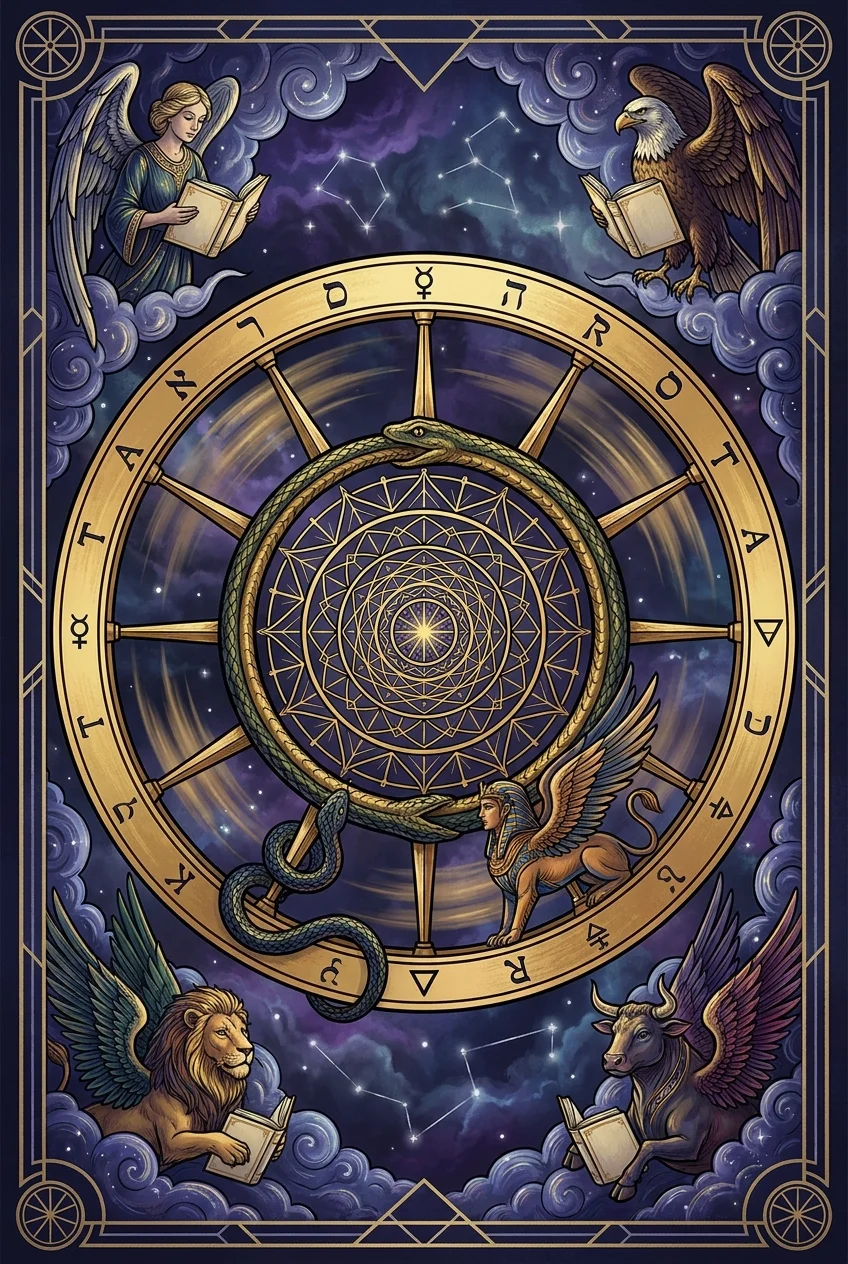
Wheel of Fortune
"The wheel turns. You are not the wheel."
cycles, turning points, what-you-cannot-control, equanimity, the still center, pattern recognition across time ---
"What do you know about yourself that no amount of luck or bad luck can change?"
Core Meaning
The Wheel of Fortune is the card of cycles, and cycles have a way of humbling the fixed perspective. What goes up comes down; what comes down eventually rises. This is not fatalism and it is not comfort — it is pattern recognition at the scale of a life. The Wheel turns regardless of whether you are watching it.
Pollack reads the Wheel as the shift from the purely personal journey (cards I through IX) to a confrontation with forces larger than the individual will. You have done the internal work; now the external world exerts its own logic. The sphinx at the top of the Wheel holds a sword — the capacity to cut through, to discern — which suggests that the fully realized response to Fortune isn't passivity but wisdom about what you can and cannot control. The snake descending is Set, the Egyptian god of chaos. The jackal ascending is Anubis, psychopomp of transformation. The Hermit has come down from his mountain; the world is moving again.
The Kabbalah connects this card to Kaph — the palm of the hand. The palm that receives, the palm that releases. The hand that doesn't grip. This is the card of learning to hold lightly what the wheel can take.
turning point, cycles, good fortune, destiny, pivoting moment, what-comes-around, pattern recognition
stuck in a cycle, fighting the tide, bad luck compounding, refusing the pivot, the wheel stuck, falling without insight
Upright Meaning
The Wheel of Fortune upright is a turning point — often the kind that you can feel before you can explain. The scene is shifting. Something that was moving is slowing; something stalled is beginning to accelerate. The card doesn't tell you whether the change is welcome. It tells you: this is a moment of movement, and your relationship to that movement determines your experience of it.
The figures on the rim of the Wheel are the ones suffering — ascending with excitement that becomes hubris, descending in confusion and grief. The ones who suffer most are the ones who believe the position on the rim is permanent. The insight of the Wheel is that no position is permanent. The rising will fall and the falling will rise and if you have attached your identity to your current position, you will be in trouble either way.
The winged figures in the corners of the card — the angel, the eagle, the lion, the bull — are the four fixed signs of the zodiac. They are reading books. They are not on the wheel. They hold still at the corners of the world while the wheel does what wheels do. The Wheel of Fortune asks: how do you become the fixed point? How do you find the center that doesn't spin?
This card often arrives at moments of significant external change: a job ending, a relationship transforming, a move, an unexpected windfall or loss. The instruction is not to resist the change but to locate yourself in relationship to it. What is yours regardless of the Wheel's position? What do you know about yourself that Fortune cannot touch?
Reversed Meaning
The Wheel reversed is the cycle that has seized up — either spinning so fast that nothing can stabilize, or stuck in a groove so deep that the expected turn never comes. There's often an element of resistance: fighting a change that is already underway, investing heavily in the continuation of conditions that are already ending. There can also be a repeated pattern — the same job going wrong in the same way, the same relationship dynamic with a different cast — that is asking to be recognized as a pattern before it can transform.
In love / relationships
The Wheel in love is the long view of a relationship — the understanding that what you're in right now is one phase of something larger. Every relationship moves through seasons: the high of the beginning, the friction of growing familiarity, the depth of shared difficulty, the renewed choice of continuing. The Wheel appears when a relationship is in transition between phases — which can feel like ending when it is actually becoming. Reversed: a relationship that has gotten stuck in one phase, usually a difficult one, because both people are waiting for the other to change first.
In work / vocation
At work, the Wheel signals a market shift, a career pivot, an industry turning. The ones who navigate it best are not the ones clinging to the rim but the ones who saw the turn coming and repositioned relative to the center. It's the card of the entrepreneur who knows their business model has a shelf life, the artist who doesn't become their most successful work, the professional who keeps learning because they know the landscape will change. Reversed: the person who was on top and cannot accept the change in conditions.
In growth / shadow work
The Wheel's shadow work is about attachment to position. What does it mean to you to be the person ascending? How do you handle the descending phase — is there shame, collapse, the catastrophic sense that the descent is permanent? The practice of the Wheel is equanimity — not the forced kind, not pretending you don't feel the rise and fall, but the developed capacity to stay oriented while the wheel turns. To know your center regardless of where the rim currently is.
In Lore's framework
Sovereign — The Wheel calls the Sovereign archetype to its deepest test: maintaining authority over the self while external circumstances shift, and leading from a place that is oriented rather than reactive.
Pull this card today in Lore
In the Lore app, every reading is generated for your archetype, in real time, with a personalized voice. Cards become a daily practice rather than a one-off.